


The Basic Law of Governance sets the foundations of the state in Saudi Arabia: the source of laws, the system of government, rights and duties, and the authorities of the state. It was issued by Royal Order No. (A/90) dated 27/8/1412H and has 83 articles in nine chapters.
This is a general explanation; the reference is the official text published by the Bureau of Experts at the Council of Ministers.

Reviewed by: Raghad Mamdouh Al-KhamshiLegal Affairs Manager at Usus Law FirmLast updated:
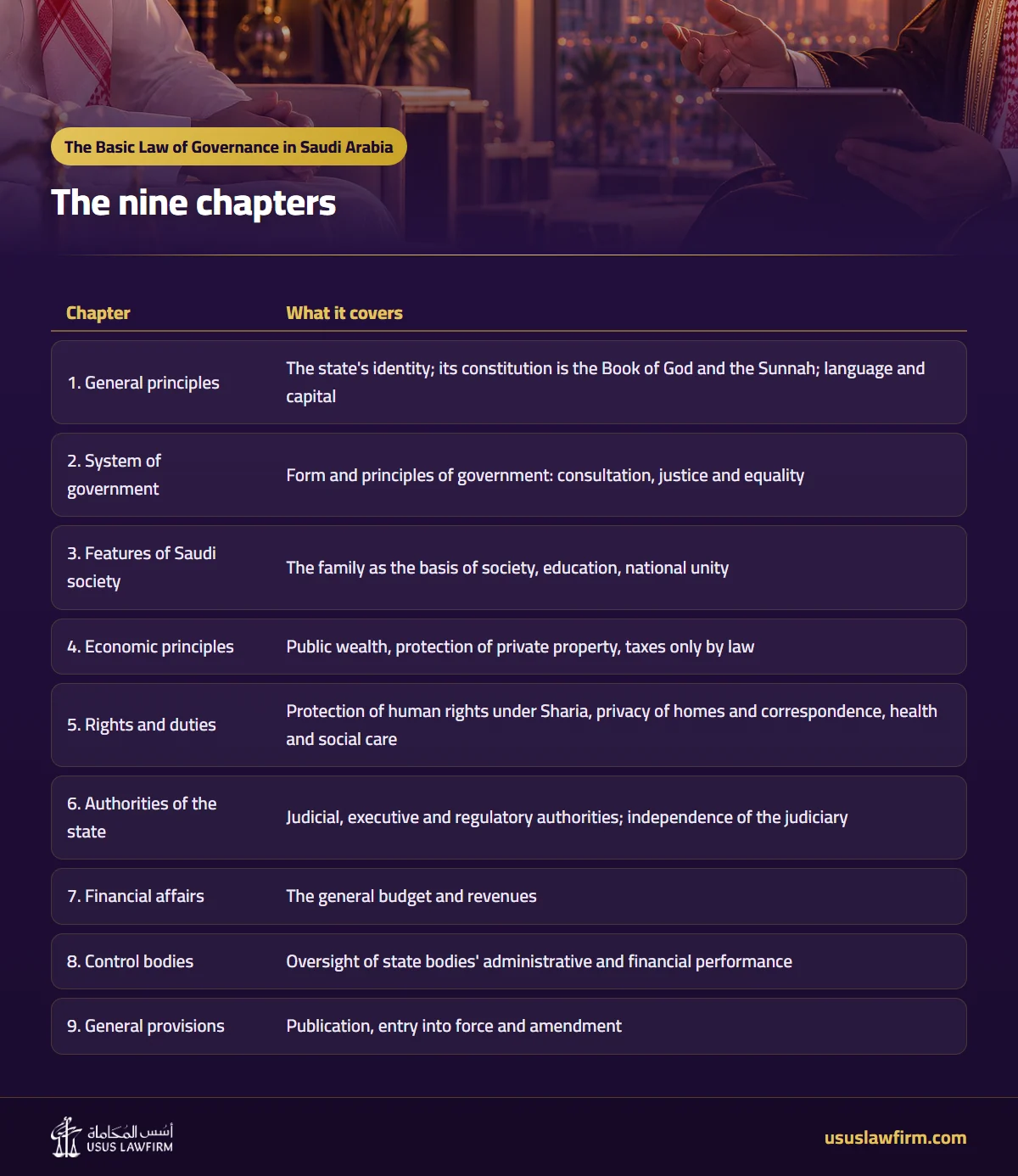
The nine chapters
| Chapter | What it covers |
|---|---|
| 1. General principles | The state's identity; its constitution is the Book of God and the Sunnah; language and capital |
| 2. System of government | Form and principles of government: consultation, justice and equality |
| 3. Features of Saudi society | The family as the basis of society, education, national unity |
| 4. Economic principles | Public wealth, protection of private property, taxes only by law |
| 5. Rights and duties | Protection of human rights under Sharia, privacy of homes and correspondence, health and social care |
| 6. Authorities of the state | Judicial, executive and regulatory authorities; independence of the judiciary |
| 7. Financial affairs | The general budget and revenues |
| 8. Control bodies | Oversight of state bodies' administrative and financial performance |
| 9. General provisions | Publication, entry into force and amendment |
What matters in practice
- The right to litigate is guaranteed to citizens and residents alike. Start with which court handles my case?
- The judiciary is independent; judges are subject to no authority other than Sharia.
- No crime and no penalty without a text, and no one may be arrested or detained except under the law. Details are in the Criminal Procedure Law.
- Private property is protected, and may be taken only for the public interest with fair compensation.
- Homes and correspondence are private, except in cases the law specifies.
How it relates to other laws
The Basic Law sets principles that detailed laws build on: the Law of Sharia Procedure, the Law of Evidence and the Civil Transactions Law.
Royal decrees: how laws are issued
Article 70 of the Basic Law of Governance provides that laws, international treaties, agreements and concessions are issued and amended by royal decree. That is why every Saudi law opens with "issued by Royal Decree No. (M/...) dated ...", such as the Enforcement Law issued by Royal Decree M/237 and the Narcotics Control Law issued by Royal Decree M/39. The decree number and date are what you cite when referring to a law.
Frequently asked questions
How are laws issued in Saudi Arabia?
By royal decree, as are international treaties, agreements and concessions and their amendments (Article 70 of the Basic Law of Governance).
Is the Basic Law the Saudi constitution?
The Basic Law itself states that the Kingdom's constitution is the Book of God and the Sunnah of His Prophet; the Basic Law is the highest statutory document organising government, authorities and rights.
Do residents enjoy these rights?
Yes. The right to litigate and other rights extend to residents, who may file claims and appoint a lawyer.
Need advice on your position?
Usus Law Firm provides legal consultations to individuals and companies in Riyadh and Tabuk, and advises in English. Request your consultation now.
Legal review: the Usus Law Firm team
A select team of lawyers and legal advisers licensed by the Saudi Ministry of Justice, working from Riyadh and Tabuk, with experience before the general, commercial, labor, criminal, personal status and administrative courts. Every article is reviewed before publication and updated when laws or regulations change.
Last reviewed: 27 October 2026
This article is general legal information and is not a substitute for advice on your specific case. Court proceedings in Saudi Arabia are in Arabic; the official Arabic text of each law prevails.
Request a quick consultation
Leave your name and mobile number, and a lawyer from our Riyadh or Tabuk office will call you during working hours. We advise in English.