


Bidding for government work in Saudi Arabia, or performing a contract with a government body? A new Government Tenders and Procurement Law was issued by Royal Decree No. M/76 dated 27/2/1448H and published in Umm Al-Qura on 4 September 2026. It replaces the 1440H law. This guide covers when it applies, the contracting stages, contractor rights, grievances and disputes, and what changed, citing the article for each rule.
| Issued by | Royal Decree No. M/76 dated 27/2/1448H and Council of Ministers Resolution No. 199 dated 21/2/1448H |
| Published | Umm Al-Qura (the official gazette), 4 September 2026 |
| In force | 120 days after publication in the official gazette (Art. 101) |
| Replaces | The law issued by Royal Decree No. M/128 dated 13/11/1440H (Art. 100) |
| Size | 101 articles in seven parts |
| Official text | Umm Al-Qura; the full Arabic text is also on our site: نظام المنافسات والمشتريات الحكومية كاملاً |

Reviewed by: Khaled ElnaggarDirector of Usus Law FirmLast updated:
When does the new law apply?
- It takes effect 120 days after publication (Art. 101). Until then, the 1440H law applies.
- Works and purchases tendered while the 1440H law was in force stay under that law; the Minister of Finance may apply some provisions of the new law to them under a mechanism he sets (Royal Decree M/76, clause 3).
- Existing exemptions granted to government bodies continue (clause 4), and so do the local-content preference regulation and the conflict-of-interest and conduct regulations issued under the old law (clause 5).
- The Ministry of Finance, with the Local Content and Government Procurement Authority, prepares the implementing regulations within 120 days of publication; they apply from the date the law takes effect (Art. 99).
Contracting methods
All works and purchases go to a public tender announced on the unified government procurement portal (currently Etimad) unless the law provides otherwise (Arts. 16, 28, 29), and work may not be split to reach direct-purchase or delegated limits (Art. 27). The seven methods are:
- Public tender: the default (Arts. 28–29).
- Limited tender: few qualified suppliers, urgent cases, local non-profits or licensed professionals, and consultancy services (Art. 30).
- Two-stage tender: when final specifications cannot be fixed because the work is complex (Art. 31).
- Direct purchase: twelve cases, including an estimated cost of up to SAR 1 million (priority to local SMEs), a single exclusive supplier, and emergencies (Art. 32).
- Reverse auction: successively lower bids within a set period (Art. 33).
- Industry localisation and knowledge transfer: by the Authority, or by a government body with its approval (Art. 34).
- Competition: for the best idea, design or creative work (Art. 35).
A framework agreement may be signed with the winning bidder when quantities or timing cannot be fixed (Art. 58).
Key stages and figures
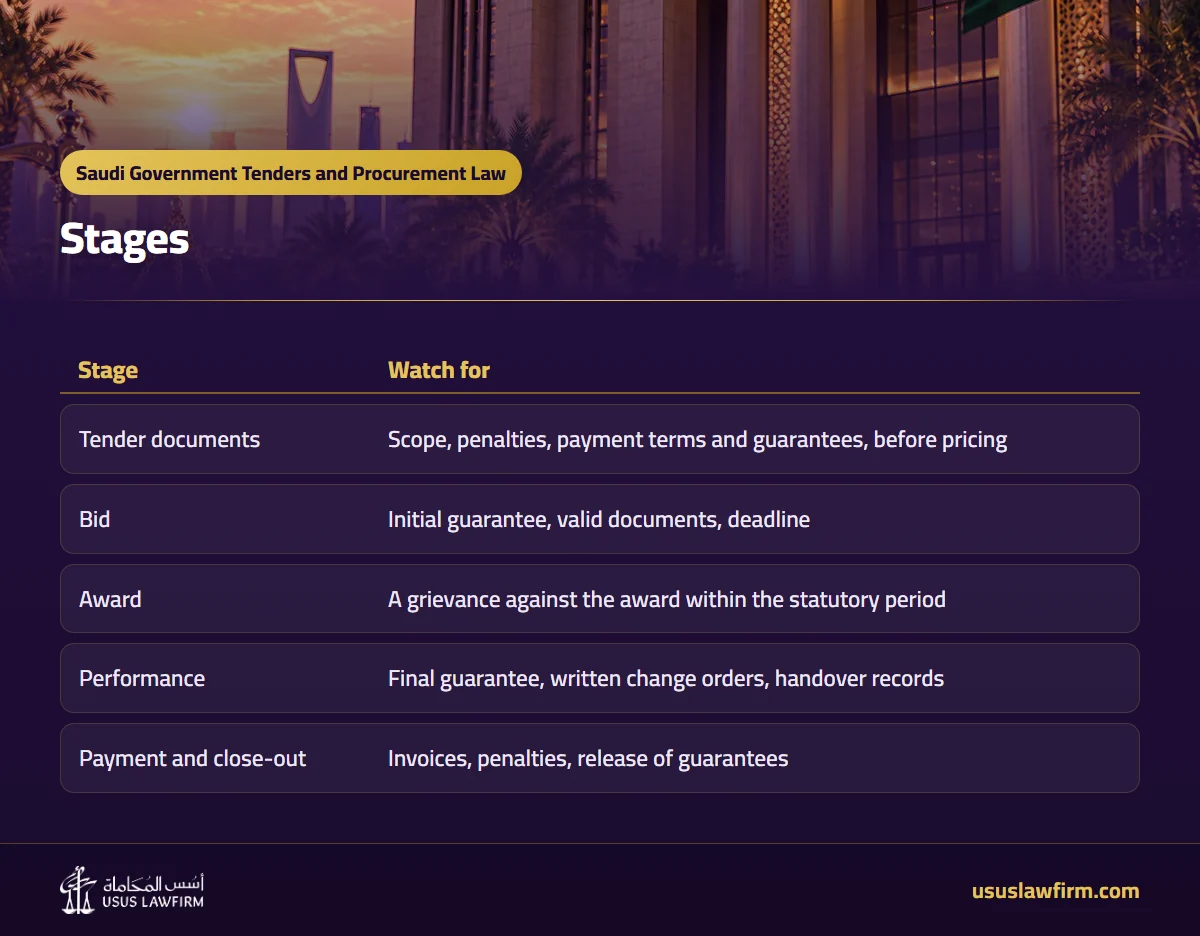
| Stage | What the law says |
|---|---|
| Bid | Submitted encrypted through the portal within the set period, with all-inclusive prices; a discount in a separate letter is ignored (Arts. 36, 40). Bids stay valid for 90 working days from opening (Art. 39). |
| Bid bond | 1% to 2% of the bid value; a bid without it is rejected (Art. 41), except in listed cases such as direct purchase, local SMEs, emergencies and urgent cases (Art. 42). |
| Evaluation | Technical before financial (Art. 44). A bid cannot be excluded for a low price unless it is at least 25% below the estimated cost, after the bidder explains it in writing (Art. 46). |
| Award and standstill | Results are announced (Art. 47), then a standstill period of 3 to 10 working days in which the contract cannot be signed (Art. 50). |
| Performance bond and signing | 5% of the contract value within 15 working days of notice of award (Art. 59). A winner who does not sign within 10 working days of a warning loses the award and the bond (Art. 56). |
Contractor rights during performance
- Site handover within 60 working days of signing, unless the tender documents say otherwise (Art. 56).
- Late payment: the Ministry of Finance notifies a body that is late paying its contractors; if it still takes no action, it may not issue new awards, with limited exceptions (Art. 91).
- Price adjustment only for changes in the prices of main materials or services, in customs duties, fees or taxes, or unforeseeable physical difficulties (Art. 66).
- Change orders: new items up to 10% of the contract value with the contractor's consent; existing items increased up to 20% (consent needed above 10%) or reduced up to 20%; total increase capped at 20% (Art. 67).
- Extension and waiver of penalties for additional work, insufficient annual funding, delay caused by the government body or emergencies, causes beyond the contractor's control, or a suspension order not caused by the contractor (Art. 72).
- Compensation before the competent court if the government body breaches the contract (Art. 94), or if it terminates for public interest with the Ministry's approval (Art. 75).
Penalties and termination
- Delay penalty up to 6% of a supply contract and 15% of other contracts (Art. 70); up to 15% for underperformance in continuous service contracts such as maintenance and cleaning (Art. 71).
- Mandatory termination for bribery, fraud or forgery, liquidation or insolvency, or assignment without written consent; optional termination for unremedied delay or breach, or subcontracting without consent (Art. 74). In these cases the performance bond is forfeited and the case goes to the violations committee (Art. 76).
Grievances and disputes
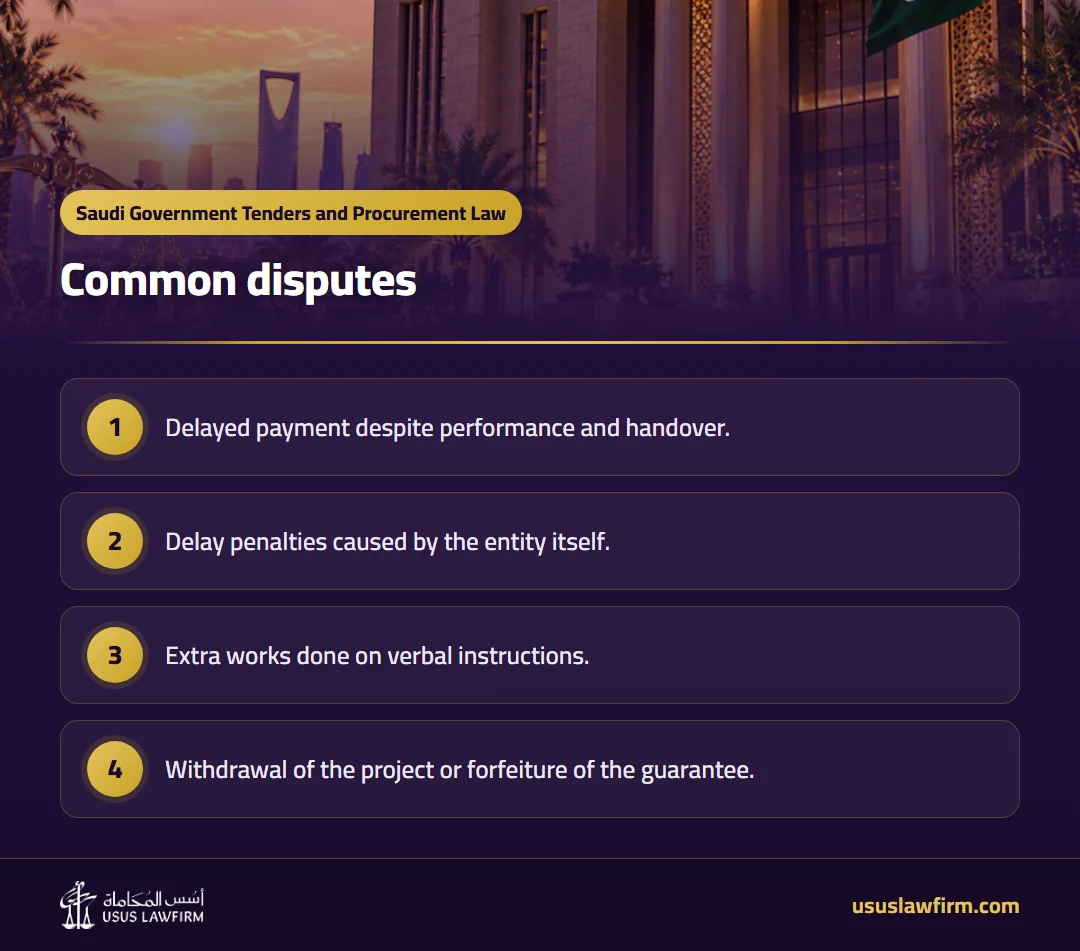
- A grievance to the government body within 5 working days of a pre-award decision, or within the standstill period against the award; the body must decide within 15 working days or the grievance is deemed rejected (Art. 85).
- Then a grievance to the Ministry of Finance committee within 3 working days, with a deposit of 0.5% of the bid value (SAR 15,000 against a prequalification decision), refunded if the grievance succeeds; the committee's decisions bind the government body (Arts. 84–85).
- The violations committee may ban a bidder or contractor for up to 5 years and/or downgrade its classification, or fine it up to 10% of its bid instead of a ban; its decisions can be challenged before the competent court within 60 days (Art. 87).
- Contract claims go to the competent court, which for government contracts is the Administrative Court of the Board of Grievances; arbitration needs the Minister of Finance's approval (Art. 94). Read grievances before the Board of Grievances and administrative enforcement.
What changed from the 1440H law
| Item | 1440H law | 1448H law |
|---|---|---|
| Direct purchase by value | Up to SAR 100,000 (Art. 32) | Up to SAR 1 million (Art. 32) |
| Standstill period | 5 to 10 working days (Art. 53) | 3 to 10 working days (Art. 50) |
| Bid validity | 90 days (Art. 39) | 90 working days (Art. 39) |
| Change orders (increase) | Up to 10% (Art. 69) | Up to 20%; new items up to 10% with consent (Art. 67) |
| Delay penalty, non-supply contracts | Up to 20% (Art. 72) | Up to 15% (Art. 70) |
| Continuous services penalty | Up to 20% (Art. 73) | Up to 15% (Art. 71) |
| Grievance deposit | Half the bid bond (Art. 86) | 0.5% of the bid; SAR 15,000 for prequalification (Art. 84) |
| Delegated award authority | SAR 10 million for tenders, SAR 3 million for direct purchase (Art. 54) | Up to SAR 50 million (Art. 51) |
New provisions in the text of the law include the 60-working-day site handover (Art. 56), the late-payment rule (Art. 91), and the express right to compensation after termination for public interest (Art. 75).
Frequently asked questions
Has the new law replaced the old one?
Yes. It replaces the 1440H law (Art. 100) and takes effect 120 days after its publication on 4 September 2026 (Art. 101). Tenders issued under the 1440H law remain under it (Royal Decree M/76, clause 3).
What is the direct purchase limit?
An estimated cost of up to SAR 1 million, with priority to local SMEs, among twelve direct-purchase cases (Art. 32). The old limit was SAR 100,000.
How long is the standstill period after award?
Between 3 and 10 working days, during which the contract cannot be signed and unsuccessful bidders may file grievances (Art. 50).
Can I sue a government body for overdue payments?
Yes. If the body breaches the contract, the contractor may claim compensation before the competent court, the Administrative Court of the Board of Grievances (Art. 94). The new law also bars a body that ignores the Ministry of Finance's late-payment notice from issuing new awards (Art. 91).
A government contract dispute?
Usus Law Firm handles administrative cases and contractor claims before the Board of Grievances, and proceedings before quasi-judicial committees, in Riyadh and Tabuk, and advises in English. See also our administrative lawyer in Tabuk.
Legal review: the Usus Law Firm team
A select team of lawyers and legal advisers licensed by the Saudi Ministry of Justice, working from Riyadh and Tabuk, with experience before the general, commercial, labor, criminal, personal status and administrative courts. Every article is reviewed before publication and updated when laws or regulations change.
Last reviewed: 15 November 2026
This article is general legal information and is not a substitute for advice on your specific case. Court proceedings in Saudi Arabia are in Arabic; the official Arabic text of each law prevails.
Request a quick consultation
Leave your name and mobile number, and a lawyer from our Riyadh or Tabuk office will call you during working hours. We advise in English.