


The Implementing Regulations of the Saudi Labour Law (اللائحة التنفيذية لنظام العمل) fill in what the Labour Law refers to them: holiday days, compensatory leave, transfer of services and change of profession, hours for guards and cleaners, part-time and flexible work, and objections to labour violations. Anyone looking into their rights at work usually needs both: the article in the Law, and its detail in the Regulations. Here we set out what the Regulations actually contain, with their article numbers.

Reviewed by: Ahmed Hasan AlShehriAttorney at Usus Law FirmLast updated:
The Law and the Regulations: what is the difference?
The Labour Law is issued by Royal Decree and sets the general rules and basic rights. The Implementing Regulations are issued by the Ministry of Human Resources and Social Development to detail how the Law is applied, and they may not contradict it. They were reissued with their annexes by Ministerial Decision 115921 of 19/6/1446H, and the edition we used, updated 5/5/1447H, records Articles 2, 36, 37 and 41 as repealed. Wages, investigations and penalties are governed by the Law itself, not the Regulations. Read our guide to the Saudi Labour Law.
What the Regulations cover, article by article
| Article | Topic | What it says |
|---|---|---|
| 1 | Temporary and casual contracts | If the parties continue past 90 days, the contract becomes subject to all of the Law |
| 3 and 4 | Work regulations | A unified model. A business with its own regulations has them reviewed and certified by a law firm approved on the Ministry website; under 50 workers may choose the model online without changes |
| 4 bis and 5 | Data and records | Update business data within 10 days of a change, and the records to keep on paper or electronically |
| 6 | Documents | The employer must not keep a non-Saudi worker's passport, iqama or medical insurance card |
| 11 | Jobs reserved for Saudis | 18 occupations, including HR roles, reception, cashier, government relations clerk and customs broker |
| 12 | Non-Saudi contracts | Fixed-term however long they run, and never indefinite even if the parties agree |
| 13 | Ajeer | A worker whose work the Ministry approves through the programme is not in breach of Article 39 |
| 14 | Recruitment, transfer and change of profession | The conditions for each, including transfer without consent |
| 15 to 17 | Training | Employer duties, when training costs may be charged to the worker, and post-training service conditions |
| 18 | Contract documentation | Unified models and electronic documentation |
| 19 | Probation | The 180-day limit, splitting into consecutive periods, and the leave that does not count |
| 20 | Relocation | A clause placing the job anywhere in the Kingdom counts as written consent |
| 21 | Forced labour and housing | Definition of forced labour; the housing duty applies to the private and non-profit sectors |
| 22 and 22 bis | Overtime | 720-hour annual limit and compensatory leave |
| 23 | Special working-hours groups | Preparatory and intermittent work, guarding and cleaning |
| 24 | Eids and occasions | The days, and how they overlap with rest days, annual and sick leave |
| 25 and 26 | Unpaid and sick leave | Contract suspension beyond 20 days; annual leave stops during sickness |
| 27 | Part-time and flexible work | Conditions for each; flexible work is for Saudis only |
| 28 to 30 | Injuries and safety | Reporting an injury within a week where the occupational hazards branch does not apply, first-aid kits, and remote locations |
| 31 | Nursing | One hour a day for 24 months, and how it is timed |
| 32 to 35 | Juveniles | Banned work, night work cases and training conditions |
| 38 to 40 | Labour violations | Objection within 60 days, settlement request within 90 days, removal within 10 working days, and payment within 60 days or Ministry services stop |
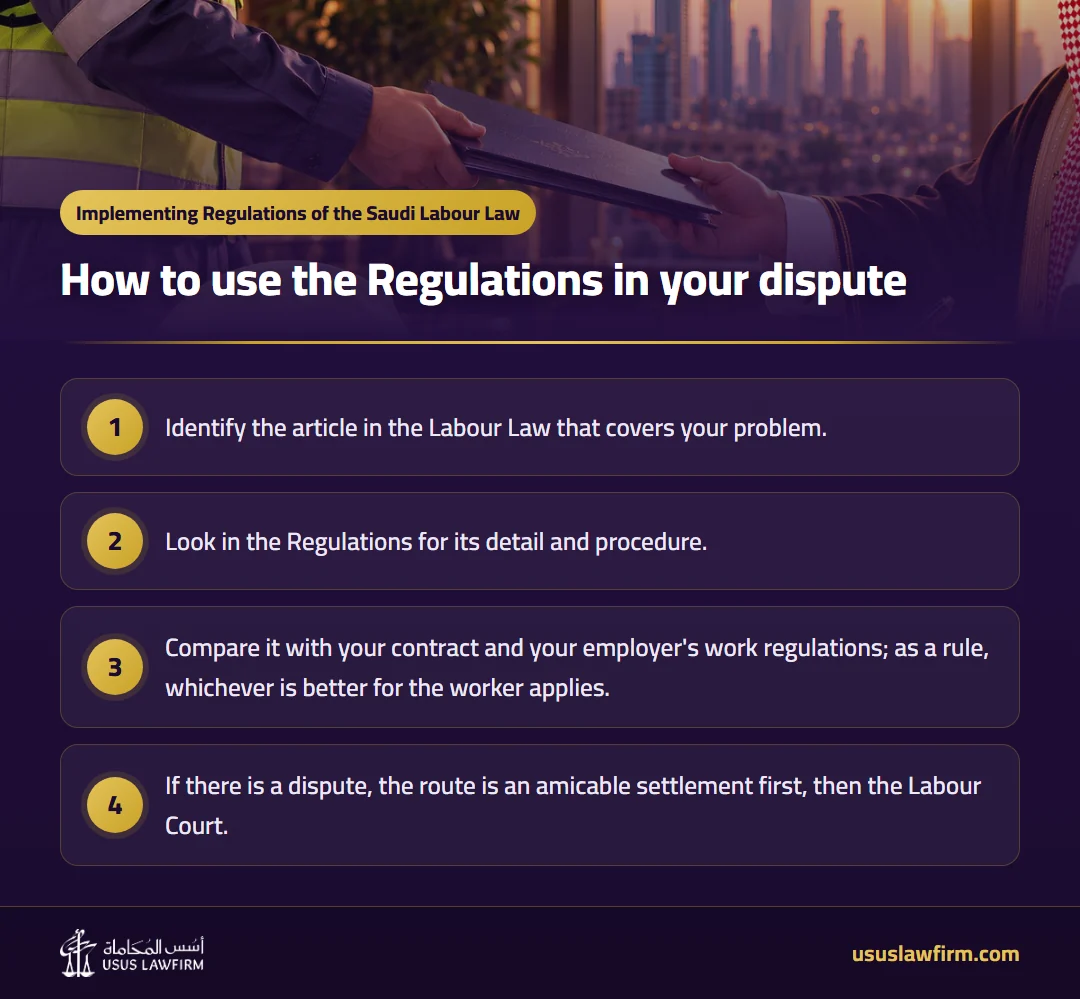
How to use the Regulations in your dispute
- Identify the article in the Labour Law that covers your problem.
- Look in the Regulations for its detail and procedure.
- Compare it with your contract and your employer's work regulations; as a rule, whichever is better for the worker applies.
- If there is a dispute, the route is an amicable settlement first, then the Labour Court. Read filing a labour case.
The Regulations are amended from time to time, and the current official version is published on the website of the Ministry of Human Resources and Social Development. The official text is in Arabic, and any filing with the Labour Court is in Arabic too.
Frequently asked questions
If my contract conflicts with the Regulations, which applies?
As a rule, a term that reduces the worker's statutory rights is void, and a term in the contract that is better for the worker is valid.
Do the Regulations apply to domestic workers?
Domestic workers have their own regulations, so the Labour Law and its Regulations do not, as a rule, apply to them.
A labour dispute that needs a careful reading of the Law and the Regulations?
The team at Usus Law Firm handles labour cases for employees and employers, and drafts work regulations for companies, in Riyadh and Tabuk.
Legal review: the Usus Law Firm team
A select team of lawyers and legal advisers licensed by the Saudi Ministry of Justice, working from Riyadh and Tabuk, with experience before the general, commercial, labor, criminal, personal status and administrative courts. Every article is reviewed before publication and updated when laws or regulations change.
Last reviewed: 5 November 2026
This article is general legal information and is not a substitute for advice on your specific case. Court proceedings in Saudi Arabia are in Arabic; the official Arabic text of each law prevails.
Request a quick consultation
Leave your name and mobile number, and a lawyer from our Riyadh or Tabuk office will call you during working hours. We advise in English.