


A hidden (latent) defect is a defect that reduces the value or usefulness of the thing sold, that the buyer could not have discovered by inspecting it with ordinary care, and that existed at delivery or goes back to an earlier cause. Under the Saudi Civil Transactions Law (Articles 338–344) the seller warrants against it even if unaware of it, and the claim is not heard after 180 days from delivery, with two exceptions.

Reviewed by: Rakan Jameel Al-DubaisiFounder & CEO of Usus Law FirmLast updated:
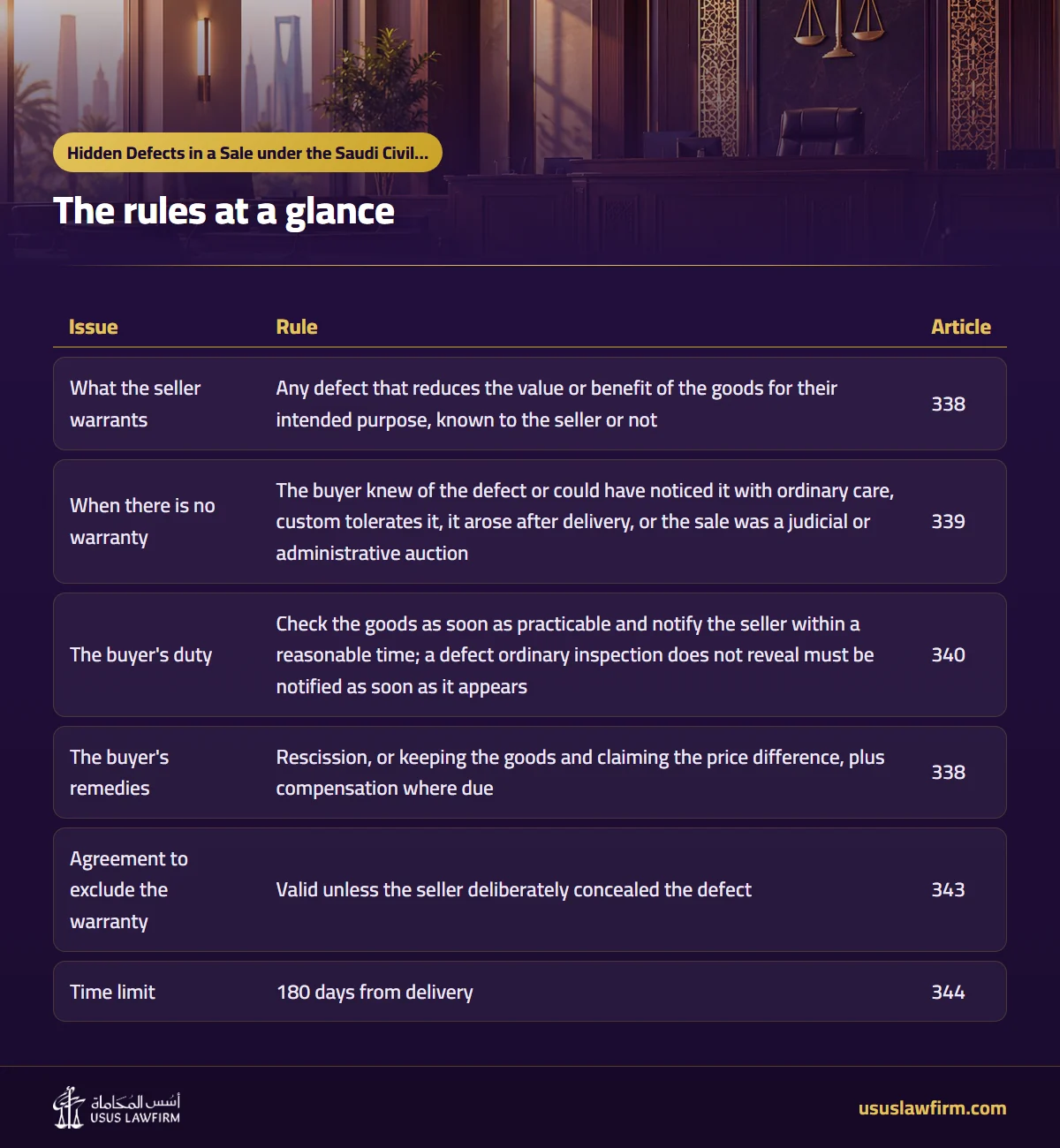
The rules at a glance
| Issue | Rule | Article |
|---|---|---|
| What the seller warrants | Any defect that reduces the value or benefit of the goods for their intended purpose, known to the seller or not | 338 |
| When there is no warranty | The buyer knew of the defect or could have noticed it with ordinary care, custom tolerates it, it arose after delivery, or the sale was a judicial or administrative auction | 339 |
| The buyer's duty | Check the goods as soon as practicable and notify the seller within a reasonable time; a defect ordinary inspection does not reveal must be notified as soon as it appears | 340 |
| The buyer's remedies | Rescission, or keeping the goods and claiming the price difference, plus compensation where due | 338 |
| Agreement to exclude the warranty | Valid unless the seller deliberately concealed the defect | 343 |
| Time limit | 180 days from delivery | 344 |
Which defects are covered?
- The defect is material: it reduces the value or benefit of the goods according to the purpose shown by the contract, the nature of the thing or its intended use.
- It is hidden: ordinary inspection would not reveal it. An exception applies if the seller guaranteed the goods free of a specific defect or deliberately concealed it (Article 339).
- The buyer did not know of it at the time of sale. The seller's own ignorance is no defence (Article 338).
- It existed at delivery, or results from a cause that existed before delivery.
- It is not a defect that custom tolerates, which matters most for used goods.
What can the buyer claim?
The buyer may ask for rescission, or keep the goods and claim the price difference, defined as the ratio of the sound value to the defective value applied to the price (Article 338). The seller may avoid both by supplying an equivalent, defect-free replacement. Compensation is available for any resulting loss. A buyer who has not yet paid may withhold the price until the seller gives adequate security for its return (Article 349).
When is the right lost?
- Accepting the defect, expressly or impliedly, ends both rescission and the price difference (Article 341).
- Rescission alone is lost, and the price difference remains, if the buyer disposes of the goods, grants a third party a right over them that cannot be cleared within a reasonable time, the goods perish or are damaged by the buyer or after delivery, or the buyer adds an attached, non-derivative increase to them (Article 341).
- If several things were sold together and only some are defective, rescission is generally limited to the defective part (Article 342).
Time limit: 180 days from delivery
A claim is not heard after 180 days from delivery, unless the seller undertook a longer warranty. The seller cannot rely on the period if the defect was concealed by fraud (Article 344). Time runs from delivery, not from discovery, so keep a dated handover record.
Hidden defects insurance is a different matter
Council of Ministers Decision No. 509 of 21/9/1439 AH requires contractors on non-government projects to insure against hidden defects that appear in buildings after use, and the Saudi Central Bank issued the model policy on 31 March 2020. It does not replace the seller's warranty under the Civil Transactions Law.
Frequently asked questions
How long do I have to claim for a hidden defect in Saudi Arabia?
180 days from delivery, unless the seller gave a longer warranty or concealed the defect by fraud (Article 344).
Is a seller liable for a defect he did not know about?
Yes. The seller warrants against the defect even if unaware of it (Article 338).
Does an "as is" clause exclude liability?
The parties may exclude or limit the warranty, but the clause has no effect if the seller deliberately concealed the defect (Article 343).
Is there a warranty in an auction?
Not if the auction is held by a judicial or administrative body (Article 339).
Found a defect in a property or car you bought?
Usus Law Firm (Riyadh and Tabuk) reviews the contract, technical reports and delivery date, and drafts the notice to the seller and the statement of claim. Request your consultation now; fees are explained in writing before any commitment. See general court cases, the Civil Transactions Law explained and property sale contract template.
General information from the Saudi Civil Transactions Law, not advice on a specific case.
Legal review: the Usus Law Firm team
A select team of lawyers and legal advisers licensed by the Saudi Ministry of Justice, working from Riyadh and Tabuk, with experience before the general, commercial, labor, criminal, personal status and administrative courts. Every article is reviewed before publication and updated when laws or regulations change.
Last reviewed: 25 November 2026
This article is general legal information and is not a substitute for advice on your specific case. Court proceedings in Saudi Arabia are in Arabic; the official Arabic text of each law prevails.
Request a quick consultation
Leave your name and mobile number, and a lawyer from our Riyadh or Tabuk office will call you during working hours. We advise in English.