

Article 81 of the Saudi Labor Law (المادة 81 من نظام العمل) protects an employee who is forced to leave their job because of the employer. It allows the employee to leave without notice while keeping all their statutory rights, so they are not treated as someone who resigned and receives only part of the award. It is the counterpart of Article 80, which protects the employer against the employee's misconduct.
Article 81 lets a worker leave without notice and keep all statutory rights in seven listed cases, such as a material breach by the employer.

Reviewed by: Ahmed Hasan AlShehriAttorney at Usus Law FirmLast updated:
Cases covered by Article 81
| # | Case | Practical examples |
|---|---|---|
| 1 | The employer fails to meet its essential contractual or statutory obligations to the employee | Salaries delayed for months, not renewing a foreign employee's iqama (residence permit) or work permit, not registering the employee with social insurance (GOSI). |
| 2 | Deception at the time of contracting about the terms and conditions of work | A salary, job title or work location offered that differs from reality. |
| 3 | Assigning the employee, without consent, work essentially different from what was agreed | An accountant assigned field work unrelated to their specialty, beyond what the law permits. |
| 4 | Violent assault or indecent conduct toward the employee or a member of their family | By the employer, a member of the employer's family, or the responsible manager. |
| 5 | Treatment marked by cruelty, injustice or humiliation | By the employer or the responsible manager. |
| 6 | A serious danger at the workplace threatening the employee's safety or health | Provided the employer knew of it and took no action indicating it would remove it. |
| 7 | The employer's conduct pushes the employee into appearing to be the one who ended the contract | Deliberate pressure and breach of contract terms until the employee is forced to "resign". |
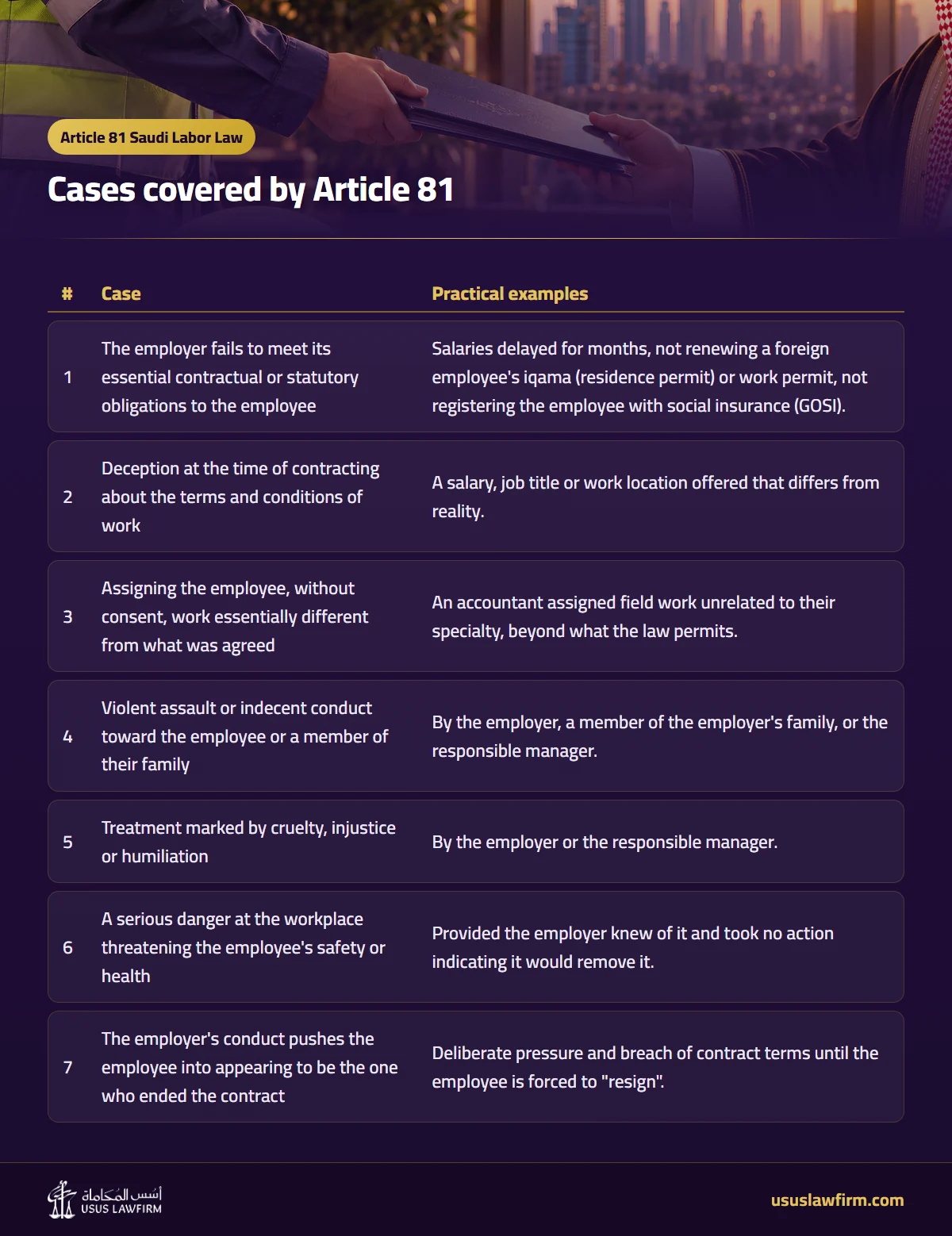
The table summarizes the text. Check the current official text of the Labor Law before taking any action.
What is an employee who leaves under Article 81 owed?
The employee keeps all their statutory rights: the full end-of-service award under Article 84 rather than the resignation percentages, overdue wages, and the leave balance. They may also claim compensation if the end of the relationship is attributed to an illegitimate reason on the employer's side, under Article 77. Work out the award with the end-of-service calculator.
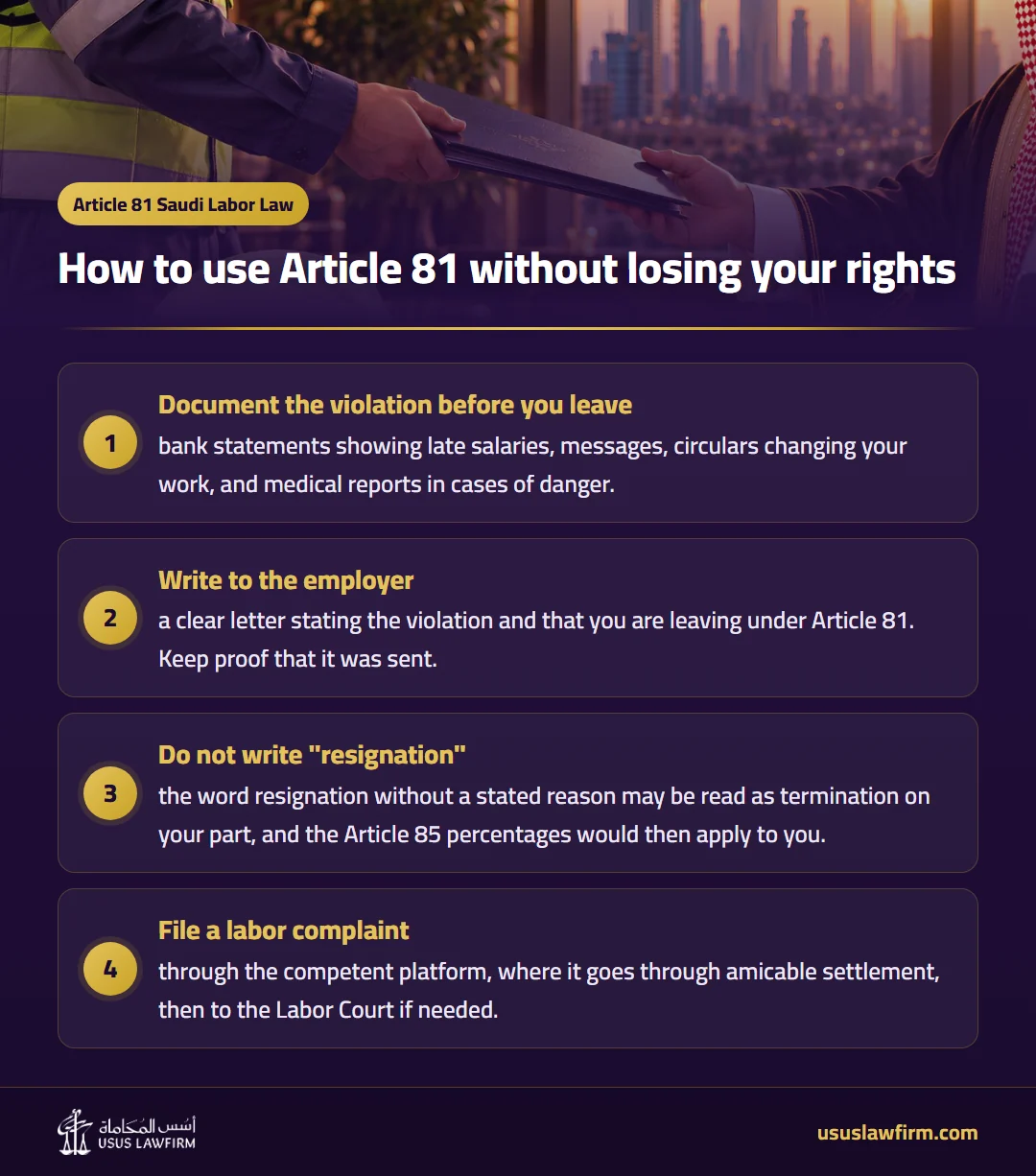
How to use Article 81 without losing your rights
- Document the violation before you leave: bank statements showing late salaries, messages, circulars changing your work, and medical reports in cases of danger.
- Write to the employer: a clear letter stating the violation and that you are leaving under Article 81. Keep proof that it was sent.
- Do not write "resignation": the word resignation without a stated reason may be read as termination on your part, and the Article 85 percentages would then apply to you.
- File a labor complaint: through the competent platform, where it goes through amicable settlement, then to the Labor Court if needed.
Watch the time limit: the Labor Law provides that claims relating to an employee's rights will not be heard after twelve months from the date the employment relationship ended.
Delayed salaries: the most common Article 81 case
Paying wages is the employer's most important obligation, and repeated delays or delays of several months are usually treated as an essential breach. But the court decides this based on the length and circumstances of the delay. So do not leave after a short delay without advice, and document every month your salary was late.
Article 80 vs Article 81: what is the difference?
| Article 80 | Article 81 | |
|---|---|---|
| Who ends the contract | The employer | The employee |
| When | In listed cases, such as assaulting the employer or a manager, failing essential obligations after a written warning, forgery to obtain the job, or absence without a valid reason for more than 30 separate days a year or 15 consecutive days after a warning | When the employer breaches essential obligations, such as months of unpaid salary, not renewing the iqama or work permit, deception when contracting, substantially different work without consent, or cruelty or insult |
| Notice and award | No notice, no end-of-service award and no compensation, if the employer proves the case and gave the employee a chance to answer | No notice needed, and the employee keeps all rights, including the full end-of-service award |
If an Article 80 dismissal skips the written warning where the law requires it, or the employee was not heard, or the reason is not proven, it may count as termination for an unlawful reason, with the award and Article 77 compensation. See Article 80 explained.
Where to read the official text of Article 81
The official Labour Law is published by the Ministry of Human Resources and Social Development (hrsd.gov.sa) and the Bureau of Experts at the Council of Ministers (laws.boe.gov.sa). The Arabic text prevails, and the law was amended in 2025, so check that the copy you read is the current one. Our guide to the implementing regulations explains how the rules apply in practice.
Article 81 and an absconding (huroob) report
Some employers respond to an employee who leaves under Article 81 by filing an absconding report. As the Ministry of Human Resources has explained, after a report there is a 60-day period in which the worker may transfer their services or take final exit; if it passes with no action, the status becomes "absent from work" and the report can no longer be cancelled. If the report is malicious, the worker can show they did not abscond and claim their rights in the labour case. Act within the period: see absconding report and the 60-day period.
Article 81 compared with Articles 77, 80 and 85
| Article | Who ends the contract? | End-of-service award |
|---|---|---|
| 81 | The employee leaves because the employer breached its obligations | In full, as if the employer had ended the contract |
| 80 | The employer terminates for the employee's serious misconduct | None in its cases; the employee is heard first |
| 77 | Termination by either party for an illegitimate reason | Compensation for the other party on top of the award |
| 85 | The employee resigns without cause from the employer | A share of the award depending on years of service |
Template: notice of leaving work under Article 81
Fill in the brackets, send it in a way that proves delivery, and keep a copy.
When Article 81 will not help you
- No real breach: an ordinary disagreement or a short salary delay may not be enough; the court decides.
- Writing "resignation" without a reason: you may be treated under Article 85.
- More than 12 months after the employment ended without a claim.
- Domestic workers: they fall under the Domestic Workers Regulation, not the Labour Law.
Frequently asked questions
What are the conditions for ending the contract under Article 81?
One of the Article 81 cases must occur on the employer's side — failure to meet essential obligations, fraud at contracting, assault, degrading treatment or a serious hazard — and the employee must be able to prove it. The employee can then leave without notice and keep all rights.
What is the difference between termination and resignation?
A resignation is ended by the employee, who receives part of the award depending on service (Article 85). Termination by the employer, or leaving under Article 81, keeps the full award.
When does an employee lose the right to claim?
Claims about an employee's rights are not heard after twelve months from the end of the employment, so do not delay the complaint.
Do I need to notify the employer before leaving under Article 81?
The article allows you to leave without notice, but it is always advisable to inform the employer of the reason in writing. That notice is your evidence later.
Does Article 81 apply to foreign employees?
Yes. It applies to every employee covered by the Labor Law, and many of its cases particularly affect expatriates, such as an iqama not being renewed or wages being delayed.
What if the employer denies the violation?
Then it comes down to proof through documents and witnesses, which is why documenting everything before you leave matters.
What is Article 80 and 81 in the Saudi Labor Law?
Article 80 lists the cases in which the employer may end the contract without notice, award or compensation. Article 81 lists the cases in which the employee may leave without notice and keep all rights, because the employer breached essential obligations.
Can my employer file an absconding report if I leave under Article 81?
An employer can file one, but a malicious report can be challenged. Keep proof of the employer's breach and of the date you left, and act within the 60-day period the Ministry allows after a report.
Thinking of leaving your job because of your employer?
Speak to a lawyer before you take the step. The Usus Law Firm team handles labor cases in Riyadh and Tabuk, and can advise you in English. Read also Article 80 explained and Article 74 explained.
Legal review: the Usus Law Firm team
A select team of lawyers and legal advisers licensed by the Saudi Ministry of Justice, working from Riyadh and Tabuk, with experience before the general, commercial, labor, criminal, personal status and administrative courts. Every article is reviewed before publication and updated when laws or regulations change.
Last reviewed: 4 November 2026
This article is general legal information and is not a substitute for advice on your specific case. Court proceedings in Saudi Arabia are in Arabic; the official Arabic text of each law prevails.
Request a quick consultation
Leave your name and mobile number, and a lawyer from our Riyadh or Tabuk office will call you during working hours. We advise in English.