

The Saudi Criminal Procedure Law (نظام الإجراءات الجزائية) sets out how a criminal case is handled in the Kingdom: how a suspect is arrested, who investigates them, how long they can be detained, and what rights they have up to the judgment and any objection to it. The current law was issued by Royal Decree No. (M/2) dated 22/1/1435H. Knowing this law is the first line of defense for any accused person and their family, because many cases are effectively decided in the first hours.
This is a general explanation. The reference is the current official text and its regulations, and every case needs a lawyer to review its details.

Reviewed by: Ghada Nasser Al-HarbiAttorney at Usus Law FirmLast updated:
Facing a criminal case, or is a relative detained?
Tell us what you know: the charge, the date of arrest and who summoned you. A lawyer from our team will reply.
WhatsApp a lawyerCall RiyadhCall Tabuk
What you send us is confidential and used only to study your case.
Service page: Criminal lawyer in Riyadh
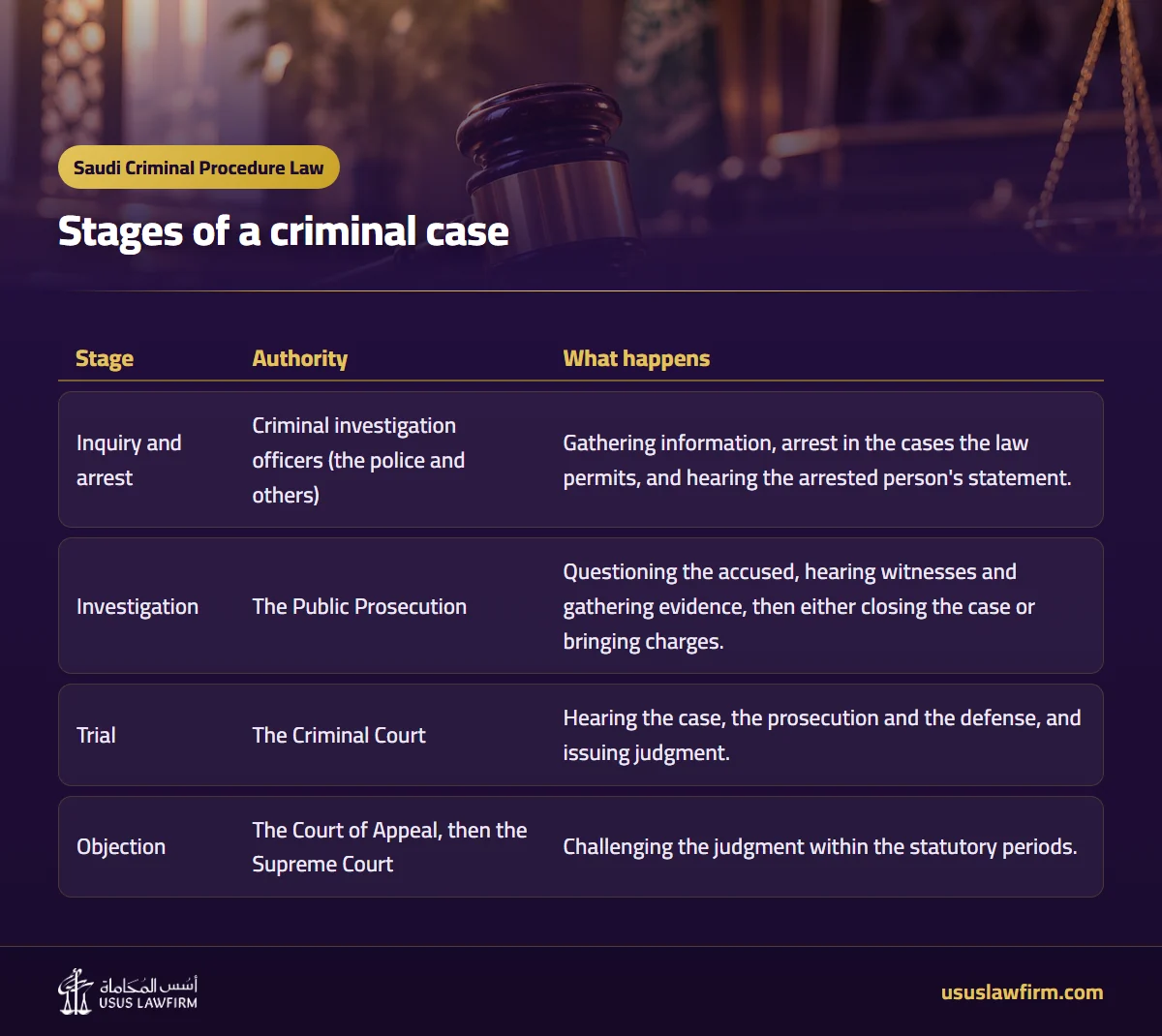
Stages of a criminal case
| Stage | Authority | What happens |
|---|---|---|
| Inquiry and arrest | Criminal investigation officers (the police and others) | Gathering information, arrest in the cases the law permits, and hearing the arrested person's statement. |
| Investigation | The Public Prosecution | Questioning the accused, hearing witnesses and gathering evidence, then either closing the case or bringing charges. |
| Trial | The Criminal Court | Hearing the case, the prosecution and the defense, and issuing judgment. |
| Objection | The Court of Appeal, then the Supreme Court | Challenging the judgment within the statutory periods. |
Arrest and what must follow
No one may be arrested or detained except in the cases provided for by law. The arresting officer must hear the arrested person's statement immediately, and if it does not clear them, they must be sent to the investigating authority within twenty-four hours. The arrested person may not be harmed physically or mentally, nor subjected to torture or degrading treatment.
Detention and its periods
If the investigator considers that the investigation requires the accused to be detained, a detention order is issued for a set period. It can be extended by decisions of the competent authority within maximum limits set by the law, after which detention continues only by order of the competent court. Check the detention periods and extensions in the current official text: they are among the most frequently asked questions, and the detainee and their family have the right to know the legal basis for continued detention.
Temporary release and bail
A detainee may be released temporarily during the investigation if the investigation does not require continued detention. This may be on a personal guarantee or a financial guarantee (bail), where the guarantor undertakes to bring the accused whenever required. A release request based on clear grounds, such as no risk of flight or of interfering with evidence, is one of the most important things a lawyer can submit early.
Rights of the accused under the Criminal Procedure Law
- The right to a lawyer during investigation and trial.
- The right to know the charge against them and its evidence.
- No coercion: a confession obtained by coercion or threats is not valid.
- Inviolability of the home: a home may only be searched in the cases provided for by law and, outside cases of being caught in the act, with authorization from the competent authority.
- Notification: the detainee has the right to inform a family member of their choice of the detention.
- Defense and objection: submitting defenses and evidence, and objecting to the judgment within the statutory period.
Proceedings are conducted in Arabic. A foreign accused who does not speak Arabic should make sure they understand any statement before signing it, and our team can advise in English.
Closing the case or bringing charges
After the investigation, the Public Prosecution decides either to close the case if the evidence is insufficient or the act is not proven, or to bring a criminal case before the competent court. During the investigation, a lawyer can submit memoranda showing weak evidence or an invalid procedure, which may lead to the case being closed before it reaches court.
Trial and objecting to the judgment
The Criminal Court hears the case, listens to the prosecution and the defense, and rules either conviction or acquittal. The period for objecting to the judgment by appeal is thirty days as a rule, and missing it makes the judgment final. After judgment, the provisions of a royal pardon may apply to some cases according to its conditions.
Time limits under the Law of Criminal Procedure
The law has ten parts, from general provisions through investigation and trial to appeals and enforcement. An accused must have at least three days' notice of the hearing, which can be cut to one hour in necessity under conditions (Art. 136). The objection period is thirty days, after which the right lapses. Judgments of death, stoning, amputation or qisas go to the Court of Appeal for review even if no one asks (Art. 194). Cassation before the Supreme Court is available on set grounds (Art. 198).
Frequently asked questions
What does Article 3 of the Criminal Procedure Law say?
That no criminal penalty may be imposed on anyone except after their guilt is proven at a trial conducted according to Sharia — the basis of the accused's right to a fair trial.
Should a lawyer attend the investigation?
The accused has the right to a lawyer during investigation. A lawyer's early involvement protects against answers that may be misunderstood and against procedures that may be invalid.
What is the difference between closing a case and acquittal?
Closing the case is a Public Prosecution decision not to bring charges; acquittal is a court judgment after trial. Each ends the case in its own way.
Is a search carried out without authorization valid?
A search outside the lawful cases may invalidate the evidence it produced. This is one of the most important defenses, especially in drug cases, and assessing it requires a lawyer who has reviewed the official reports.
Need a criminal lawyer?
The Usus Law Firm team handles criminal cases and drug cases from the investigation stage through to judgment and objection, in Riyadh and Tabuk. Read also drug penalties in Saudi Arabia.
Read also: Rehabilitation and clearing a criminal record.
Legal review: the Usus Law Firm team
A select team of lawyers and legal advisers licensed by the Saudi Ministry of Justice, working from Riyadh and Tabuk, with experience before the general, commercial, labor, criminal, personal status and administrative courts. Every article is reviewed before publication and updated when laws or regulations change.
Last reviewed: 4 November 2026
This article is general legal information and is not a substitute for advice on your specific case. Court proceedings in Saudi Arabia are in Arabic; the official Arabic text of each law prevails.
Request a quick consultation
Leave your name and mobile number, and a lawyer from our Riyadh or Tabuk office will call you during working hours. We advise in English.