

The Law of Procedure before Sharia Courts (نظام المرافعات الشرعية) is the path every case follows in court: filing the claim and notifying the other party, the hearings and the judgment, and then objecting to it. The current law was issued by Royal Decree No. (M/1) dated 22/1/1435H, replacing the previous law, and implementing regulations set out its procedures in detail. Knowing this law helps you avoid procedural mistakes that can end your case before the court looks at its merits.
This is a simplified explanation for general awareness. The official text and its regulations are the authoritative reference, and the commercial courts have their own law.

Reviewed by: Raghad Mamdouh Al-KhamshiLegal Affairs Manager at Usus Law FirmLast updated:
Which courts does it apply to?
The law applies to cases before the general courts and the personal status courts, and it is referred to in the labour courts where there is no specific provision. Procedures in the commercial courts are governed by the Commercial Courts Law, criminal cases by the Law of Criminal Procedure, and cases before the Board of Grievances (the administrative judiciary) by the Law of Procedure before the Board of Grievances.
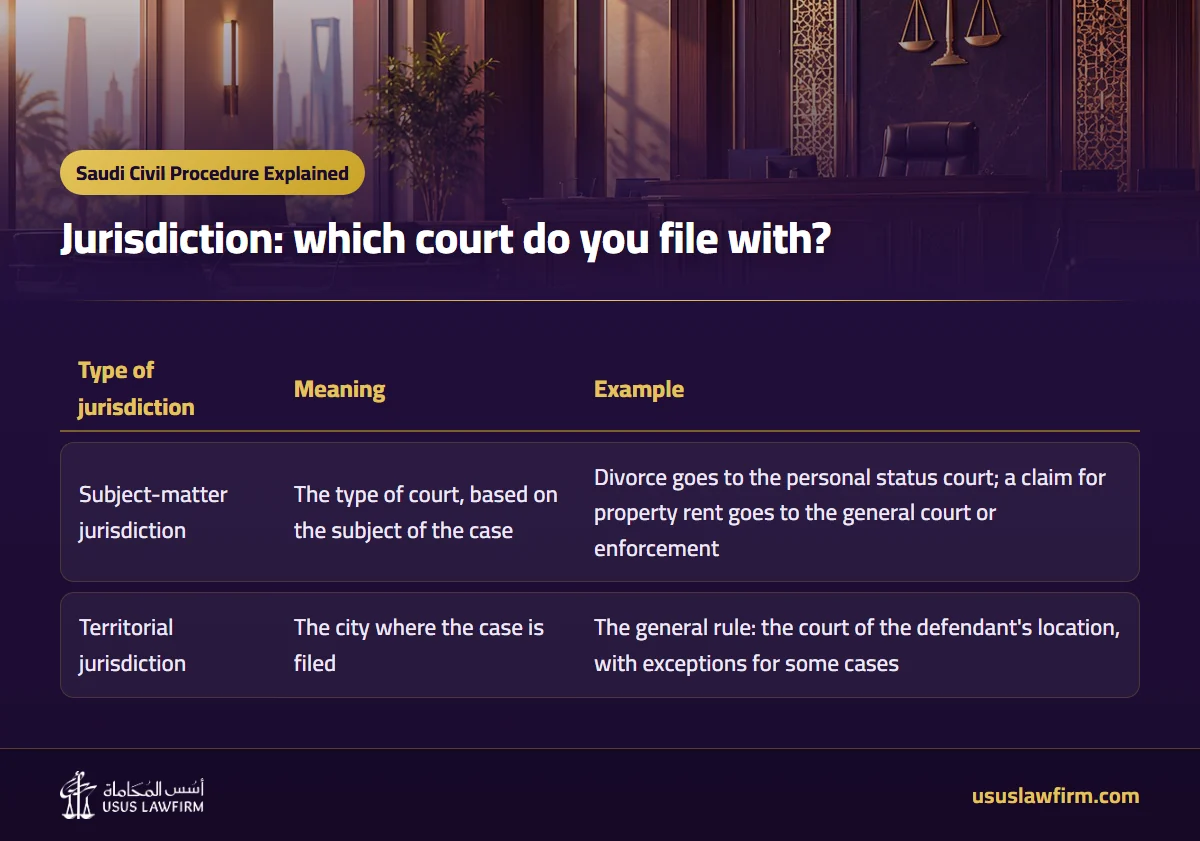
Jurisdiction: which court do you file with?
| Type of jurisdiction | Meaning | Example |
|---|---|---|
| Subject-matter jurisdiction | The type of court, based on the subject of the case | Divorce goes to the personal status court; a claim for property rent goes to the general court or enforcement |
| Territorial jurisdiction | The city where the case is filed | The general rule: the court of the defendant's location, with exceptions for some cases |
Filing in a court that lacks jurisdiction delays your case, because the court will rule that it has no jurisdiction.
Filing the claim and the statement of claim
Claims are now filed online through Najiz (the Ministry of Justice e-services platform), with a statement of claim containing the essential details:
- The claimant's and defendant's details and addresses.
- The subject of the claim and its facts, briefly and clearly.
- The specific orders you want the court to make.
- The supporting grounds and documents.
A vague statement of claim or unclear requests are among the most common reasons cases are delayed or dismissed. State exactly what you are asking for: an amount, delivery of something, or an order to do a specific act. The statement and the hearings are in Arabic.
Notification
The defendant must be notified of the claim and the hearing date. Electronic notification through approved channels, such as messages linked to the national ID and the Najiz platform, is valid. So keep your contact details up to date: a notification can be valid even if you didn't notice the message.
Attendance and absence
If the claimant misses hearings without an excuse, the case may be struck out. If the defendant is absent after being notified, the court may proceed and rule on the case. Attending, or appointing a lawyer to attend, is the simplest protection of your rights.
Defences
The defendant may raise procedural defences, such as lack of jurisdiction or invalid notification, and substantive defences about the right itself. Some procedural defences must be raised at the start of the case, or the right to raise them is lost.
The judgment and how to challenge it
| Type of challenge | Before | Note |
|---|---|---|
| Appeal | The Court of Appeal | Reviews the judgment on the merits and on procedure |
| Cassation | The Supreme Court | In specific cases, such as breach of Sharia rules or the law |
| Petition for reconsideration | The court that issued the judgment | In specific cases, such as the discovery of decisive documents or fraud |
The deadline: an appeal or scrutiny must be filed within thirty days, or ten days in urgent matters (Article 187), and a cassation request within thirty days, or fifteen days in urgent matters (Article 194). Once the period passes, the judgment becomes final, so don't delay your challenge.
See also the Implementing Regulations and the Regulations on Objection to Judgments.
Where to file and what happens on absence
A claim is normally filed where the defendant lives (Art. 36). In maintenance the claimant may choose either party's court, and in marital, custody and visitation matters a woman may file in her town or the defendant's (Art. 39). If a claimant misses a hearing the court may strike out the claim, and after 60 days without a request to resume it is treated as never filed (Art. 55).
Objection periods and defences
An appeal or review must be filed within 30 days, or 10 days in urgent matters (Art. 187). Cassation is 30 days, or 15 in urgent matters (Art. 194). Invalidity of the statement of claim and territorial jurisdiction must be raised before any other defence or the right lapses (Art. 75). Lack of standing, capacity or interest, and res judicata, can be raised at any stage (Art. 76).
Frequently asked questions
Do I need a lawyer to file a claim?
Not in most cases; you can file it yourself through Najiz. But a lawyer helps with drafting the statement of claim, identifying the competent court, defences and challenge deadlines.
When does the appeal period start?
As a general rule, it starts from the date you receive a copy of the judgment, or the date the law sets for this. Check the delivery date in Najiz.
What is the difference between a case being struck out and being dismissed?
Striking out is a procedural step that halts the case, usually because the claimant was absent, and you can apply to resume it. Dismissal is a ruling on the merits that the claimant is not entitled to what they claimed.
Need someone to manage the procedure of your case?
The Usus Law Firm team drafts statements of claim and memoranda, attends hearings and handles appeals in general court cases, personal status and labour cases, in Riyadh and Tabuk. See also our guide to the Law of Evidence.
Read also: Filing a lawsuit on Najiz.
Read also: Statement of claim template.
Read also: Appeal memorandum template.
Read also: Table of competent courts.
Legal review: the Usus Law Firm team
A select team of lawyers and legal advisers licensed by the Saudi Ministry of Justice, working from Riyadh and Tabuk, with experience before the general, commercial, labor, criminal, personal status and administrative courts. Every article is reviewed before publication and updated when laws or regulations change.
Last reviewed: 4 November 2026
This article is general legal information and is not a substitute for advice on your specific case. Court proceedings in Saudi Arabia are in Arabic; the official Arabic text of each law prevails.
Request a quick consultation
Leave your name and mobile number, and a lawyer from our Riyadh or Tabuk office will call you during working hours. We advise in English.