

Saudi law distinguishes between qadhf (accusing someone of adultery), insult and abuse, and online defamation, each with its own penalty and route.

Reviewed by: Ahmad Farag Al-Sayed MuhammadHead of the Criminal Department at Usus Law FirmLast updated:
Facing a criminal case, or is a relative detained?
Tell us what you know: the charge, the date of arrest and who summoned you. A lawyer from our team will reply.
WhatsApp a lawyerCall RiyadhCall Tabuk
What you send us is confidential and used only to study your case.
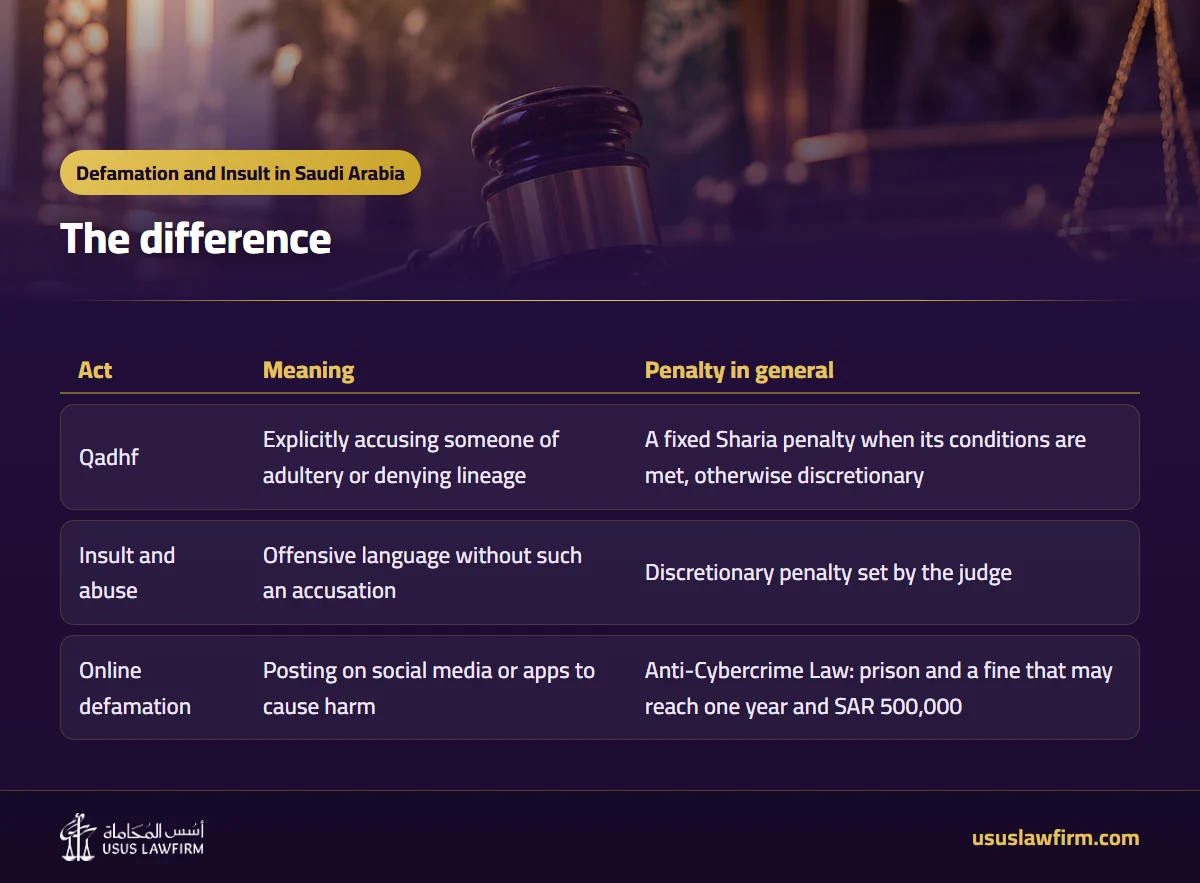
The difference
| Act | Meaning | Penalty in general |
|---|---|---|
| Qadhf | Explicitly accusing someone of adultery or denying lineage | A fixed Sharia penalty when its conditions are met, otherwise discretionary |
| Insult and abuse | Offensive language without such an accusation | Discretionary penalty set by the judge |
| Online defamation | Posting on social media or apps to cause harm | Anti-Cybercrime Law: prison and a fine that may reach one year and SAR 500,000 |
Public and private rights
You hold a private right you may claim or waive; the court also hears a public right that may continue even after you waive. Settlement usually reduces the penalty but does not always end the case.
Proving it
- Online: screenshots showing the account, date and link, and save the link before deletion.
- In person: witnesses and camera footage.
- Voice and text messages are evidence under the Law of Evidence. Do not reply in kind: it makes you an accused too.
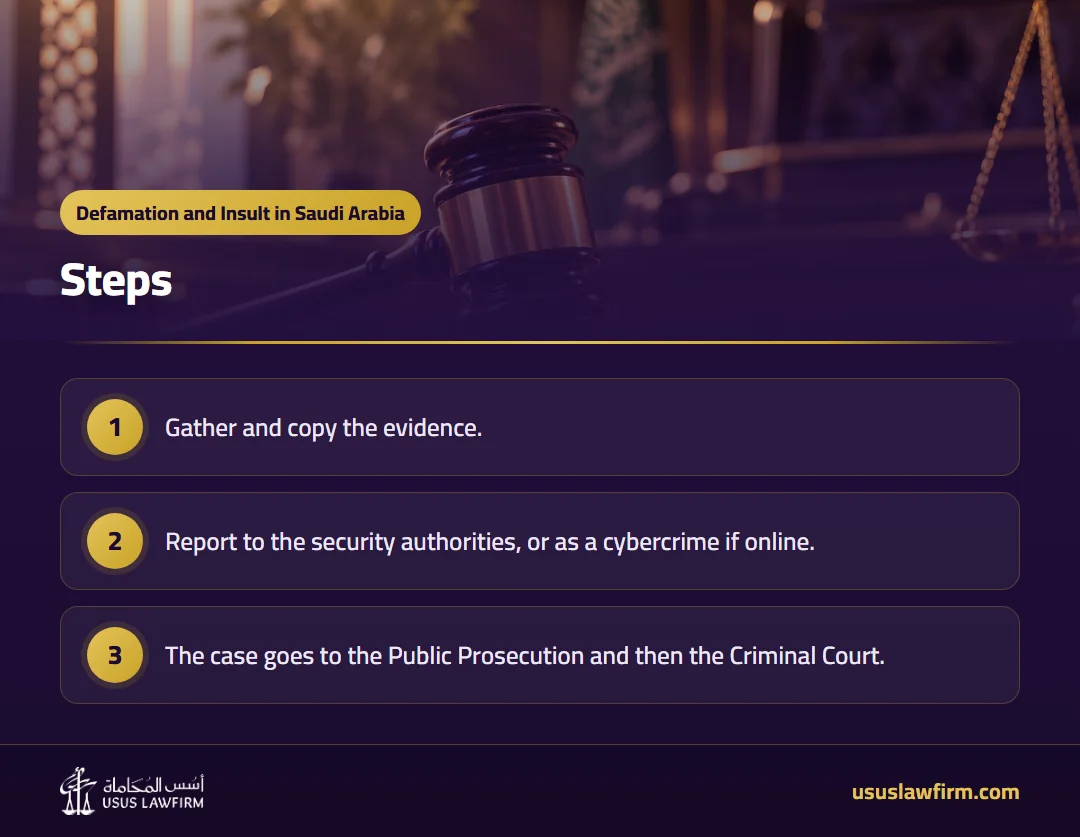
Steps
- Gather and copy the evidence.
- Report to the security authorities, or as a cybercrime if online. Read the Anti-Cybercrime Law.
- The case goes to the Public Prosecution and then the Criminal Court.
Frequently asked questions
What is the penalty for verbal qadhf (an accusation of zina)?
If the words are an explicit accusation of zina, it is qadhf, with the fixed hadd punishment of 80 lashes under the Quran (Surat An-Nur, verse 4) once its conditions are met and the accused person demands it. Insults that fall short of that are ordinary abuse with a discretionary (ta'zir) penalty set by the judge, and online they also fall under the Anti-Cybercrime Law.
Does blocking or deleting end the case?
No. Deleting a post after publishing it does not erase the offence if it is proven, which is why you should keep the evidence before it is deleted.
Do words in a private WhatsApp group count as publication?
They may. Others besides the person spoken about can read the group, and the court looks at the circumstances.
Can the parties settle?
Yes. A documented settlement of the private right is taken into account in the judgment, ideally in writing with clear terms.
Defamed, or accused of insult?
Usus Law Firm handles criminal and cybercrime cases in full confidence, in Riyadh and Tabuk, and advises in English.
Legal review: the Usus Law Firm team
A select team of lawyers and legal advisers licensed by the Saudi Ministry of Justice, working from Riyadh and Tabuk, with experience before the general, commercial, labor, criminal, personal status and administrative courts. Every article is reviewed before publication and updated when laws or regulations change.
Last reviewed: 3 November 2026
This article is general legal information and is not a substitute for advice on your specific case. Court proceedings in Saudi Arabia are in Arabic; the official Arabic text of each law prevails.
Request a quick consultation
Leave your name and mobile number, and a lawyer from our Riyadh or Tabuk office will call you during working hours. We advise in English.