


A foreign national leaves Saudi Arabia in one of two ways: voluntarily, either temporarily on an exit and re-entry visa or for good on a final exit visa, or compulsorily, by the will of the State: withdrawal of residence without stated reasons, deportation, expulsion as a penalty or an administrative measure, or extradition under a treaty. The legal basis is the Residency Law (Articles 33 and 34 on withdrawing residence, Articles 50–60 on expulsion), the Rules for Dealing with Expatriates Violating the Regulations on deportation, and criminal laws that order a non-Saudi's expulsion after the sentence is served.
A foreign national cannot be made to stay in the Kingdom against their will unless wanted in a legal matter, in which case they must settle their affairs first. Conversely, the Kingdom may end their residence without stating reasons. The Riyadh Arab Agreement for Judicial Cooperation (1983), which the Kingdom has ratified, governs the extradition of accused and convicted persons between Arab states.

Reviewed by: Rakan Jameel Al-DubaisiFounder & CEO of Usus Law FirmLast updated:
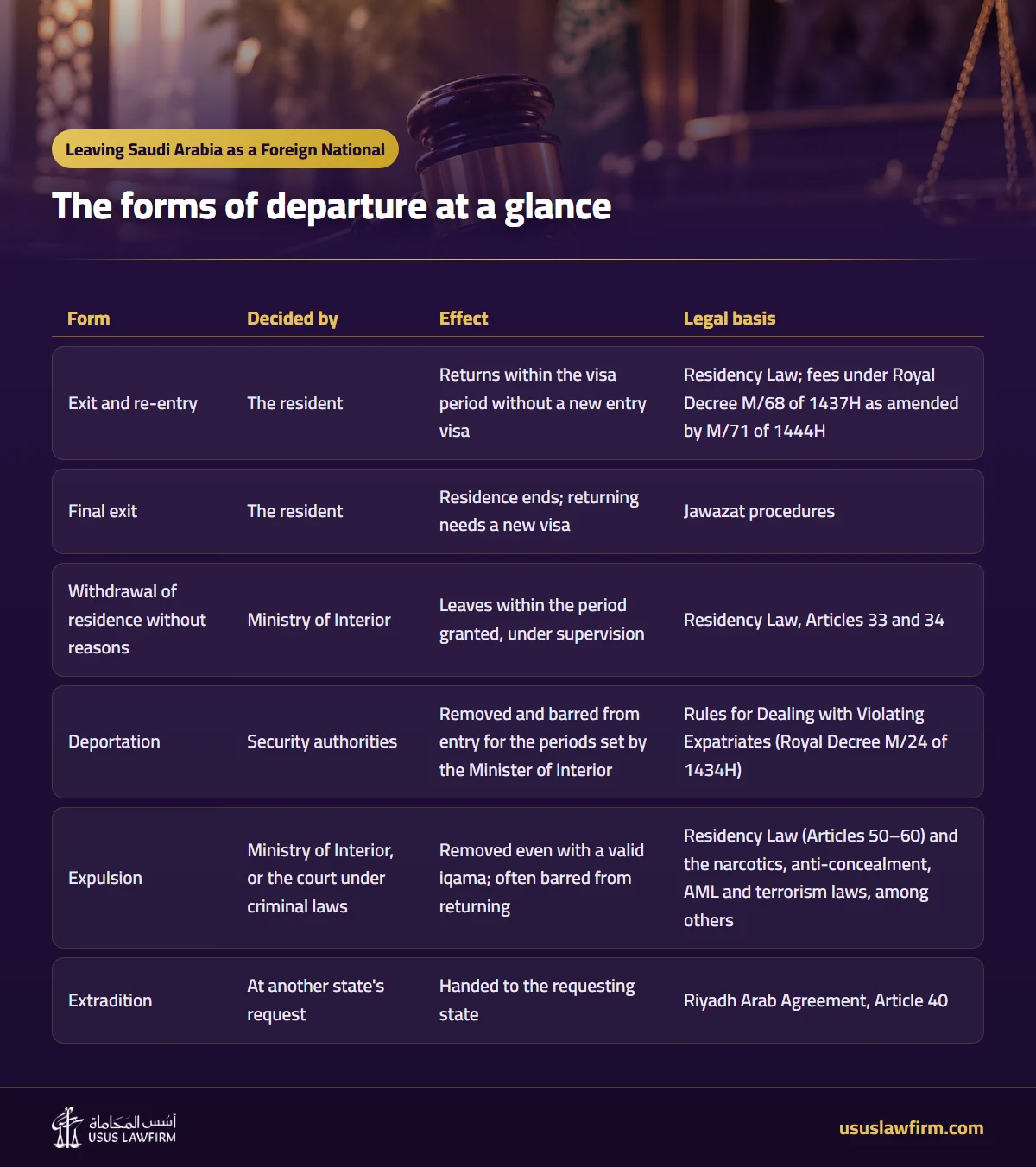
The forms of departure at a glance
| Form | Decided by | Effect | Legal basis |
|---|---|---|---|
| Exit and re-entry | The resident | Returns within the visa period without a new entry visa | Residency Law; fees under Royal Decree M/68 of 1437H as amended by M/71 of 1444H |
| Final exit | The resident | Residence ends; returning needs a new visa | Jawazat procedures |
| Withdrawal of residence without reasons | Ministry of Interior | Leaves within the period granted, under supervision | Residency Law, Articles 33 and 34 |
| Deportation | Security authorities | Removed and barred from entry for the periods set by the Minister of Interior | Rules for Dealing with Violating Expatriates (Royal Decree M/24 of 1434H) |
| Expulsion | Ministry of Interior, or the court under criminal laws | Removed even with a valid iqama; often barred from returning | Residency Law (Articles 50–60) and the narcotics, anti-concealment, AML and terrorism laws, among others |
| Extradition | At another state's request | Handed to the requesting state | Riyadh Arab Agreement, Article 40 |
Voluntary departure
Exit and re-entry: conditions and fees
The Residency Law allows a foreign resident to leave temporarily and return, for leave at home or any other purpose. The passport and the iqama must be valid, the visa period must fall within the remaining validity of the iqama, and the fee must be paid. The visa is requested electronically through Absher or Muqeem; a worker under the Labour Law may request it with notice to the employer (see the kafala system in Saudi Arabia).
Current fees are set by item 6 of Royal Decree M/68 of 6/11/1437H, as amended by Royal Decree M/71 of 1/6/1444H:
| Visa | Base fee | Each extra month, resident inside the Kingdom | Each extra month, resident outside the Kingdom |
|---|---|---|---|
| Single trip | SAR 200 for up to two months | SAR 100 | SAR 200 (doubled) |
| Multiple trips | SAR 500 for three months | SAR 200 | SAR 400 (doubled) |
The visa never runs beyond the validity of the iqama. The same decree added to Article 38 of the Residency Law that the iqamas of a worker's dependants and of domestic workers who are outside the Kingdom are renewed online at double the fee charged inside it (see iqama renewal and the late fine). In an employment relationship the employer pays the exit and re-entry fees (Labour Law, Article 40).
Cancelling the visa: a resident who obtains an exit and re-entry visa and then does not travel must cancel it before it expires, or pay SAR 1,000 the first time, SAR 2,000 the second and SAR 3,000 the third time and after; the fee is not refunded, as announced by the General Directorate of Passports (Jawazat).
Extending it from abroad: if the visa expires while the resident is abroad, the employer may extend it through Absher, provided the iqama is valid for the whole extension; the extra-month fee is doubled as shown above. After seven months abroad for a worker, or thirteen months for a wife and children, the request goes through the Saudi embassy, as announced by the General Directorate of Passports (Jawazat).
"Exited and did not return"
A resident who leaves on an exit and re-entry visa and does not return in time is automatically recorded as "exited and did not return" two months after the visa expires. The instructions published by Jawazat bar them from entering for three Hijri years from the expiry date, except on a new visa from the former employer; the ban does not extend to dependants. Press reports in January 2024 said the ban was lifted, but we found no published official announcement, so check with Jawazat before travelling. Domestic workers who do not return are removed from the employer's record six months after expiry, or by the employer through Absher after thirty days, as announced by the General Directorate of Passports (Jawazat).
Final exit
A resident may leave for good provided they owe nothing to the State or to anyone in the Kingdom and hand back the documents issued to them as a resident. The final exit visa requires an iqama valid for at least thirty days (otherwise it is renewed first), a valid passport, payment of registered traffic fines and no legal impediment such as a travel ban (see suspension of services and travel bans). It is free, issued through Absher, Absher Business or Muqeem, and valid for sixty days, or for the remaining iqama period if shorter; cancelling an expired, unused final exit visa costs SAR 1,000, as announced by the General Directorate of Passports (Jawazat). The employer pays the worker's ticket home when the relationship ends; the worker pays if unfit for work or leaving without a legitimate reason (Labour Law, Article 40). See final exit for expat workers.
Compulsory departure
Withdrawal of residence without stated reasons
Article 33 of the Residency Law: "The Ministry of Interior may withdraw from any foreigner the right of residence and its permit and direct them to leave the country whenever it sees fit, without stating reasons." Article 34: a foreigner deprived of residence and directed to leave may be given such period as the Ministry deems sufficient to wind up their ties with the country, during which they remain under supervision.
Deportation
Deportation targets mainly those who entered unlawfully or breached the residence and work rules: arriving without a valid passport or recognised travel document, entering without a visa or entry permit, being unable to provide a sponsor or the cost of return, failing the conditions for residence, pilgrims who enter unlawfully, seamen who overstay their shore leave, workers working for themselves or absent from work, overstayers on Hajj, Umrah, visit, tourism, medical or transit visas, and infiltrators.
The Rules for Dealing with Expatriates Violating the Regulations, issued by Royal Decree M/24 of 12/5/1434H (which also amended Article 39 of the Labour Law), provide that:
- A violator is deported at the employer's expense, unless the worker was absent and reported in time, in which case the person they were found working for pays. A self-employed violator pays, and the State pays if they cannot.
- A Hajj, Umrah or visit visa overstayer is deported at the expense of whoever employed them, themselves, the company or person who brought them, or the transporter or concealer.
- Every deported expatriate is barred from entering the Kingdom for the periods set by a regulation of the Minister of Interior. Violators are held in shelter centres until deported (see deportation centres in Saudi Arabia).
- Anyone who employs, shelters, transports or helps violators is also pursued (see penalty for transporting or sheltering violators); a sponsor who does not report a visitor's overstay is deemed to conceal them; employers who use violators may be barred from recruiting for up to five years; employers must report an absent worker within five days.
- Committees at Jawazat decide these violations; their decisions may be challenged before the Minister of Interior within thirty working days of notification.
Expulsion under the Residency Law
| Case | Penalty | Article |
|---|---|---|
| Unlawful entry, unless a political refugee or forced by necessity such as an emergency landing | Imprisonment until expelled | 50 |
| Breaching the obligations of Article 5 | Fine of SAR 100–200, or one week to one month in prison, or both; residence may be withdrawn and the person expelled | 53 |
| Working, paid or unpaid, without a work permit (Article 12) | Loss of residence and expulsion | 54 |
| Failing to renew a visa or iqama at least three days before expiry without excuse | Double fee, doubled again if repeated, expulsion the third time | 55 |
| Erasing or forging cards, permits or identity documents | Loss of residence and imprisonment until expelled | 59 |
| Obtaining residence, a visa or a work permit by forgery, fraud or bribery, or submitting false documents or statements | Up to one year in prison and a fine of up to SAR 15,000, or either; the non-Saudi is expelled | 60 |
The Ministry of Interior issues expulsion decisions. In principle the decision is personal and does not cover the spouse and children, though their residence usually depends on it. A ministerial decision of 14/4/1434H, not published in the Official Gazette, sets an undertaking for first minor cases, entry bans of three years for a first Residency Law violation and permanent bans in serious cases, and the settlement of the expatriate's rights within a month of the expulsion decision.
Expulsion under other laws
| Law | Article | Rule | Mandatory or discretionary |
|---|---|---|---|
| Narcotics Law | 56(2) | A non-Saudi is expelled after serving the sentence and not allowed back, except as Hajj and Umrah instructions permit | Mandatory |
| Anti-Concealment Law (M/4 of 1442H) | 11(2) | Conviction of a non-Saudi for a concealment offence entails expulsion and an entry ban after the judgment is executed and dues are paid | Mandatory |
| Anti-Money Laundering Law | 28(2) | Expelled after the sentence; entry only for Hajj or Umrah | Mandatory |
| Law on Combating Terrorism Crimes and Financing | 53(2) | A non-Saudi sentenced to prison is expelled after the sentence and not allowed back | Mandatory |
| Anti-Commercial Fraud Law (amended by M/109 of 1442H) | 23(2) | After a final conviction, the Ministry of Interior may expel and bar the non-Saudi | Discretionary |
| Traffic Law (amended by M/50 of 1447H) | 74(2) | After a final conviction for any violation that endangers public safety, the Ministry of Interior may expel and bar the non-Saudi | Discretionary |
| Domestic Pilgrims Service Law | 22(5) | Expulsion after settlement and the penalty, for unlicensed service or taking pilgrims' money by fraud | Mandatory |
See also drug penalties for foreigners and anti-concealment (tasattur).
Deportation and expulsion: the difference
Both fall on a foreign national, carry the meaning of a sanction and end in removal from the Kingdom. Deportation usually follows unlawful entry, a breach of residence or work rules, or an overstay, under the violators rules. Expulsion usually falls on someone whose residence is lawful but who did something that calls for removal, or follows a criminal conviction as an ancillary penalty (narcotics, concealment, money laundering, terrorism), or is a discretionary measure for the Ministry (traffic, commercial fraud).
Extradition
Under Article 40 of the Riyadh Arab Agreement, extradition is mandatory for a person accused of an act punishable in both states by one year's imprisonment or more, and for a person sentenced, in person or in absentia, to one year or more for an act punishable in the requested state. It is also mandatory where the act is not punishable in the requested state if the person is a national of the requesting state or of another party applying the same penalty. Political offences, purely military offences and offences committed in the requested state are excluded (Article 41).
Frequently asked questions
What is the difference between deportation and expulsion in Saudi Arabia?
Deportation mostly follows unlawful entry, breaches of residence and work rules or overstays, under the violators rules. Expulsion can hit a lawful resident, by Ministry of Interior decision or as an ancillary penalty after a criminal sentence.
Can Saudi Arabia cancel an iqama without giving a reason?
Yes. Article 33 of the Residency Law lets the Ministry of Interior withdraw residence and order departure without stating reasons; Article 34 allows a period to wind up one's affairs, under supervision.
Is a deported expatriate banned from returning?
Yes. Every deported expatriate is barred from entry for the periods set by a regulation of the Minister of Interior. After expulsion, the length of the ban depends on its basis.
How much does it cost to extend an exit and re-entry visa from abroad?
The extra month is doubled when the resident is outside the Kingdom: SAR 200 for a single-trip visa and SAR 400 for a multiple-trip visa (Royal Decree M/71 of 1444H).
Is a foreigner convicted in a drug case expelled?
Yes. Article 56(2) of the Narcotics Law expels the non-Saudi after the sentence and bars return, except as Hajj and Umrah instructions allow.
Facing deportation or expulsion?
Usus Law Firm (Riyadh and Tabuk) acts for residents before the criminal courts and the competent committees: we check the legal basis and length of the measure, file the grievance on time and follow up the settlement of rights before departure. Request your consultation now; fees are explained in writing before any commitment. See criminal cases.
General information from the Residency Law, the laws cited and Jawazat announcements, not advice on a specific case. Fees and procedures change; check Absher before travelling.
Legal review: the Usus Law Firm team
A select team of lawyers and legal advisers licensed by the Saudi Ministry of Justice, working from Riyadh and Tabuk, with experience before the general, commercial, labor, criminal, personal status and administrative courts. Every article is reviewed before publication and updated when laws or regulations change.
Last reviewed: 28 November 2026
This article is general legal information and is not a substitute for advice on your specific case. Court proceedings in Saudi Arabia are in Arabic; the official Arabic text of each law prevails.
Request a quick consultation
Leave your name and mobile number, and a lawyer from our Riyadh or Tabuk office will call you during working hours. We advise in English.