


Drug penalties for foreigners in Saudi Arabia are the same as for Saudis: use under Article 41, possession under Article 39, dealing under Article 38 and smuggling under Article 37 of the Narcotics Law. The big difference is one consequence: deportation. Article 56 provides that a non-Saudi convicted of a drug offence is deported after serving the sentence and may not return, except as Hajj and Umrah rules allow. Here is what that means for a resident, his family and his employer.

Reviewed by: Ahmad Farag Al-Sayed MuhammadHead of the Criminal Department at USUS Law FirmLast updated:
Facing a criminal case, or is a relative detained?
Tell us what you know: the charge, the date of arrest and who summoned you. A lawyer from our team will reply.
WhatsApp a lawyerCall RiyadhCall Tabuk
What you send us is confidential and used only to study your case.
Service page: Drug lawyer in Riyadh
Penalties for residents
| Offence | Article | Basic penalty |
|---|---|---|
| Use, or possession for personal use | Art. 41 | 6 months to 2 years in prison |
| Possession or transport with no intent to deal or use | Art. 39 | 2 to 5 years, up to 50 lashes each time, fine SAR 3,000–30,000 |
| Possession, sale or purchase with intent to deal | Art. 38 | 5 to 15 years, up to 50 lashes each time, fine SAR 1,000–50,000 |
| Smuggling, importing, manufacturing; dealing a second time | Art. 37 | Death as ta'zir; the court may instead impose at least 15 years and a fine of at least SAR 100,000 |
The same relief applies to residents: closing the case for a first-time user aged 20 or under (Article 42), treatment instead of punishment (Article 43), and a reduced or suspended sentence for a non-repeat offender (Article 60).
Deportation: when and how
- After conviction and sentence: deportation after serving the sentence, with no return except as Hajj and Umrah rules allow (Article 56).
- Arriving for Hajj or Umrah: the Minister may settle for deporting an addict who arrived on a Hajj or Umrah visa carrying no more than his personal need (Article 47).
- With money laundering: the Anti-Money Laundering Law also deports a non-Saudi after serving the sentence (its Article 28).
So deportation is not something a lawyer negotiates away after the judgment; it follows from a conviction. The real way to avoid it is the defence in the case itself: acquittal, closure, or a lighter classification before judgment.
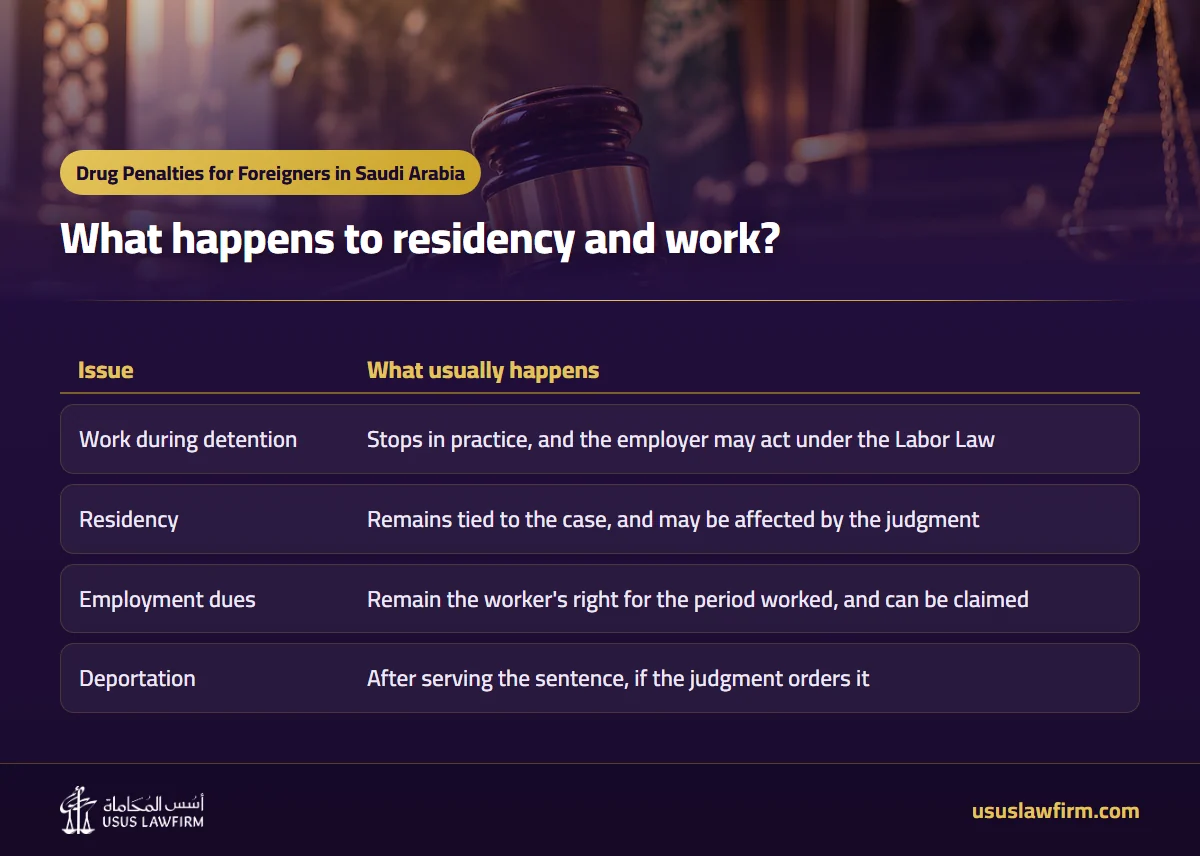
Residency and work
| Issue | What usually happens |
|---|---|
| Work during detention | Stops in practice; the employer may act under the Labour Law |
| End-of-service and wages | Remain the worker's right for the period worked |
| Absconding report | May be filed if the employer is not told about the detention. See absconding report |
| Deportation | After serving the sentence, if convicted (Article 56) |
Rights of a foreign suspect
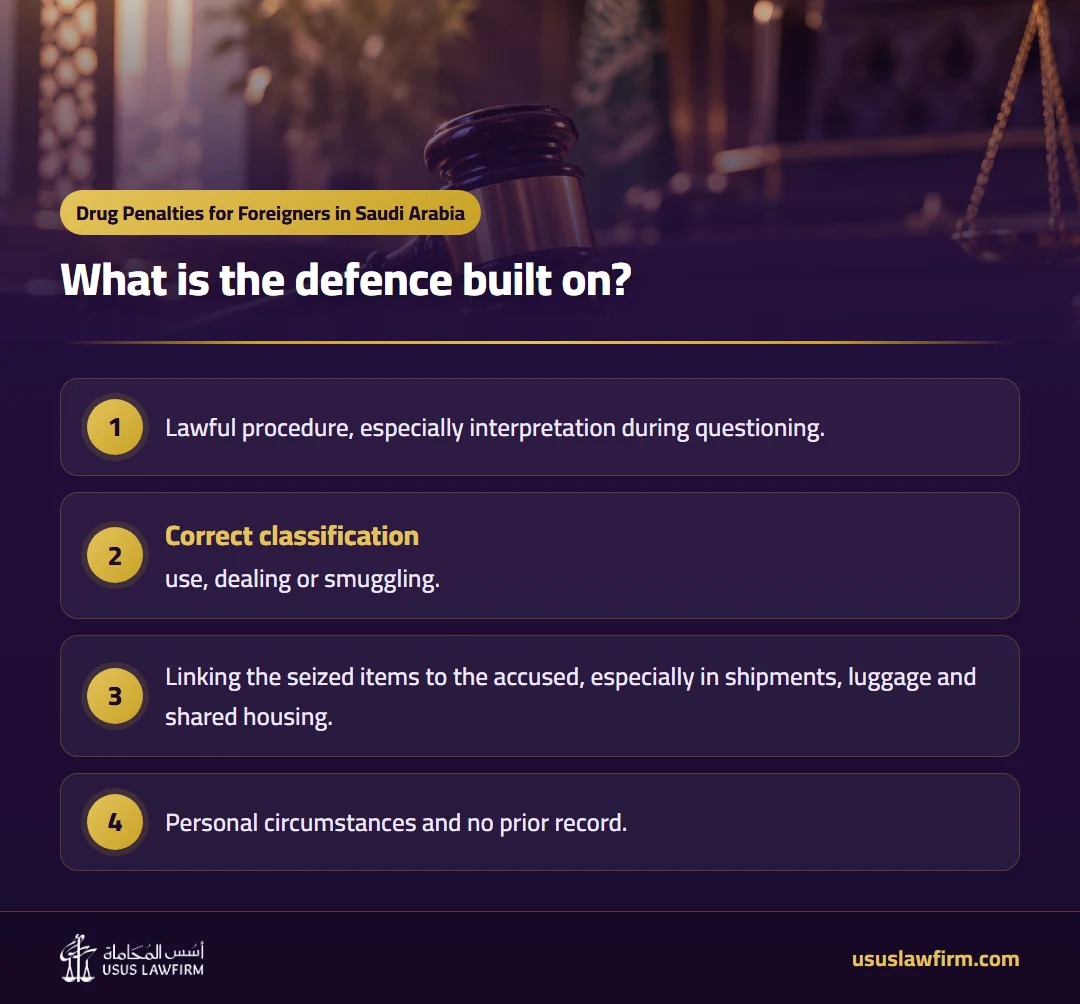
- All rights in the Criminal Procedure Law apply equally: a lawyer (Art. 4), knowing the charge (Art. 101), and contacting someone of his choice after arrest (Art. 116).
- Translation: a person who does not read Arabic should have his statements and what is read to him translated before signing.
- The embassy or consulate is informed under the procedures followed.
Frequently asked questions
Will a resident be deported for drug use?
If convicted of a drug offence, a non-Saudi is deported after serving the sentence (Article 56). If the investigation is closed under Article 42, there is no conviction.
Are drug penalties harsher for foreigners?
The penalty is the same by offence; the difference is deportation for non-Saudis and a travel ban for Saudis after the sentence (Article 56).
What about a pilgrim carrying drugs for personal use?
The Minister may settle for deporting an addict who arrived on a Hajj or Umrah visa with no more than personal need (Article 47).
Can a foreign suspect have a lawyer?
Yes. Every accused has the right to a lawyer during investigation and trial (Article 4 of the Criminal Procedure Law).
A resident facing a drug case?
Usus Law Firm handles drug cases for residents and Saudis, in English and Arabic, and keeps the family and employer informed confidentially. See drug lawyer in Riyadh.
Articles cited are from the Law of Combating Narcotics and Psychotropic Substances (Royal Decree M/39 of 8/7/1426H) and the Law of Criminal Procedure (Royal Decree M/2 of 22/1/1435H). Always check the current official text.
Legal review: the Usus Law Firm team
A select team of lawyers and legal advisers licensed by the Saudi Ministry of Justice, working from Riyadh and Tabuk, with experience before the general, commercial, labor, criminal, personal status and administrative courts. Every article is reviewed before publication and updated when laws or regulations change.
Last reviewed: 19 October 2026
This article is general legal information and is not a substitute for advice on your specific case. Court proceedings in Saudi Arabia are in Arabic; the official Arabic text of each law prevails.
Request a quick consultation
Leave your name and mobile number, and a lawyer from our Riyadh or Tabuk office will call you during working hours. We advise in English.