

The Personal Status Court (محكمة الأحوال الشخصية) is the court that handles family cases in Saudi Arabia: marriage, divorce and khula (divorce at the wife's request), custody, maintenance and visitation, proof of parentage, guardianship and custodianship, and identifying heirs and dividing estates. If your case is within the family, this is most likely your court. This article explains what the court hears, how to file a case, what to expect at hearings, and how its judgments are enforced.

Reviewed by: Raghad Mamdouh Al-KhamshiLegal Affairs Manager at Usus Law FirmLast updated:
What cases does the Personal Status Court hear?
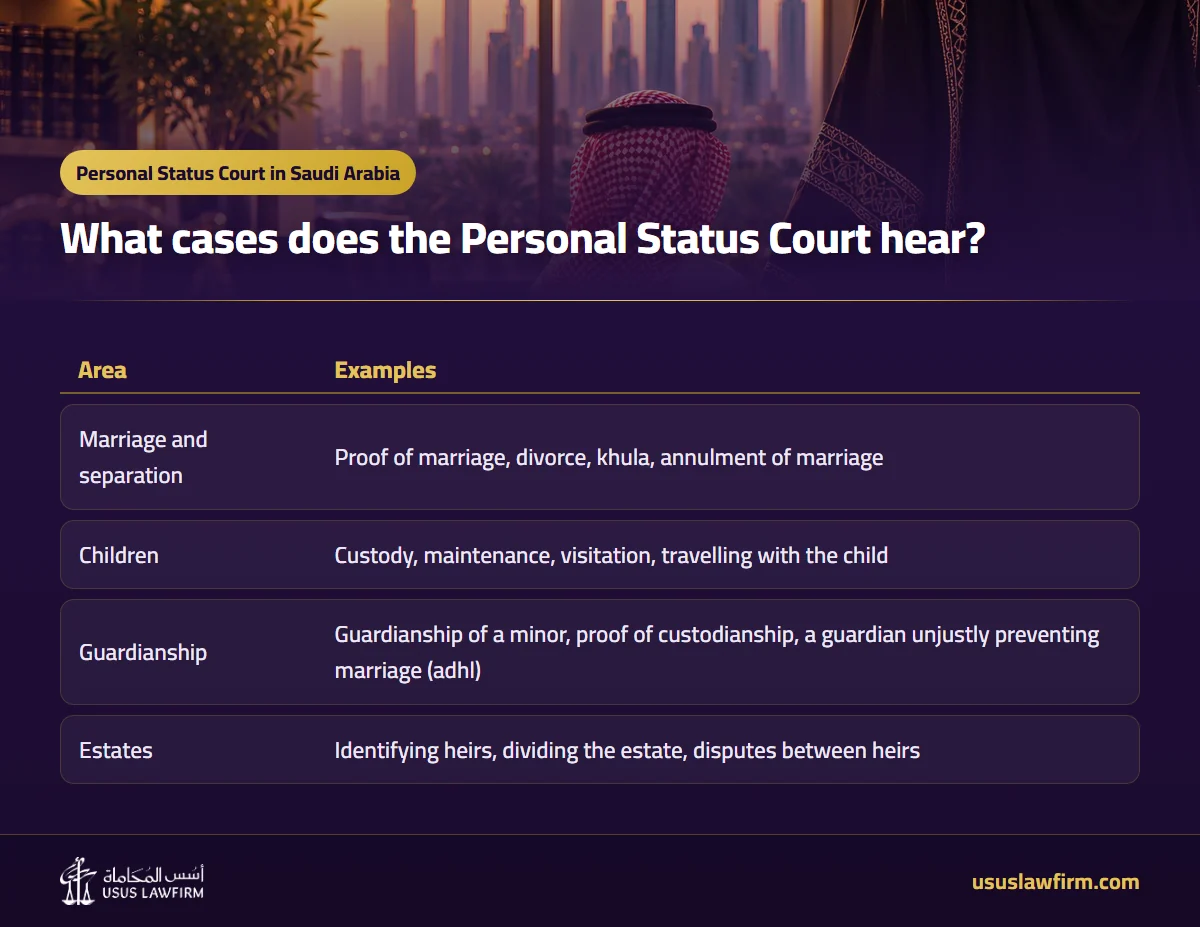
| Area | Examples | Read |
|---|---|---|
| Marriage and separation | Proof of marriage, divorce, khula, annulment of marriage | Khula: conditions and steps |
| Children | Custody, maintenance, visitation, travelling with the child | Custody and maintenance after divorce |
| Guardianship | Guardianship of a minor, proof of custodianship, a guardian unjustly preventing marriage (adhl) | The Personal Status Law |
| Estates | Identifying heirs, dividing the estate, disputes between heirs | Identifying heirs and dividing an estate |
In cities without a separate Personal Status Court, these cases are heard by the personal status circuits of the General Court. If you aren't sure which body is competent, read which court handles my case?
How do you file a case at the Personal Status Court?
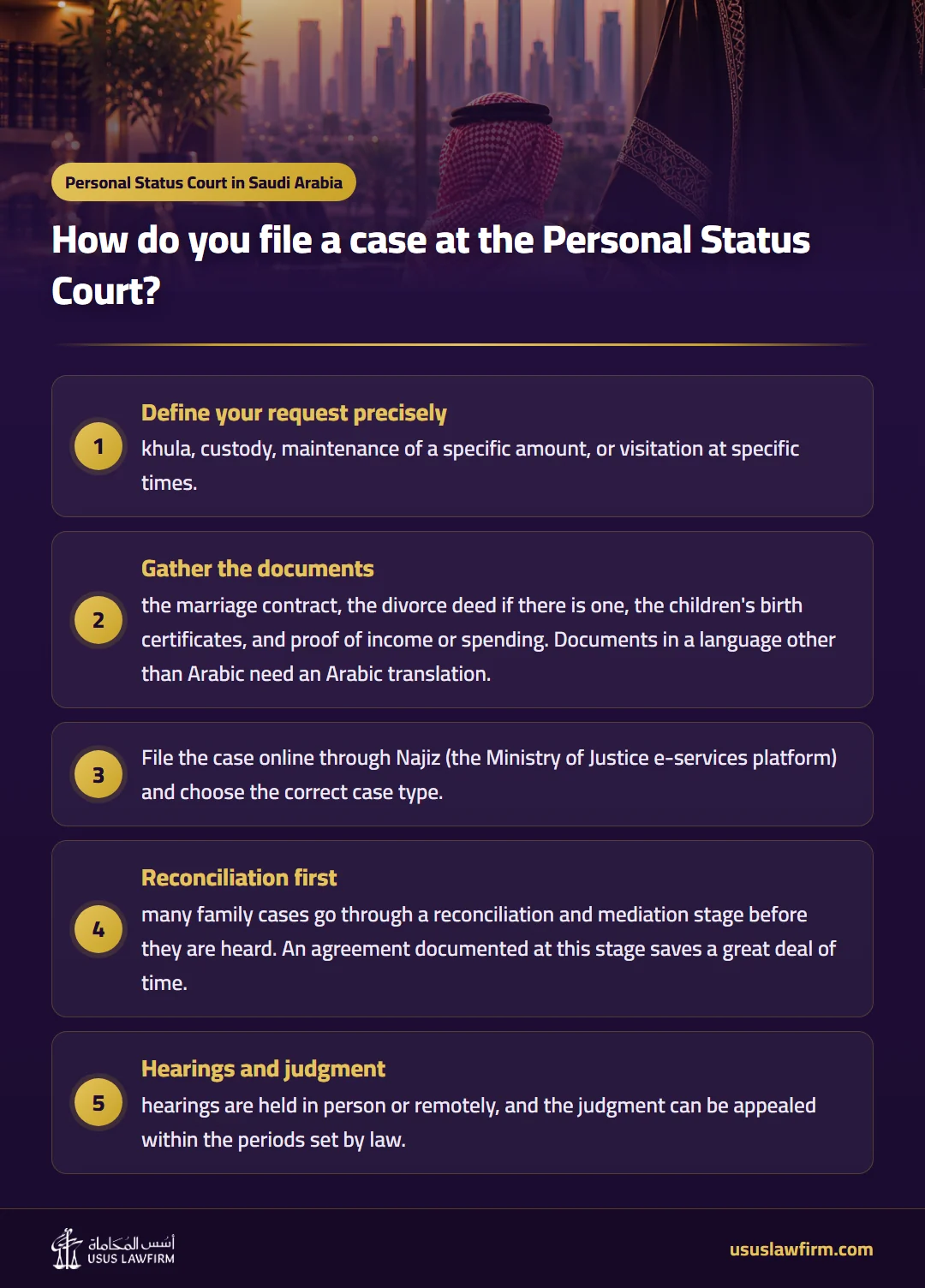
- Define your request precisely: khula, custody, maintenance of a specific amount, or visitation at specific times.
- Gather the documents: the marriage contract, the divorce deed if there is one, the children's birth certificates, and proof of income or spending. Documents in a language other than Arabic need an Arabic translation.
- File the case online through Najiz (the Ministry of Justice e-services platform) and choose the correct case type. Read filing a case on Najiz.
- Reconciliation first: many family cases go through a reconciliation and mediation stage before they are heard. An agreement documented at this stage saves a great deal of time.
- Hearings and judgment: hearings are held in person or remotely, and the judgment can be appealed within the periods set by law.
Proceedings are conducted in Arabic. If you don't speak Arabic, a lawyer can represent you and explain each step in English.
What makes personal status cases different?
- The child's interest comes first: in custody and visitation, the court looks at the child's best interest before either parent's wishes.
- Speed in urgent matters: matters such as interim maintenance and visitation have requests that can be heard before the main case is decided.
- Privacy: family cases are sensitive, and a woman may have her case handled by a female lawyer if she prefers. Read female lawyer at Usus Law Firm.
Enforcing personal status judgments
If the other party doesn't comply with the judgment, for example by falling behind on maintenance or preventing visits, enforcement is requested from the Enforcement Court. The party who refuses may face measures such as suspension of government services. Read the Enforcement Court and suspension of services and travel bans.
What the Personal Status Court hears
Article 33 of the Law of Procedure gives it marriage, divorce, khula, annulment, custody, maintenance and visitation; proof of endowment, wills, lineage, death and heirs; inheritance and estate division where there is a dispute or a minor; and guardians and trustees. Where no specialised court exists, the general court hears these cases (Art. 32).
Filing at the Personal Status Court
A claim normally goes to the defendant's court (Art. 36), but in marital, custody and visitation matters a woman may file in her own town (Art. 39). The objection period is 30 days, or 10 in urgent matters (Art. 187). Judgments on maintenance, seeing a child or handing a child to the custodian carry accelerated enforcement (Art. 169).
Frequently asked questions
Do I have to attend the hearings in person?
A lawyer holding a power of attorney can represent you at most hearings, but the court may ask you to attend for some matters, such as reconciliation or hearing your statement.
Can I file the case in my city if my husband lives in another city?
For some family cases, the law gives the woman and the custodian options as to where the case is filed. This depends on the type of case.
How long does a personal status case take?
It varies with the type of case, whether the documents are complete, and how the other party responds. Cases that are well prepared from the start, with clear requests, are usually faster.
Is your case before the Personal Status Court?
The Usus Law Firm team, including a female lawyer for women's and family cases, handles personal status cases in full confidence, in Riyadh and Tabuk. You can start with your question through the inquiries centre.
Legal review: the Usus Law Firm team
A select team of lawyers and legal advisers licensed by the Saudi Ministry of Justice, working from Riyadh and Tabuk, with experience before the general, commercial, labor, criminal, personal status and administrative courts. Every article is reviewed before publication and updated when laws or regulations change.
Last reviewed: 4 November 2026
This article is general legal information and is not a substitute for advice on your specific case. Court proceedings in Saudi Arabia are in Arabic; the official Arabic text of each law prevails.
Request a quick consultation
Leave your name and mobile number, and a lawyer from our Riyadh or Tabuk office will call you during working hours. We advise in English.