

The Enforcement Court (محكمة التنفيذ) is the judicial body that turns a right on paper into money in the creditor's hands. If you hold a court judgment, a promissory note, a cheque or a registered lease and the debtor has not paid, you don't need a new lawsuit to prove your right. You file an enforcement application instead. This is governed by the Enforcement Law (نظام التنفيذ) and its regulations. This guide explains what can be enforced, the steps of an enforcement application, what happens to the debtor, and how a debtor can defend themselves.
What are enforceable instruments?
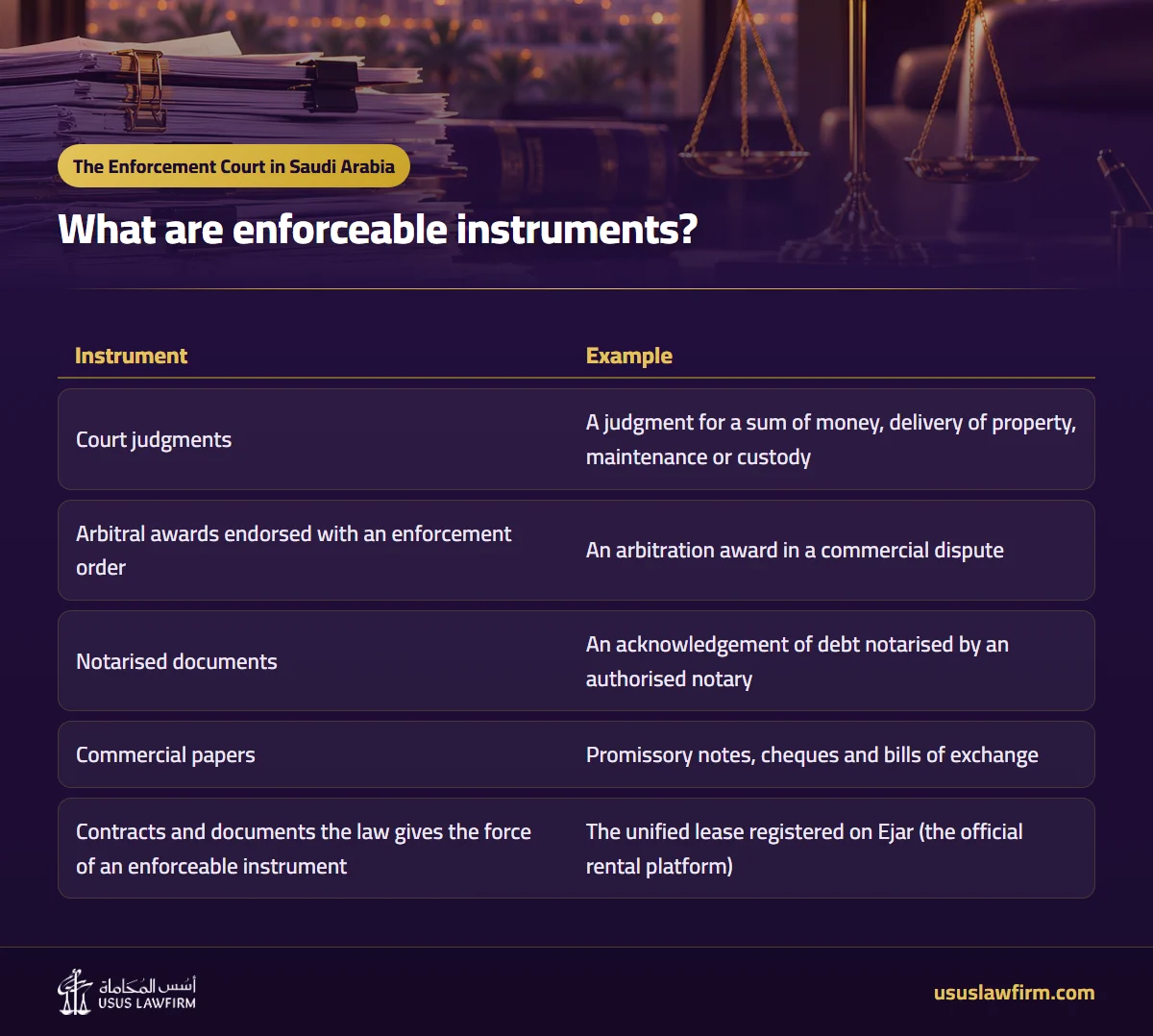
Enforcement only proceeds on the basis of an enforceable instrument. The best-known instruments set out in the law include:
| Instrument | Example |
|---|---|
| Court judgments | A judgment for a sum of money, delivery of property, maintenance or custody |
| Arbitral awards endorsed with an enforcement order | An arbitration award in a commercial dispute |
| Notarised documents | An acknowledgement of debt notarised by an authorised notary |
| Commercial papers | Promissory notes, cheques and bills of exchange |
| Contracts and documents the law gives the force of an enforceable instrument | The unified lease registered on Ejar (the official rental platform) |
If you don't have an enforceable instrument, for example your right is supported only by invoices or messages, the route starts with a lawsuit before the competent court, and the judgment is enforced once issued.
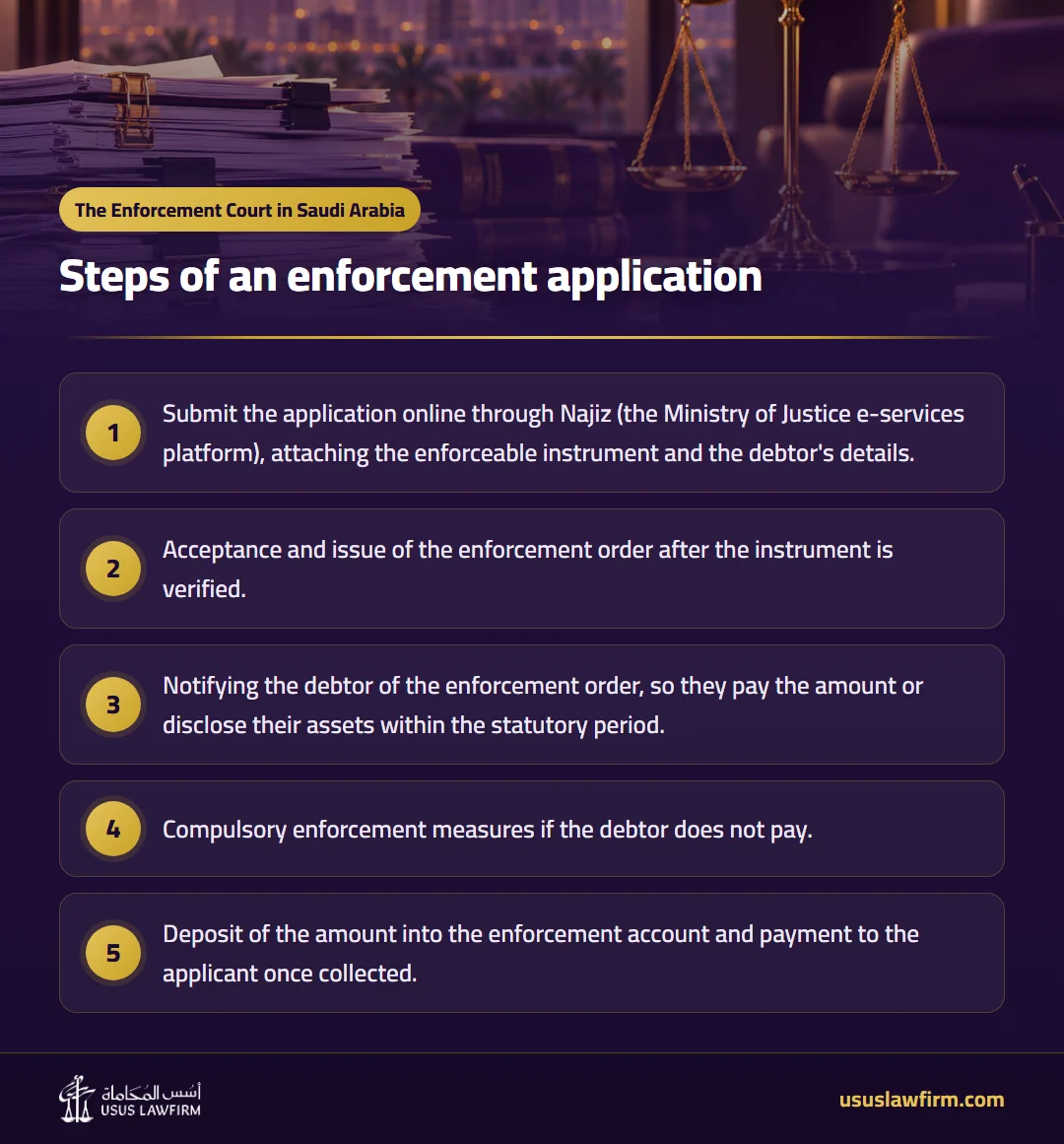
Steps of an enforcement application
- Submit the application online through Najiz (the Ministry of Justice e-services platform), attaching the enforceable instrument and the debtor's details.
- Acceptance and issue of the enforcement order after the instrument is verified.
- Notifying the debtor of the enforcement order, so they pay the amount or disclose their assets within the statutory period.
- Compulsory enforcement measures if the debtor does not pay.
- Deposit of the amount into the enforcement account and payment to the applicant once collected.
What happens to a debtor who doesn't pay?
The Enforcement Law allows the enforcement judge to take escalating measures against a debtor who refuses to pay, including:
- Seizing their assets and bank accounts, and enforcing against enough of them to settle the debt.
- Suspending government services and financial transactions.
- A travel ban.
- Disclosure of their assets and those of anyone suspected of helping hide them.
- Stopping them from issuing powers of attorney.
- Notifying credit information bodies of the failure to pay.
These measures are lifted on payment, on a settlement with the applicant, or by decision of the enforcement judge.
If enforcement is against you: what are your options?
- Payment or settlement: the fastest way to lift the measures. An instalment arrangement approved by the enforcement judge can be agreed.
- Enforcement dispute: if you have a legal ground, such as earlier payment, an invalid instrument, or the debt not yet being due.
- Insolvency claim: if you genuinely cannot pay. An insolvent debtor is treated under special rules that differ from those for a debtor who simply delays.
The earlier a debtor acts, the more options they have and the less the measures affect their life and work.
Enforcement before the Board of Grievances
If the enforceable instrument is a judgment of the Board of Grievances (ديوان المظالم, the administrative judiciary), or enforcement is against a government body, special procedures apply before the enforcement circuits of the administrative courts. Some of their rules differ from enforcement before the general enforcement courts.
The Enforcement Court in Riyadh and other cities
An enforcement request is filed electronically on Najiz wherever you are, then referred to the competent enforcement body: a standalone Enforcement Court in cities that have one, such as Riyadh, or an enforcement circuit of the competent court elsewhere. Territorial jurisdiction usually follows where the debtor or their assets are. Check the latest official text on jurisdiction.
- Before filing: prepare the enforceable instrument (final judgment, cheque, promissory note, registered lease) and the debtor's details.
- After filing: the debtor is notified and given time, then enforcement measures follow if they do not pay.
- If the debtor is a government body: the route is different; see administrative enforcement.
Frequently asked questions
How long does enforcement take?
It depends on the type of instrument, the debtor's situation and whether they have assets. Identifying the debtor's assets and details accurately in the application saves a lot of time.
Do I need a lawyer to file an enforcement application?
You can file it yourself through Najiz. A lawyer helps with large amounts, multiple debtors, responding to enforcement disputes, and tracing the debtor's assets. Najiz and the proceedings are in Arabic, which is a practical reason many expatriates instruct a lawyer.
Can a foreign judgment be enforced in Saudi Arabia?
Yes, under conditions set out in the Enforcement Law, including reciprocity and that the judgment does not conflict with public order.
Need an enforcement lawyer?
The Usus Law Firm team handles enforcement and suspension of services for applicants and debtors: filing applications, following up seizures and collection, enforcement disputes and settlements, in Riyadh and Tabuk.
Read also: The Law of Procedure before Sharia Courts explained.
Read also: Amicable settlement and the settlement deed.
Read also: Suspension of services and travel bans.
Read also: Legal notice template before enforcement.
This article is general legal information and is not a substitute for advice on your specific case. Court proceedings in Saudi Arabia are in Arabic; the official Arabic text of each law prevails.
Request a quick consultation
Leave your name and mobile number, and a lawyer from our Riyadh or Tabuk office will call you during working hours. We advise in English.

