

If a wife is being harmed by continuing the marriage and the husband will not divorce her, she has two main routes: khula (خلع), in return for compensation she pays, or annulment of the marriage contract (faskh, فسخ عقد الزواج) by a judge's ruling, for a reason the law allows and, in principle, without compensation. The difference between them in financial rights is significant. Here we explain what faskh is, its grounds, how the claim is filed, and what you need to prove.
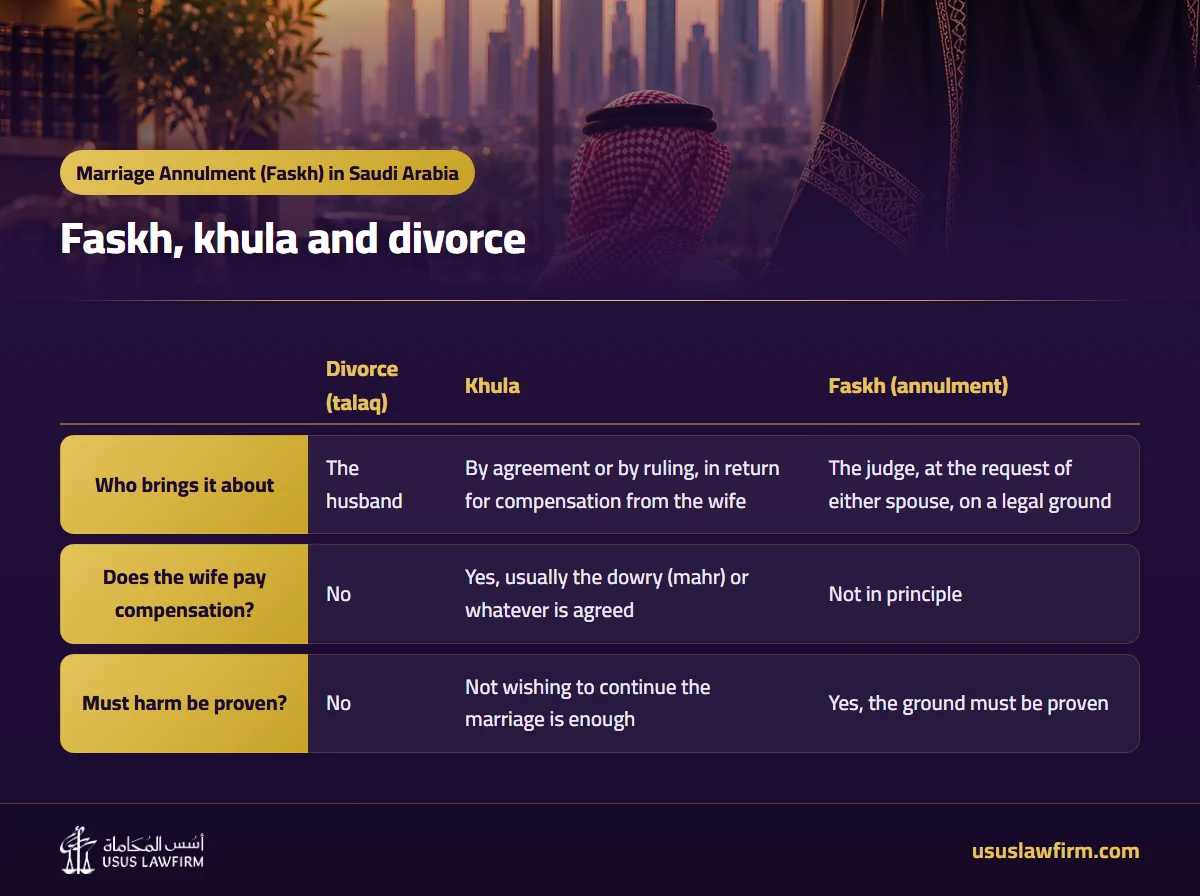
Faskh, khula and divorce
| Divorce (talaq) | Khula | Faskh (annulment) | |
|---|---|---|---|
| Who brings it about | The husband | By agreement or by ruling, in return for compensation from the wife | The judge, at the request of either spouse, on a legal ground |
| Does the wife pay compensation? | No | Yes, usually the dowry (mahr) or whatever is agreed | Not in principle |
| Must harm be proven? | No | Not wishing to continue the marriage is enough | Yes, the ground must be proven |
Read Khula: conditions and steps.
Grounds for annulment of marriage
The Personal Status Law sets out grounds on which faskh may be requested, including:
- Harm that makes continued married life impossible, such as abuse or humiliation.
- Failure to provide financial support (nafaqa), whether or not the husband is able to, as detailed in the law.
- Absence, desertion or imprisonment for a period set by the law.
- A defect or illness that prevents the purposes of marriage being fulfilled or harms the other spouse.
- Breach of a condition stipulated in the marriage contract.
Each ground has its own conditions and periods in the law, so check the current official text or consult a lawyer before filing the claim.
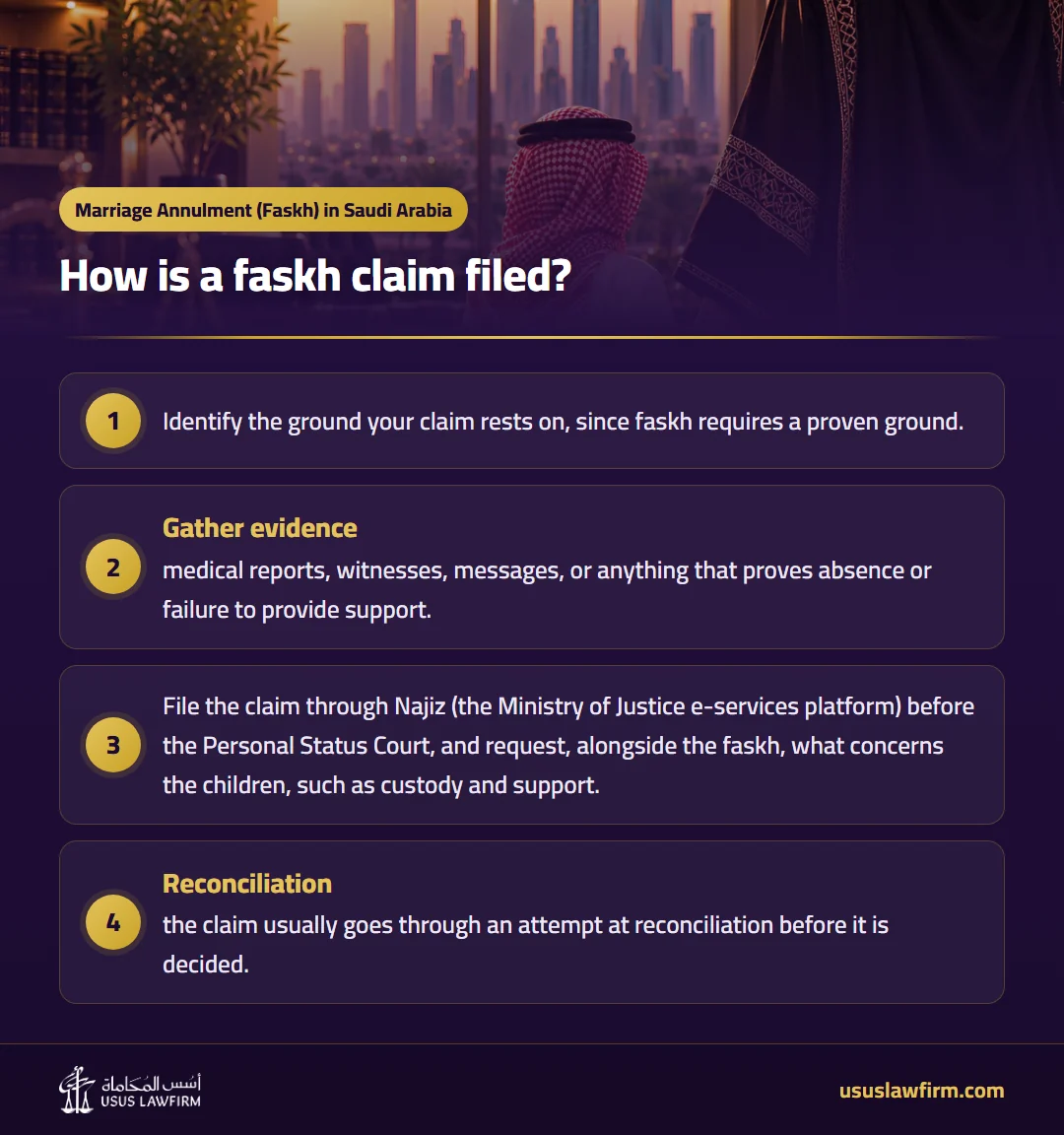
How is a faskh claim filed?
- Identify the ground your claim rests on, since faskh requires a proven ground.
- Gather evidence: medical reports, witnesses, messages, or anything that proves absence or failure to provide support.
- File the claim through Najiz (the Ministry of Justice e-services platform) before the Personal Status Court, and request, alongside the faskh, what concerns the children, such as custody and support.
- Reconciliation: the claim usually goes through an attempt at reconciliation before it is decided.
Proceedings are in Arabic, so documents and messages in other languages will need an Arabic translation. Our team can advise you in English.
Documents to prepare for a faskh claim
- The marriage contract or a copy, and both parties' IDs.
- Proof of the ground: medical reports, messages, witnesses, or proof of absence or non-maintenance.
- Children's birth records, since custody and maintenance are usually claimed in the same case.
- A statement of the dowry paid and deferred.
- Any earlier reconciliation attempts or reports related to harm.
Having these ready before filing shortens the hearings considerably.
Frequently asked questions
If I cannot prove harm, will I lose the case?
A faskh claim may be rejected if the ground is not proven, and khula remains available. That is why the best route for your situation should be assessed before filing.
Do I keep my dowry in a faskh?
The general rule in faskh for harm is that the wife does not have to return the dowry, unlike khula, with details depending on the ground and what the judgment decides.
Who gets custody of the children after faskh?
Custody is decided according to the child's best interests. Read Custody and child support after divorce.
Considering faskh or khula?
A female lawyer from the Usus Law Firm team handles women's and family cases in complete confidence, as part of our personal status cases practice, in Riyadh and Tabuk. Read about Usus's women lawyers.
This article is general legal information and is not a substitute for advice on your specific case. Court proceedings in Saudi Arabia are in Arabic; the official Arabic text of each law prevails.
Request a quick consultation
Leave your name and mobile number, and a lawyer from our Riyadh or Tabuk office will call you during working hours. We advise in English.