


If you are a civilian government employee, your rights and duties are not governed by the Labor Law but by the civil service laws and regulations, most importantly the Human Resources Regulations in the Civil Service. These regulate appointment, promotion, transfer, leave, appraisal and the end of service. Here is what matters most to an employee, and how to file a grievance if treated unfairly.
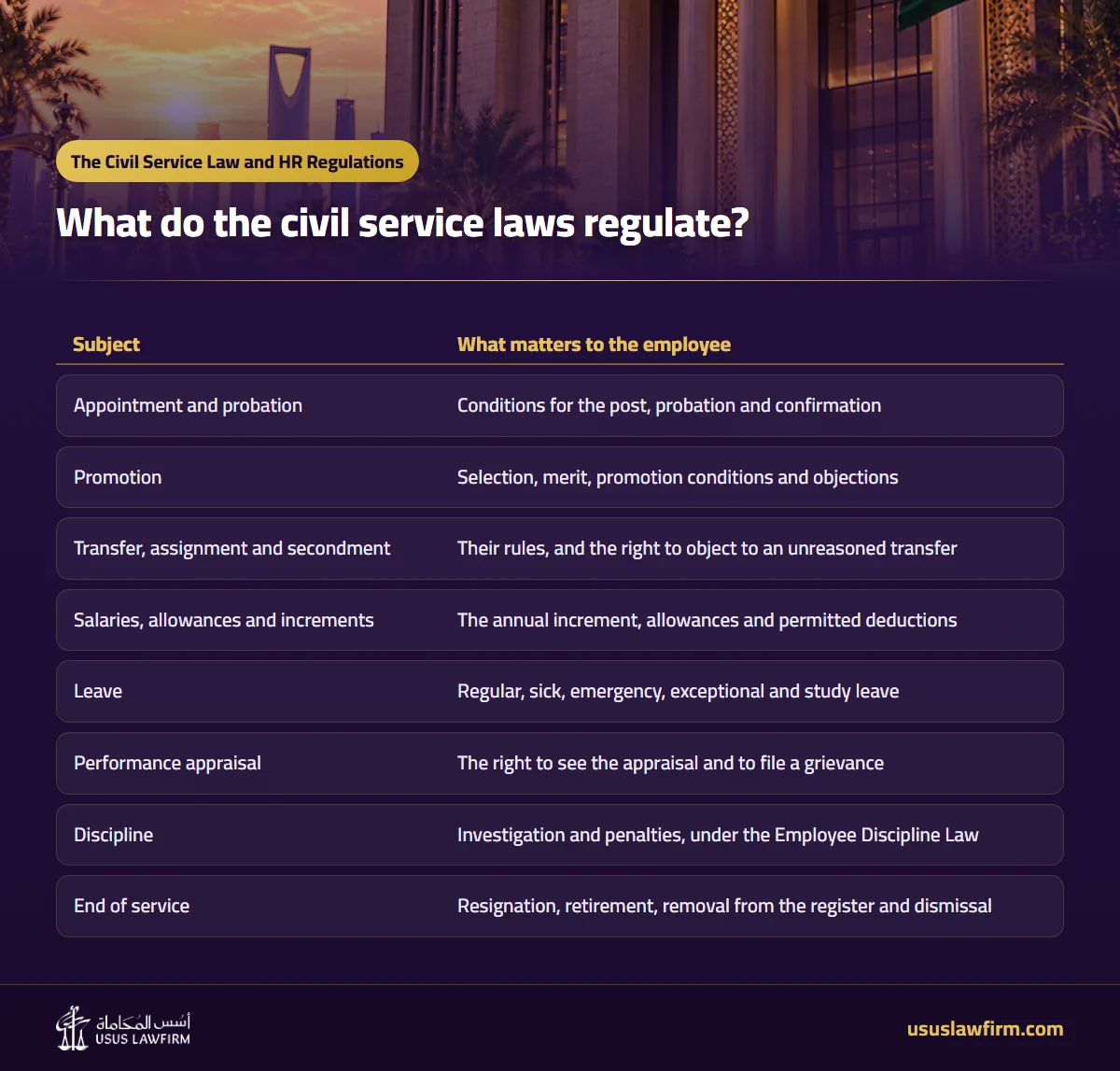
What do the civil service laws regulate?
| Subject | What matters to the employee |
|---|---|
| Appointment and probation | Conditions for the post, probation and confirmation |
| Promotion | Selection, merit, promotion conditions and objections |
| Transfer, assignment and secondment | Their rules, and the right to object to an unreasoned transfer |
| Salaries, allowances and increments | The annual increment, allowances and permitted deductions |
| Leave | Regular, sick, emergency, exceptional and study leave |
| Performance appraisal | The right to see the appraisal and to file a grievance |
| Discipline | Investigation and penalties, under the Employee Discipline Law |
| End of service | Resignation, retirement, removal from the register and dismissal |
The civil service laws have been updated repeatedly; check the current official text on the Ministry of Human Resources website before relying on any detailed rule.
Government sector and private sector
| Civilian government employee | Private-sector employee | |
|---|---|---|
| Governing law | The civil service laws and regulations | the Labor Law |
| First grievance body | The government body itself, then the Ministry of Human Resources | Amicable settlement |
| Competent court | The administrative courts of the Board of Grievances | The labor courts |
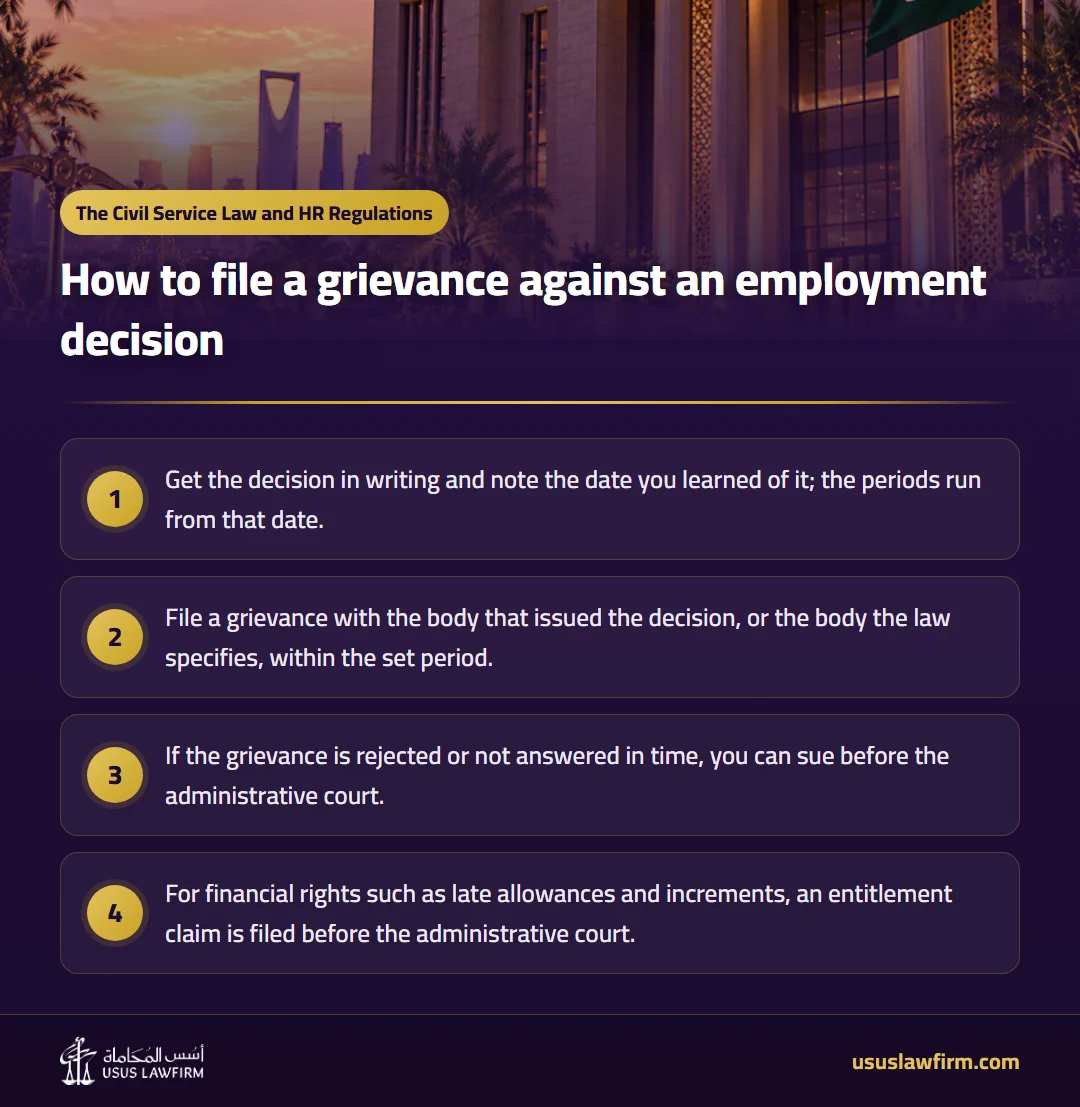
How to file a grievance against an employment decision
- Get the decision in writing and note the date you learned of it; the periods run from that date.
- File a grievance with the body that issued the decision, or the body the law specifies, within the set period.
- If the grievance is rejected or not answered in time, you can sue before the administrative court. Read the Law of Procedure before the Board of Grievances.
- For financial rights such as late allowances and increments, an entitlement claim is filed before the administrative court.
Read also grievances before the Board of Grievances.
Frequently asked questions
Does the Labor Law apply to government employees?
Not to civilian employees covered by the civil service laws, although some staff in government bodies are under the Labor Law depending on their contracts.
I was transferred to another city against my wishes. Can I object?
Yes, if the transfer broke the rules or had no justification, by grievance and then an administrative claim within the deadlines.
Allowances owed to me were not paid for years. Is my right lost?
Financial claims must be brought within set periods, so act quickly; check the current official text.
Treated unfairly by an employment decision?
The Usus Law Firm team handles administrative cases and employee rights before the Board of Grievances, in Riyadh and Tabuk.
Legal review: the Usus Law Firm team
A select team of lawyers and legal advisers licensed by the Saudi Ministry of Justice, working from Riyadh and Tabuk, with experience before the general, commercial, labor, criminal, personal status and administrative courts. Every article is reviewed before publication and updated when laws or regulations change.
Last reviewed: 12 October 2026
This article is general legal information and is not a substitute for advice on your specific case. Court proceedings in Saudi Arabia are in Arabic; the official Arabic text of each law prevails.
Request a quick consultation
Leave your name and mobile number, and a lawyer from our Riyadh or Tabuk office will call you during working hours. We advise in English.