

The Law of Evidence unified the rules of proof before the courts, and the Procedural Guides to the Law of Evidence followed to show judges and litigants how those rules work in practice: how digital evidence is submitted, when testimony is heard, how an expert is requested and when an oath is put. If your case rests on WhatsApp messages, emails or witnesses, these guides decide the fate of your evidence.
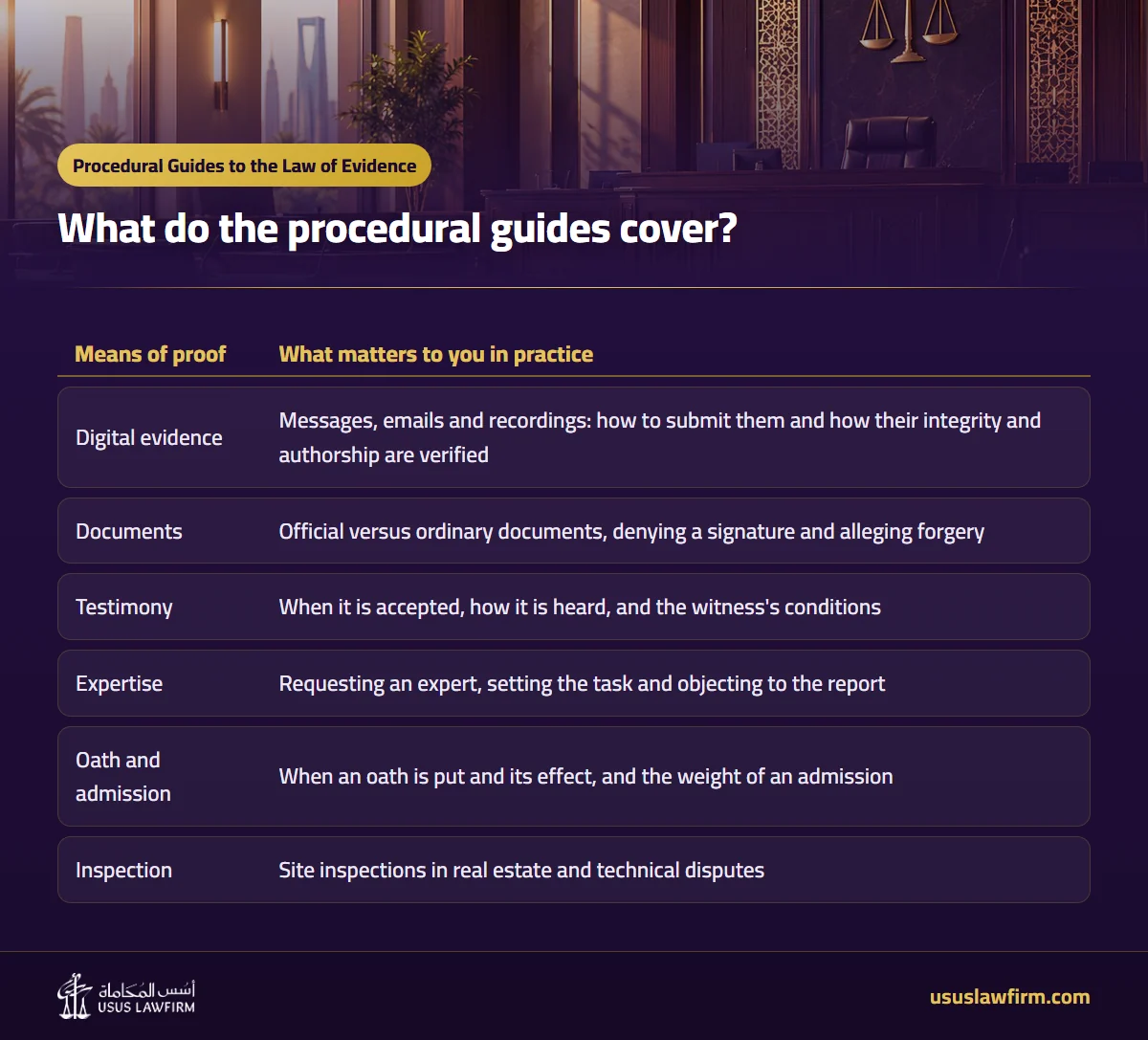
What do the procedural guides cover?
| Means of proof | What matters to you in practice |
|---|---|
| Digital evidence | Messages, emails and recordings: how to submit them and how their integrity and authorship are verified |
| Documents | Official versus ordinary documents, denying a signature and alleging forgery |
| Testimony | When it is accepted, how it is heard, and the witness's conditions |
| Expertise | Requesting an expert, setting the task and objecting to the report |
| Oath and admission | When an oath is put and its effect, and the weight of an admission |
| Inspection | Site inspections in real estate and technical disputes |
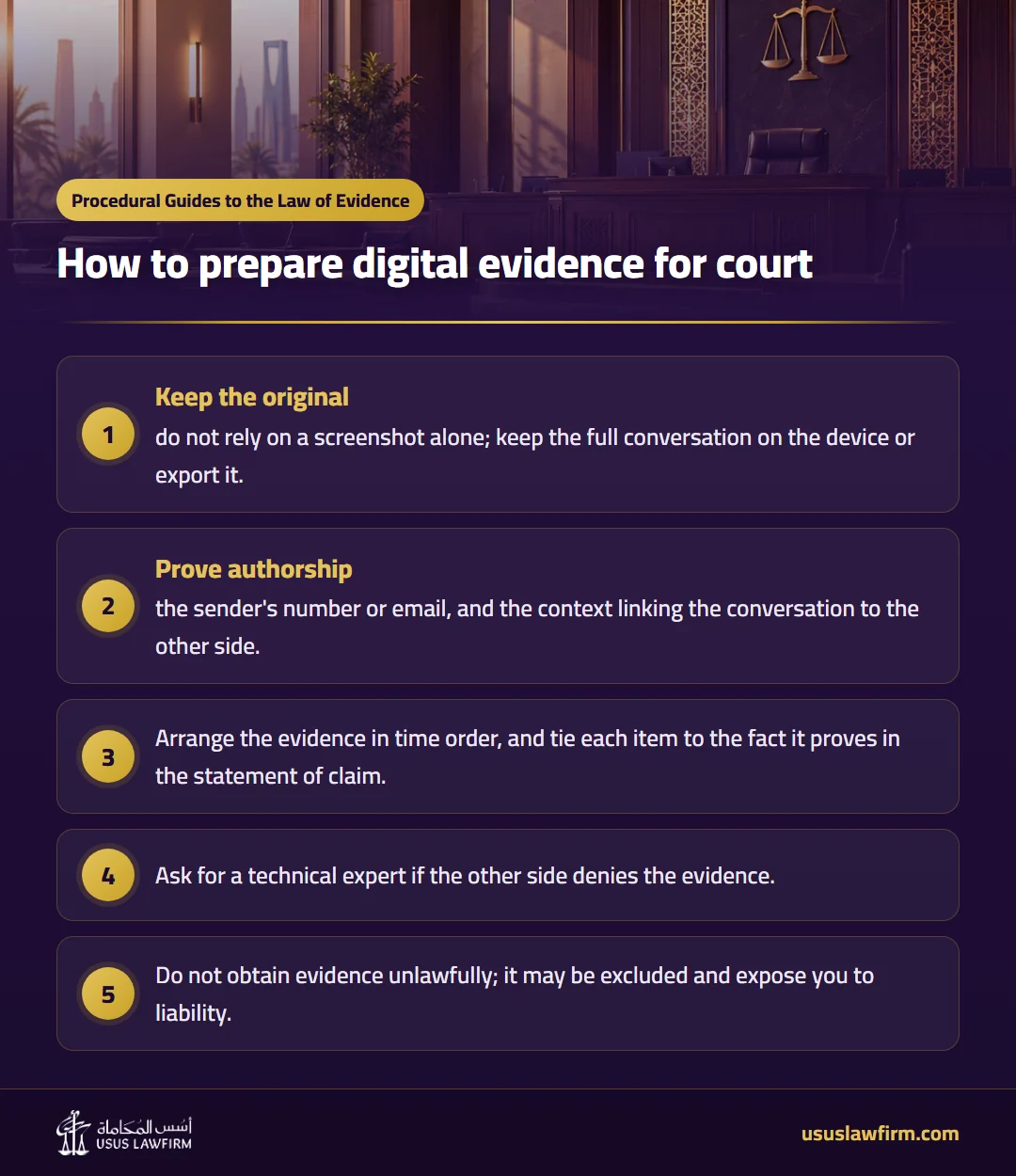
How to prepare digital evidence for court
- Keep the original: do not rely on a screenshot alone; keep the full conversation on the device or export it.
- Prove authorship: the sender's number or email, and the context linking the conversation to the other side.
- Arrange the evidence in time order, and tie each item to the fact it proves in the statement of claim.
- Ask for a technical expert if the other side denies the evidence.
- Do not obtain evidence unlawfully; it may be excluded and expose you to liability.
Common mistakes in proof
- Submitting cropped images of a conversation that lose its context.
- Relying on one witness for something that needs written proof.
- Staying silent on an adverse expert report instead of objecting within the period.
- Confusing what must be proved in writing with what can be proved by other means.
For the full rules read the Saudi Law of Evidence explained. Check the current official text of the procedural guides when applying them to your case.
Frequently asked questions
Are WhatsApp messages accepted as evidence?
Yes, digital evidence is a means of proof under the law; its weight depends on its integrity, authorship and context.
May I record a call without the other party knowing?
This is a sensitive matter that may expose you to liability, and the evidence may be excluded; consult a lawyer before relying on it.
Who pays the expert's fees?
The court decides; usually the party requesting the expert pays first, and the matter is settled with the judgment.
Does your case depend on evidence?
The Usus Law Firm team assesses your evidence and prepares it in the form the court accepts, in general court cases, in Riyadh and Tabuk.
Legal review: the Usus Law Firm team
A select team of lawyers and legal advisers licensed by the Saudi Ministry of Justice, working from Riyadh and Tabuk, with experience before the general, commercial, labor, criminal, personal status and administrative courts. Every article is reviewed before publication and updated when laws or regulations change.
Last reviewed: 12 October 2026
This article is general legal information and is not a substitute for advice on your specific case. Court proceedings in Saudi Arabia are in Arabic; the official Arabic text of each law prevails.
Request a quick consultation
Leave your name and mobile number, and a lawyer from our Riyadh or Tabuk office will call you during working hours. We advise in English.