


Sponsorship transfer, officially transfer of services today, is an expatriate worker moving from one employer to another inside the Kingdom. Since the Labour Reform Initiative, transfer is possible in set cases without the current employer's consent.

Reviewed by: Ahmed Hasan AlShehriAttorney at Usus Law FirmLast updated:
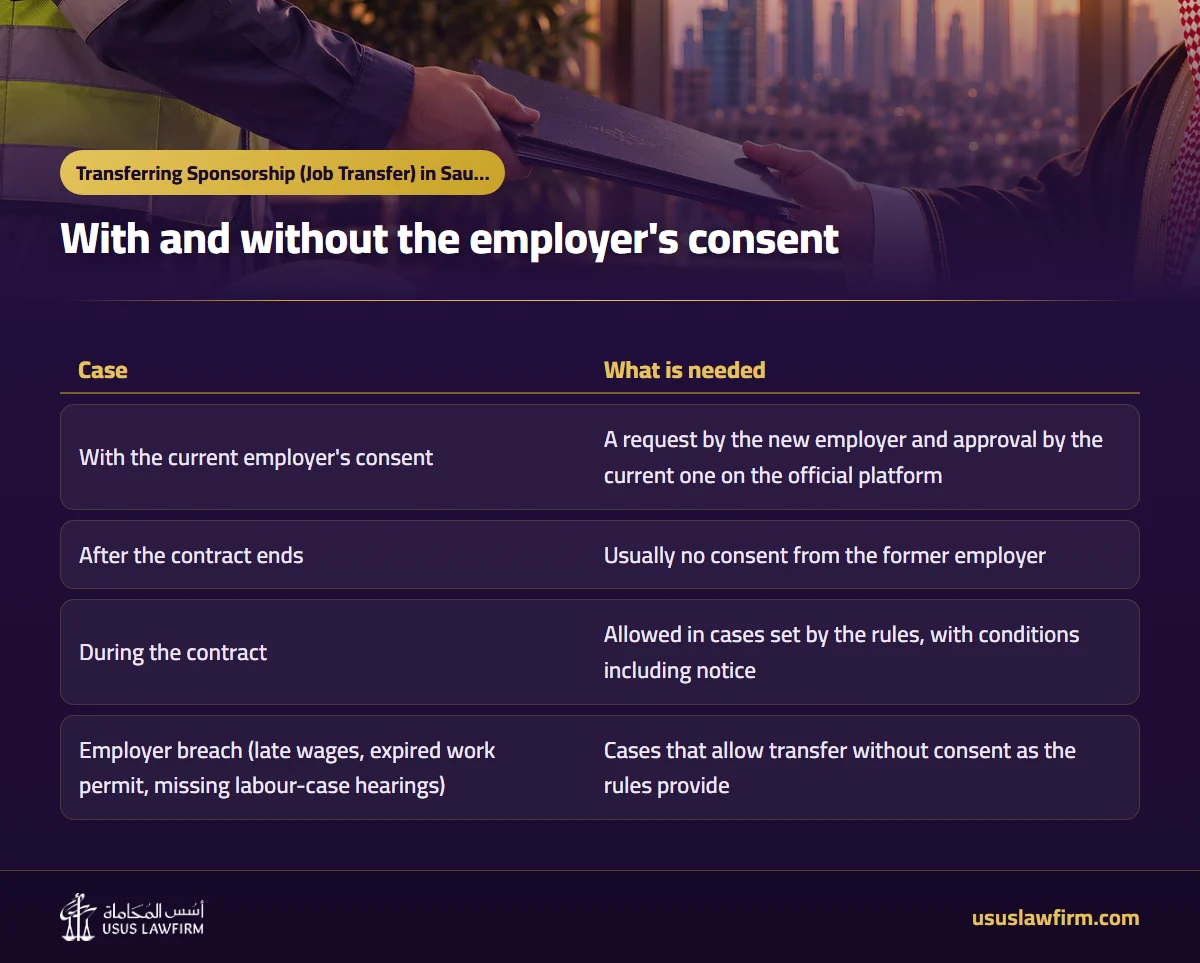
With and without the employer's consent
| Case | What is needed |
|---|---|
| With the current employer's consent | A request by the new employer and approval by the current one on the official platform |
| When the documented contract ends | No consent from the current employer is needed (Regulations, Article 14, II/7) |
| During the contract | Allowed without consent once 12 months have passed since entry to the Kingdom, with at least 90 days' notice before ending the relationship unless agreed otherwise, subject to Article 77 (II/21) |
| Employer breach (late wages, expired work permit, missing labour-case hearings) | The Minister or delegate may approve transfer without consent in the cases listed below (II/8) |
These rules come from Article 14 of the Implementing Regulations, which in places refers to the Nitaqat programme controls. Requests go through the Ministry's approved platform; check the latest official text.
Transfer without the employer's consent in the Regulations
Article 14 (II/8) lets the Minister or a delegate approve transfer without the employer's consent in these cases:
- A case the employer prolongs: the employer or representative misses two hearings at one court level without an accepted excuse, or is shown to have prolonged the case, provided you did not contribute to the delay.
- A recommendation by the court during the case, to avoid possible harm to the worker.
- Unpaid wages for three consecutive months, or wages late past the due date of the third month, on a request within one Hijri year of that date.
- Employer absence through travel, prison, death or otherwise, where the business cannot meet its obligations for three months and no one is appointed to run it.
- Certain groups or nationalities with special instructions, when the contract ends or the employer ends it.
- An accompanying dependant whose services were transferred to work for a business, after the employment ends.
- Family reunification: one spouse has a valid employment contract in the Kingdom and the other's contract ends or is ended by the employer, or one spouse is Saudi.
- Reporting commercial concealment against the employer with supporting evidence, provided the worker took no part in it.
- Any other case the public interest requires, as decided by the Minister or delegate.
The Regulations also allow transfer without consent for a worker whose work permit or iqama has expired, and for a new worker with no work permit yet, under the Nitaqat controls (II/5 and 6). A transfer is not accepted if the new employer has collective wage delays, proven concealment or workers left to work for others unlawfully, or if a final decision conflicts with it.
Source: the Implementing Regulations of the Labour Law, Saudi Judicial Society edition updated 5/5/1447H. Later changes may exist, so check the current official text.
Protect your rights before moving
- End-of-service award: moving does not cancel it; use the end-of-service calculator.
- Late wages: document them; see the wage protection system.
- Ending before the contract term: compensation may be due; see resignation and ending employment and Article 81.
- Absence (huroob) report: if filed unfairly, object immediately.
Read the kafala system in Saudi Arabia. Moving and claiming your dues are not exclusive: see filing a labour case.
Who pays the transfer fee?
Under Article 40 of the Labour Law the employer wishing to take the worker on bears the transfer fee. The amount appears on Qiwa at the time of the request, so rely on that rather than figures quoted elsewhere. Domestic workers are outside the initiative and use Musaned.
Frequently asked questions
Can my employer refuse my transfer after my contract ends?
The Regulations let you move when your documented contract ends without the current employer's consent, unless a final decision or judgment conflicts with the transfer. If the transfer is not approved, the Minister or delegate may license you to work for another employer under Ministry controls (Article 14, II/7, 17 and 18).
My employer has not paid my salary for months. Can I transfer?
Transfer without consent is possible if wages due for three consecutive months were not paid, or were late past the due date of the third month, on a request made within one Hijri year of that date, provided you did not cause the delay. Unpaid wages may also justify leaving work with your rights kept. Document the delay first.
Should I sue or transfer?
The two do not conflict: you can transfer and claim your dues through a labour case.
A dispute with your employer before transferring?
The Usus Law Firm team handles labour cases for workers and employers, in Riyadh and Tabuk.
Legal review: the Usus Law Firm team
A select team of lawyers and legal advisers licensed by the Saudi Ministry of Justice, working from Riyadh and Tabuk, with experience before the general, commercial, labor, criminal, personal status and administrative courts. Every article is reviewed before publication and updated when laws or regulations change.
Last reviewed: 5 November 2026
This article is general legal information and is not a substitute for advice on your specific case. Court proceedings in Saudi Arabia are in Arabic; the official Arabic text of each law prevails.
Request a quick consultation
Leave your name and mobile number, and a lawyer from our Riyadh or Tabuk office will call you during working hours. We advise in English.