

Article 81 of the Saudi Labor Law (المادة 81 من نظام العمل) protects an employee who is forced to leave their job because of the employer. It allows the employee to leave without notice while keeping all their statutory rights, so they are not treated as someone who resigned and receives only part of the award. It is the counterpart of Article 80, which protects the employer against the employee's misconduct.
Cases covered by Article 81
| # | Case | Practical examples |
|---|---|---|
| 1 | The employer fails to meet its essential contractual or statutory obligations to the employee | Salaries delayed for months, not renewing a foreign employee's iqama (residence permit) or work permit, not registering the employee with social insurance (GOSI). |
| 2 | Deception at the time of contracting about the terms and conditions of work | A salary, job title or work location offered that differs from reality. |
| 3 | Assigning the employee, without consent, work essentially different from what was agreed | An accountant assigned field work unrelated to their specialty, beyond what the law permits. |
| 4 | Violent assault or indecent conduct toward the employee or a member of their family | By the employer, a member of the employer's family, or the responsible manager. |
| 5 | Treatment marked by cruelty, injustice or humiliation | By the employer or the responsible manager. |
| 6 | A serious danger at the workplace threatening the employee's safety or health | Provided the employer knew of it and took no action indicating it would remove it. |
| 7 | The employer's conduct pushes the employee into appearing to be the one who ended the contract | Deliberate pressure and breach of contract terms until the employee is forced to "resign". |
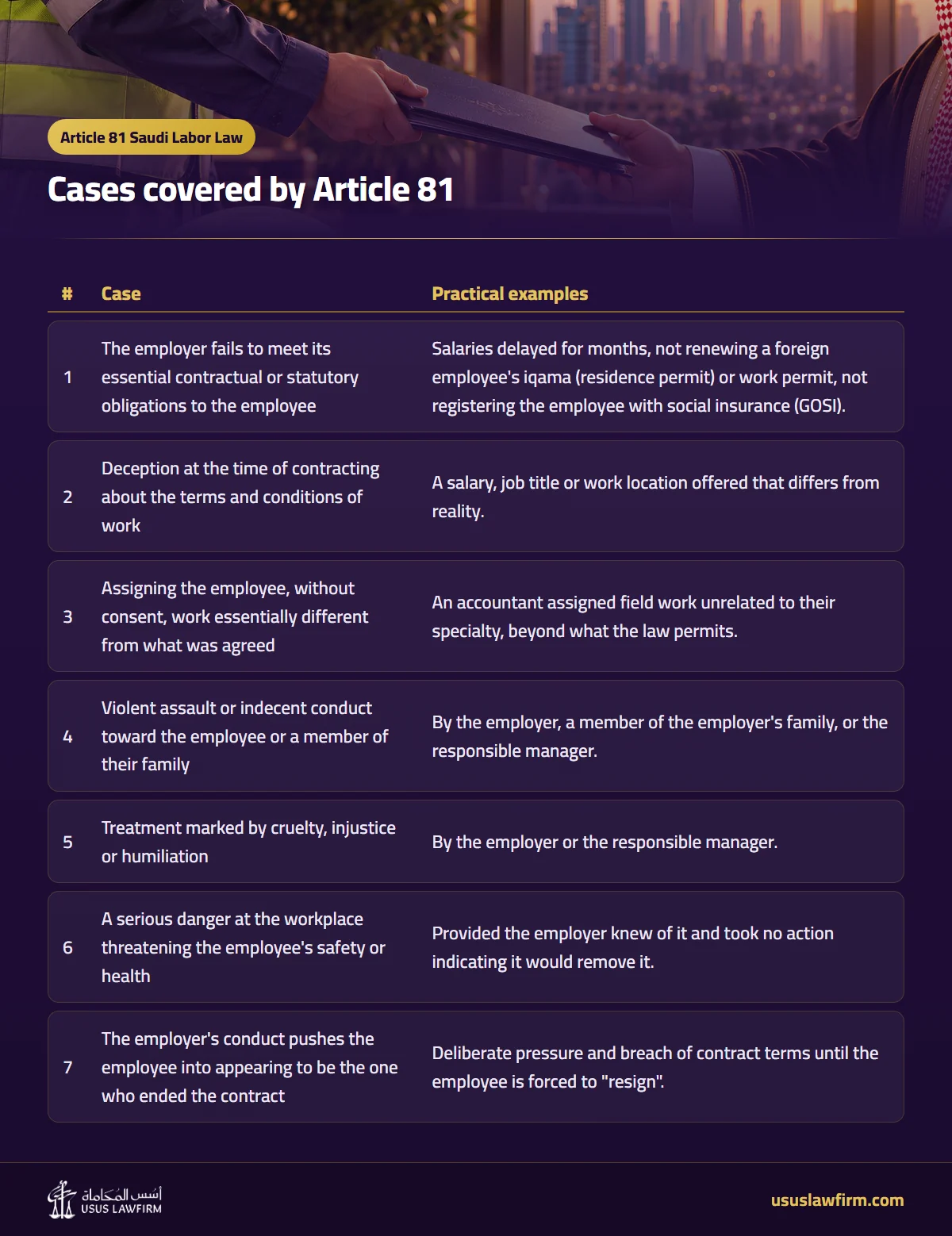
The table summarizes the text. Check the current official text of the Labor Law before taking any action.
What is an employee who leaves under Article 81 owed?
The employee keeps all their statutory rights: the full end-of-service award under Article 84 rather than the resignation percentages, overdue wages, and the leave balance. They may also claim compensation if the end of the relationship is attributed to an illegitimate reason on the employer's side, under Article 77. Work out the award with the end-of-service calculator.
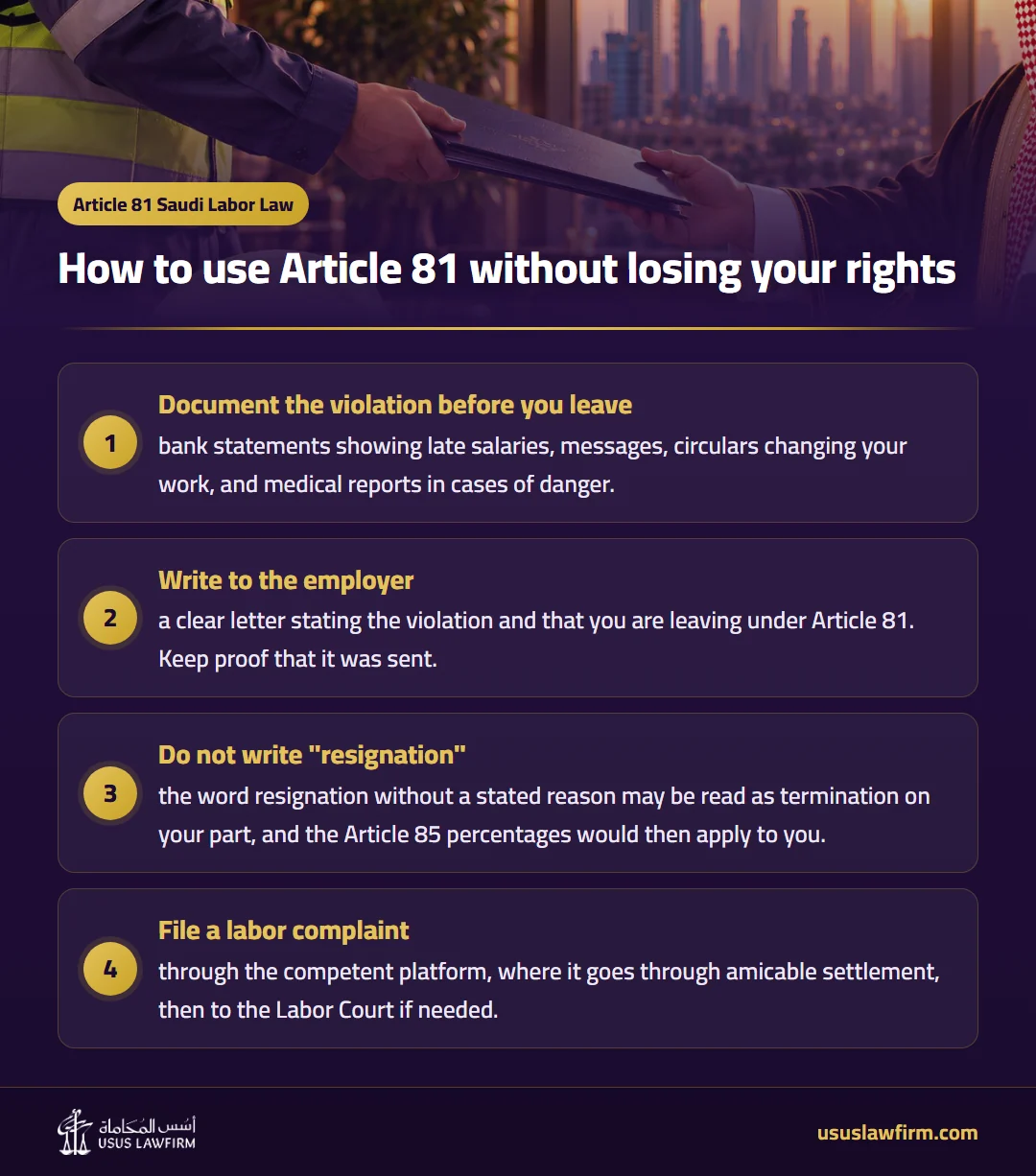
How to use Article 81 without losing your rights
- Document the violation before you leave: bank statements showing late salaries, messages, circulars changing your work, and medical reports in cases of danger.
- Write to the employer: a clear letter stating the violation and that you are leaving under Article 81. Keep proof that it was sent.
- Do not write "resignation": the word resignation without a stated reason may be read as termination on your part, and the Article 85 percentages would then apply to you.
- File a labor complaint: through the competent platform, where it goes through amicable settlement, then to the Labor Court if needed.
Watch the time limit: the Labor Law provides that claims relating to an employee's rights will not be heard after twelve months from the date the employment relationship ended.
Delayed salaries: the most common Article 81 case
Paying wages is the employer's most important obligation, and repeated delays or delays of several months are usually treated as an essential breach. But the court decides this based on the length and circumstances of the delay. So do not leave after a short delay without advice, and document every month your salary was late.
Frequently asked questions
Do I need to notify the employer before leaving under Article 81?
The article allows you to leave without notice, but it is always advisable to inform the employer of the reason in writing. That notice is your evidence later.
Does Article 81 apply to foreign employees?
Yes. It applies to every employee covered by the Labor Law, and many of its cases particularly affect expatriates, such as an iqama not being renewed or wages being delayed.
What if the employer denies the violation?
Then it comes down to proof through documents and witnesses, which is why documenting everything before you leave matters.
Thinking of leaving your job because of your employer?
Speak to a lawyer before you take the step. The Usus Law Firm team handles labor cases in Riyadh and Tabuk, and can advise you in English. Read also Article 80 explained and Article 74 explained.
This article is general legal information and is not a substitute for advice on your specific case. Court proceedings in Saudi Arabia are in Arabic; the official Arabic text of each law prevails.
Request a quick consultation
Leave your name and mobile number, and a lawyer from our Riyadh or Tabuk office will call you during working hours. We advise in English.

