


Suspension of services (إيقاف الخدمات) and a travel ban (منع السفر) are among the most serious measures a person can face in the Kingdom, and they are usually discovered suddenly: when trying to renew an iqama (residence permit), issue a power of attorney, or travel. In most cases the cause is an enforcement request that was not complied with. This article explains why services are suspended, how to find out the reason, the legal ways to lift a suspension of services, and the cases in which a person is banned from travel.
Updated November 2026: this page follows the new Enforcement Law (official Arabic text on our site), in force since 29 October 2026, and its implementing regulation.

Reviewed by: Khaled ElnaggarDirector of Usus Law FirmLast updated:
Quick answer
Under the new Enforcement Law, if five working days pass after the debtor is notified of the enforcement order without payment, compulsory enforcement starts at once: credit bureaus are notified, the debtor's funds and future income are attached, and a daily fine may be imposed (Article 18). A travel ban is ordered only at the creditor's request (Article 19). Najiz shows the request number, the creditor, the amount and the court.
- The measures are lifted by paying into the enforcement account, or by a settlement with the creditor submitted to the enforcement court.
- If you have a legal ground, the route is an enforcement dispute (Article 45) or a grievance within 10 working days (Article 46). The insolvency rules of the 1433H law still apply until civil insolvency legislation is issued.
What is left of "suspension of services"?
The concept has changed more than once. In 2020 the suspension of government e-services in enforcement cases was cancelled and limited to a ban on financial dealings. From Ramadan 1445 AH, controls on suspension requests by government bodies came into force, exempting services such as health, education, labour, the commercial register and civil documents. Since 29 October 2026, Articles 18 and 19 of the new Enforcement Law govern the measures.
Why are services suspended?
The most common cause is an enforcement request filed against you on the basis of an enforceable instrument, such as a judgment, a promissory note or a registered lease, which you then did not pay and for which you did not disclose sufficient assets within the statutory period after being notified. The debtor must disclose their assets within five working days of being notified of the enforcement order (Regulation, Article 15). If five working days pass after notification without performance, compulsory enforcement against their assets starts at once (Enforcement Law, Article 18), and the court may ban them from travel at the creditor's request (Article 19).
What does "suspension of services" cover today?
After the grace period, the measures against the debtor are those set by the new Enforcement Law:
- Notifying licensed credit bureaus of the failure to perform, which affects future financing (Article 18).
- Attaching the debtor's funds and future income and enforcing against them, including amounts owed to them by public bodies (Article 18). The authorities that supervise or register assets apply the attachment as soon as they are notified, so the assets cannot be disposed of (Regulation, Article 30).
- A fine of up to SAR 5,000 for each day of delay, within a cap set by the regulation, which the court may cancel in whole or in part once the debtor performs (Article 18).
- A travel ban at the creditor's request, issued only if attaching sufficient assets is not possible (Article 19; Regulation, Article 19).
The home of the debtor and their dependants and their means of transport, within what is sufficient, cannot be attached, nor more than one third of a salary for debts other than maintenance (Article 26). A debtor who provides a sufficient bank guarantee gets ten more working days (Article 18).
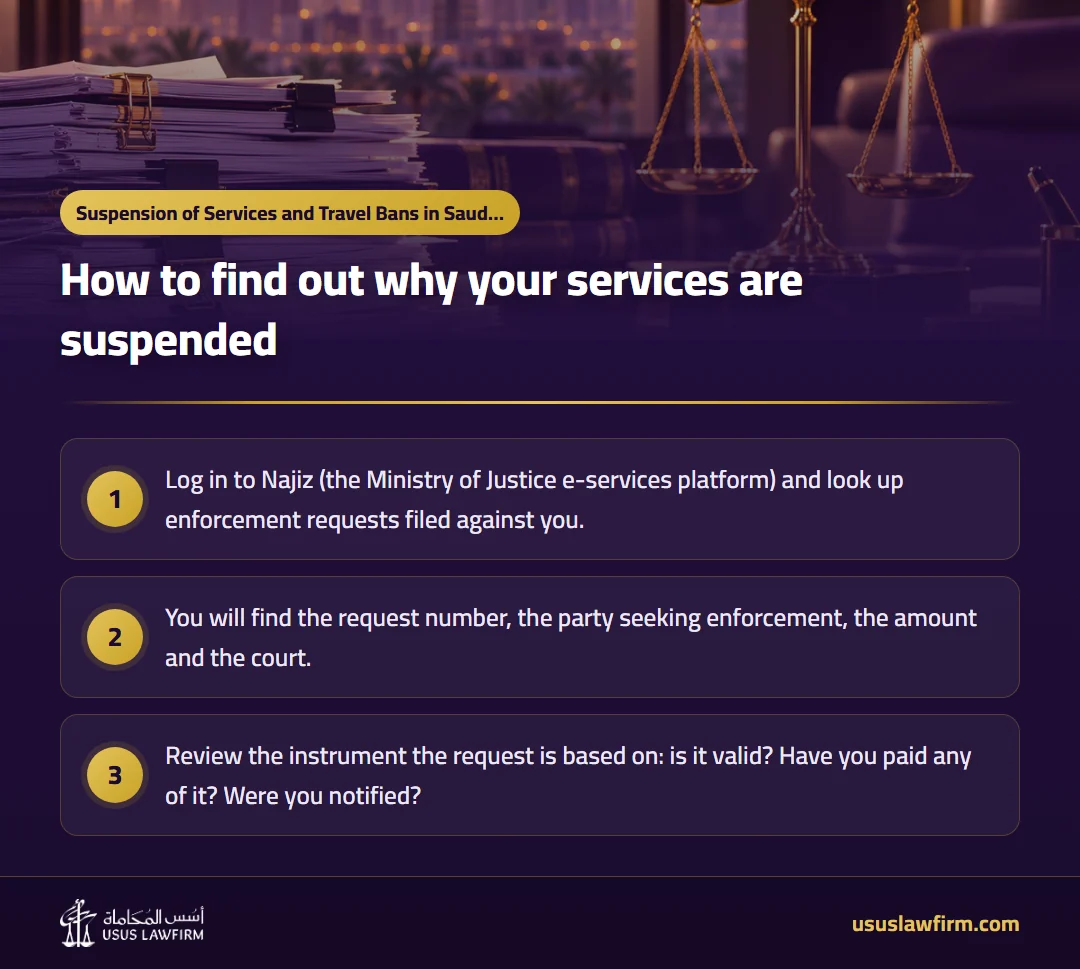
How to find out why your services are suspended
- Log in to Najiz (the Ministry of Justice e-services platform) and look up enforcement requests filed against you.
- You will find the request number, the party seeking enforcement, the amount and the court.
- Review the instrument the request is based on: is it valid? Have you paid any of it? Were you notified?
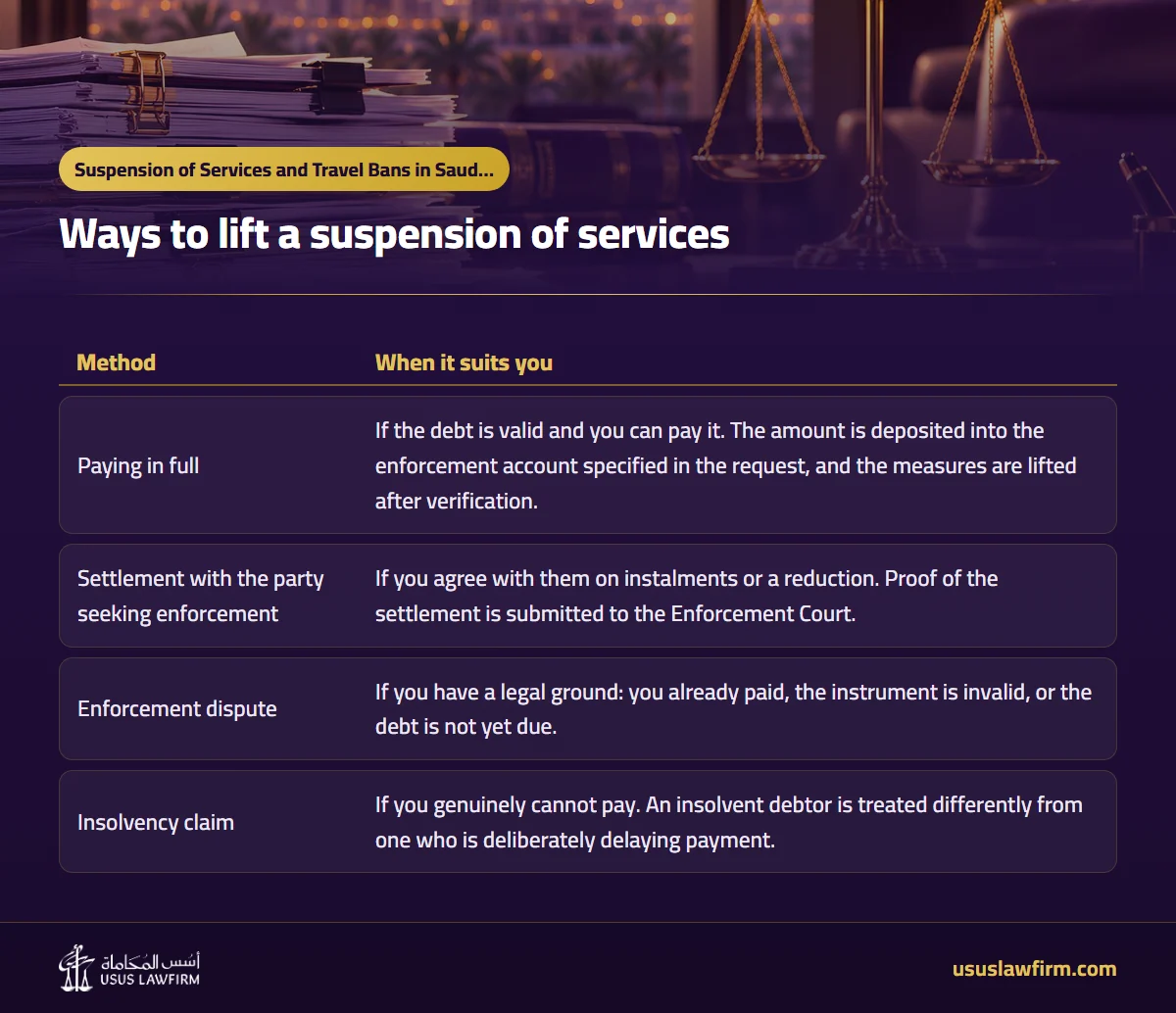
Ways to lift a suspension of services
| Method | When it suits you |
|---|---|
| Paying in full | If the debt is valid and you can pay it. The amount is deposited into the enforcement account specified in the request, and the measures are lifted after verification. |
| Settlement with the party seeking enforcement | If you agree with them on instalments or a reduction. Proof of the settlement is submitted to the Enforcement Court. |
| Enforcement dispute | If the disagreement concerns the validity of the enforceable instrument, the conditions for enforcing it, or the court's jurisdiction. It is heard as an urgent case (Article 45). |
| Grievance | Against enforcement orders and decisions, such as attachment, a travel ban or a fine, within ten working days, before the president of the court (Article 46; Regulation, Article 49). |
| Insolvency claim | If you genuinely cannot pay. An insolvent debtor is treated differently from one who is deliberately delaying payment, and the insolvency rules of the 1433 AH Enforcement Law still apply until civil insolvency legislation is issued. |
The earlier you act, the faster the solution, because the measures escalate the longer the debt goes unpaid.
Travel bans: when do they happen?
- In enforcement: ordered by the court at the creditor's request after the grace period, only if attaching sufficient assets is not possible, for up to three years, extendable by a new request to a maximum of six (Article 19; Regulation, Article 19).
- In criminal cases: an accused person may be banned from travel during investigation or trial by decision of the competent authority.
- In family cases: the court may order that a child in custody may not travel without permission, to protect the other parent's right.
In enforcement, the ban ends automatically when the enforcement request ends or its term expires. The court lifts it on the debtor's request, decided urgently, in cases including medical treatment abroad backed by an approved medical report, an unpaid balance of no more than SAR 50,000, a profession that requires travel, harm caused by the ban, or disclosure of assets sufficient to pay (Article 19; Regulation, Article 19). In other cases, it is lifted by decision of the competent authority.
All Najiz services in one place: the Najiz platform guide.
Frequently asked questions
Does a suspension of services mean a travel ban?
Not automatically. Under the new Enforcement Law, if five working days pass after notification of the enforcement order without payment, compulsory enforcement against assets starts: credit bureaus are notified and assets are attached, and a daily fine may be imposed (Article 18). A travel ban is a separate order the court issues at the creditor's request, for up to three years, extendable to a maximum of six, and it ends when the enforcement request ends (Article 19). Check the enforcement request on Najiz to see whether a travel ban was ordered.
How do I know if my services are suspended?
Check enforcement requests against you on Najiz: you will see the request number, claimant, amount, court and measures taken. If no enforcement request appears but services are blocked, the cause is usually another authority; ask the body named when the service failed.
How do I find out why I have a travel ban?
Start with the Najiz platform: check for enforcement requests filed against you, since most bans come from an unpaid enforcement request. If there is none, the ban may come from a criminal case, ordered by the investigating authority or a court; a lawyer can identify the authority and ask to see the order. See travel bans in drug cases.
Is the suspension lifted immediately after payment?
After payment into the enforcement account and verification, the measures are lifted, but updating them across the various authorities may take some time. Keep the payment receipt and the request number.
My services were suspended over a debt I don't recognize. What should I do?
Look up the request on Najiz and review the instrument. If you were never notified or the instrument is invalid, that is grounds for an enforcement dispute and needs quick action.
Can the amount be paid in instalments to lift the suspension?
Instalments are by agreement with the creditor, submitted to the enforcement court, and the creditor may end the request on the basis of an agreement with the debtor (Article 43). A debtor who provides a sufficient bank guarantee gets ten more working days (Article 18).
Are your services suspended, or are you seeking enforcement?
The Usus Law Firm team handles enforcement and suspension of services for debtors and creditors: inquiries, settlements, enforcement disputes and insolvency claims, in Riyadh and Tabuk. Proceedings are in Arabic, and we can advise you in English.
Legal review: the Usus Law Firm team
A select team of lawyers and legal advisers licensed by the Saudi Ministry of Justice, working from Riyadh and Tabuk, with experience before the general, commercial, labor, criminal, personal status and administrative courts. Every article is reviewed before publication and updated when laws or regulations change.
Last reviewed: 23 November 2026
This article is general legal information and is not a substitute for advice on your specific case. Court proceedings in Saudi Arabia are in Arabic; the official Arabic text of each law prevails.
Request a quick consultation
Leave your name and mobile number, and a lawyer from our Riyadh or Tabuk office will call you during working hours. We advise in English.