


Holding a judgment, cheque or promissory note against someone in Tabuk who has not paid? Or received an enforcement order from the Tabuk Enforcement Court? This guide follows the new Saudi Enforcement Law (Royal Decree M/237, published in Umm Al-Qura on 14/11/1447H, in force 180 days later under Article 65, i.e. from 29 October 2026).

Reviewed by: Khaled ElnaggarDirector of USUS Law FirmLast updated:
What the court handles
The Enforcement Court supervises enforcement, carries out compulsory enforcement and decides enforcement disputes, except criminal penalties and matters for the Board of Grievances (Article 4). It does not reopen the underlying right; it checks that the instrument meets the legal conditions. Requests are filed online through Najiz.
Instruments enforced directly (Article 7)
- Final judgments, orders and decisions of Saudi courts, and judgments with expedited enforcement.
- Arbitral awards.
- Notarised settlement agreements and reconciliation documents.
- Bills of exchange and promissory notes registered on the national electronic platforms.
- Cheques.
- Contracts and acknowledgements notarised under the Notarization Law.
- Foreign judgments and instruments, subject to Article 9 and reciprocity.
- Contracts given the force of an executive instrument by law or Council of Ministers decision.
An enforcement request is not accepted for an instrument that fell due more than ten years ago (Article 11).
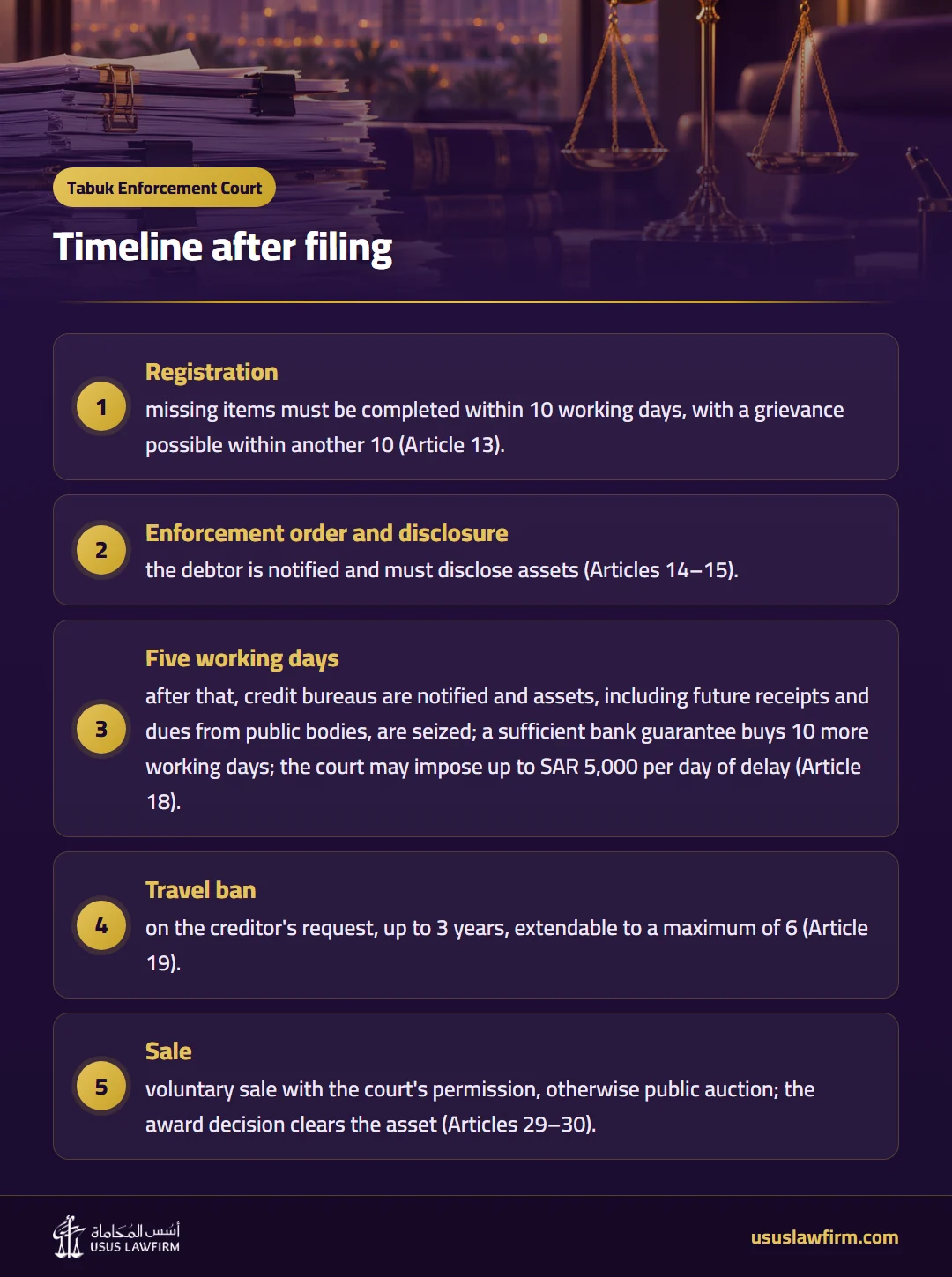
Timeline after filing
- Registration: missing items must be completed within 10 working days, with a grievance possible within another 10 (Article 13).
- Enforcement order and disclosure: the debtor is notified and must disclose assets (Articles 14–15).
- Five working days: after that, credit bureaus are notified and assets, including future receipts and dues from public bodies, are seized; a sufficient bank guarantee buys 10 more working days; the court may impose up to SAR 5,000 per day of delay (Article 18).
- Travel ban: on the creditor's request, up to 3 years, extendable to a maximum of 6 (Article 19).
- Sale: voluntary sale with the court's permission, otherwise public auction; the award decision clears the asset (Articles 29–30).
Objections and penalties
Enforcement disputes (validity of the instrument, conditions, jurisdiction) are heard as urgent cases (Article 45). Grievances against enforcement steps go to the court president within 10 working days, and the decision is final (Article 46). Neither stops enforcement unless ordered (Article 47). Hiding or smuggling assets, refusing to comply or disclose, or resisting enforcement: up to 3 years in prison and/or a fine of up to SAR 1 million (Article 50). Refusing a custody, guardianship or visitation order: up to 90 days and/or SAR 30,000 (Article 54).
Tabuk office pages: Best Lawyer in Tabuk · Lawyers in Tabuk · Lawyer Phone Number in Tabuk · Law Firm in Tabuk · Tabuk Personal Status Court · Fraud Lawyer in Tabuk · Administrative Lawyer in Tabuk · Cybercrime and Blackmail Lawyer in Tabuk · Notarization in Tabuk.
Tabuk guides: Tabuk courts · Tabuk Criminal Court · Tabuk Court of Appeal · Tabuk Enforcement Court · Labor office Tabuk.
Frequently asked questions
How do I file an enforcement request in Tabuk?
Online via Najiz, attaching the executive instrument and the debtor's details. Missing items must be completed within 10 working days (Article 13).
Is a cheque directly enforceable under the new law?
Yes. Cheques are listed in Article 7(1)(e), as are bills of exchange and promissory notes registered on the national platforms.
How long does the debtor have after the enforcement order?
Five working days from notification; then seizure and credit reporting start immediately, or ten more working days if a sufficient bank guarantee is provided (Article 18).
Enforcement matter in Tabuk?
Usus Law Firm handles enforcement requests and disputes before the Tabuk Enforcement Court from our office in Al-Muruj. Book your consultation: +966 55 848 5838.
Legal review: the Usus Law Firm team
A select team of lawyers and legal advisers licensed by the Saudi Ministry of Justice, working from Riyadh and Tabuk, with experience before the general, commercial, labor, criminal, personal status and administrative courts. Every article is reviewed before publication and updated when laws or regulations change.
Last reviewed: 7 November 2026
This article is general legal information and is not a substitute for advice on your specific case. Court proceedings in Saudi Arabia are in Arabic; the official Arabic text of each law prevails.
Request a quick consultation
Leave your name and mobile number, and a lawyer from our Riyadh or Tabuk office will call you during working hours. We advise in English.