


The Rights Enforcement Department (إدارة تنفيذ الأحكام الحقوقية, in some governorates a "branch" or شعبة) is the police unit that carries out Enforcement Court orders when force is needed: bringing a person in, carrying out detention ordered by the court, handing over a child, or evicting a property. The order always starts at the Enforcement Court, not with the police. Here is when a case reaches it, what changes under the new Enforcement Law of 1447H, and what to do as creditor or debtor.

Reviewed by: Ahmed Hasan AlShehriAttorney at USUS Law FirmLast updated:
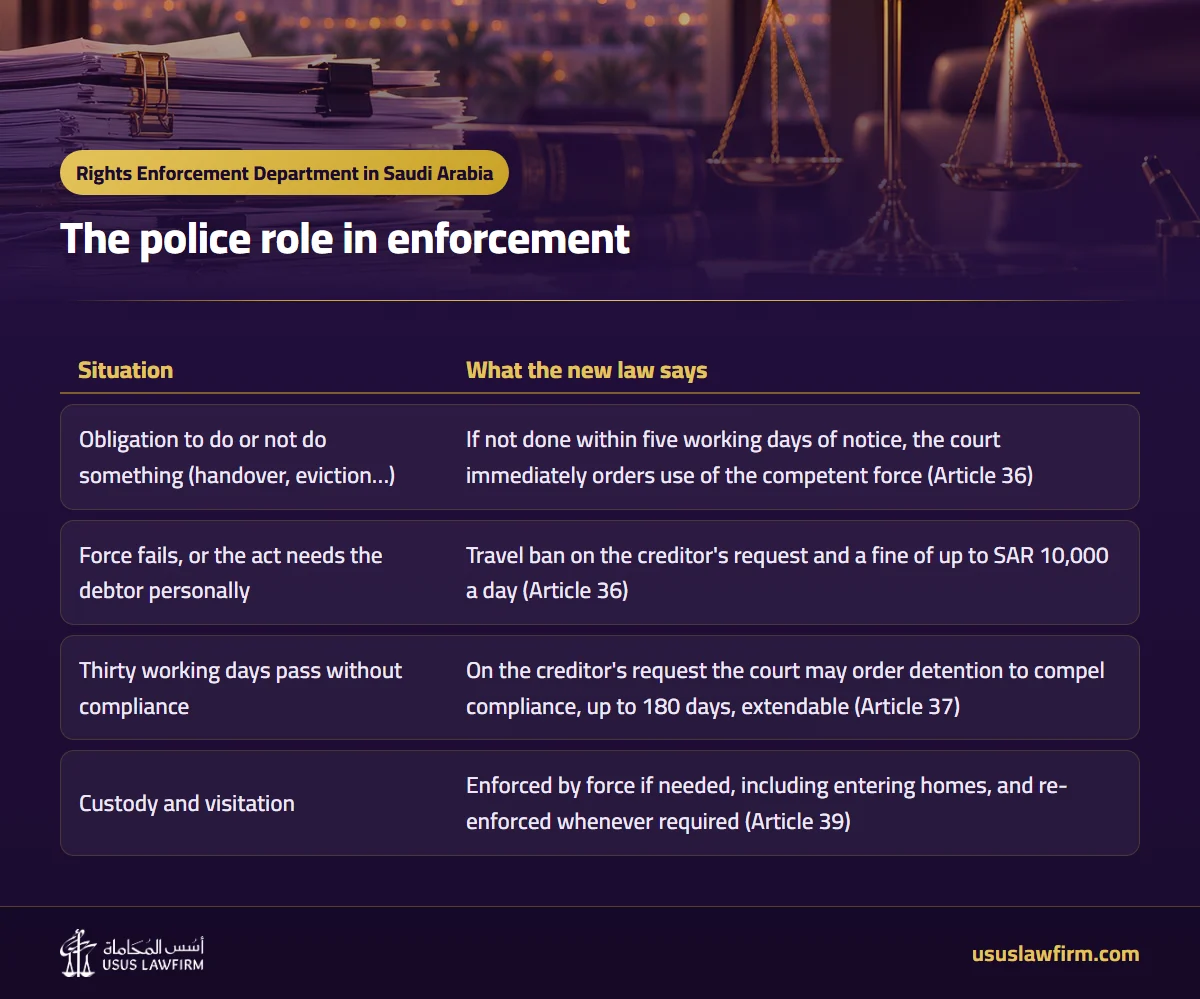
The police role in enforcement
The new law defines the "competent force" as the police or the competent security authority supporting enforcement by compulsory force. The court decides; the police execute. A creditor does not file a new enforcement request with the police: requests go to the Enforcement Court online through Najiz, and the court refers to the police whatever needs force.
| Situation | What the new law says |
|---|---|
| Obligation to do or not do something (handover, eviction…) | If not done within five working days of notice, the court immediately orders use of the competent force (Article 36) |
| Force fails, or the act needs the debtor personally | Travel ban on the creditor's request and a fine of up to SAR 10,000 a day (Article 36) |
| Thirty working days pass without compliance | On the creditor's request the court may order detention to compel compliance, up to 180 days, extendable (Article 37) |
| Custody and visitation | Enforced by force if needed, including entering homes, and re-enforced whenever required (Article 39) |
What the new Enforcement Law changes
The new law was issued by Royal Decree M/237 dated 3/11/1447H, published in the official gazette, and takes effect 180 days after publication, in late October 2026. It replaces the 1433H Enforcement Law.
- Money debts are enforced against money: if the debtor does not pay within five working days of notice, compulsory measures start: credit bureaus are notified, and the debtor's assets, future income and dues from public bodies are attached; the court may add a fine of up to SAR 5,000 a day (Article 18). A bank guarantee covering the debt buys ten more working days.
- Travel ban: after that period, on the creditor's request, up to three years, renewable to a maximum of six, ending when the enforcement request ends (Article 19).
- Detention appears after the Article 36 measures, i.e. for obligations to do or not do something.
- Hiding assets is a crime: up to three years' prison and a fine of up to SAR 1 million for hiding or smuggling assets, deliberately obstructing enforcement, refusing disclosure or giving misleading information (Article 50). Squandering large assets: up to fifteen years, even if insolvency is proven (Article 52).
- Refusing to hand over a child or allow visitation: up to ninety days' prison and a fine of up to SAR 30,000 (Article 54).
"Article 46 of the Enforcement Law": what it means now
Under the old law, Article 46 was the article on measures against a debtor who had not paid within five days, and its number appeared in government service notices. In the new law, Article 46 is about grievances: anyone with an interest may file a grievance against enforcement orders and decisions with the court president (or whoever the Council designates) within ten working days from the day after the decision is made available, and the order may be suspended until the grievance is decided. The old Article 46 measures now sit mainly in Articles 18 and 19.
If you are the debtor
- Do not ignore the notice: deadlines are short and measures escalate.
- Payment or a documented settlement is the fastest way to lift measures.
- A legal ground (payment, settlement, invalid instrument) goes to an enforcement dispute before the court, not to refusal.
- Do not move or hide assets after the order: it is now a separate crime.
Frequently asked questions
What is the Rights Enforcement Department?
The police department or branch that executes Enforcement Court orders needing force: bringing a person in, enforcement detention, child handover and eviction. The law calls it the "competent force".
Can a debtor be jailed under the new Enforcement Law?
The new law provides for enforcement detention in Article 37, after the Article 36 measures for obligations to do or not do something, on the creditor's request, up to 180 days, extendable. Money debts are enforced through attachment, fines and travel bans, and hiding or squandering assets is a crime punishable by prison.
Who cannot be detained?
Anyone under eighteen, anyone with a certified illness that detention would not allow, a pregnant woman or mother of a child under two, and the creditor's ascendants or descendants.
When does the new Enforcement Law take effect?
180 days after publication in the official gazette, in late October 2026.
Usus Law Firm acts for creditors and debtors before the Enforcement Court. See our enforcement service, the Enforcement Law guide, and our offices in Riyadh and Tabuk.
Legal review: the Usus Law Firm team
A select team of lawyers and legal advisers licensed by the Saudi Ministry of Justice, working from Riyadh and Tabuk, with experience before the general, commercial, labor, criminal, personal status and administrative courts. Every article is reviewed before publication and updated when laws or regulations change.
Last reviewed: 25 October 2026
This article is general legal information and is not a substitute for advice on your specific case. Court proceedings in Saudi Arabia are in Arabic; the official Arabic text of each law prevails.
Request a quick consultation
Leave your name and mobile number, and a lawyer from our Riyadh or Tabuk office will call you during working hours. We advise in English.