

The Saudi Anti-Money Laundering Law (نظام مكافحة غسل الأموال) is not only for banks: it places obligations on many companies and non-financial professions, and it criminalises anyone who conceals the source of illicit money or helps to conceal it. The current law was issued by Royal Decree No. (M/20) dated 5/2/1439H, followed by its Implementing Regulations. Here we explain what money laundering is, who carries the obligations, and what to do when something looks suspicious.
What is money laundering?
It is any act intended to conceal or disguise the illicit origin of funds obtained from a crime, or to convert, transfer, acquire or hold funds knowing they are the proceeds of a crime, or to assist in any of this. The law covers a wide range of predicate crimes from which the money comes, such as fraud, bribery, drug trafficking and evasion.
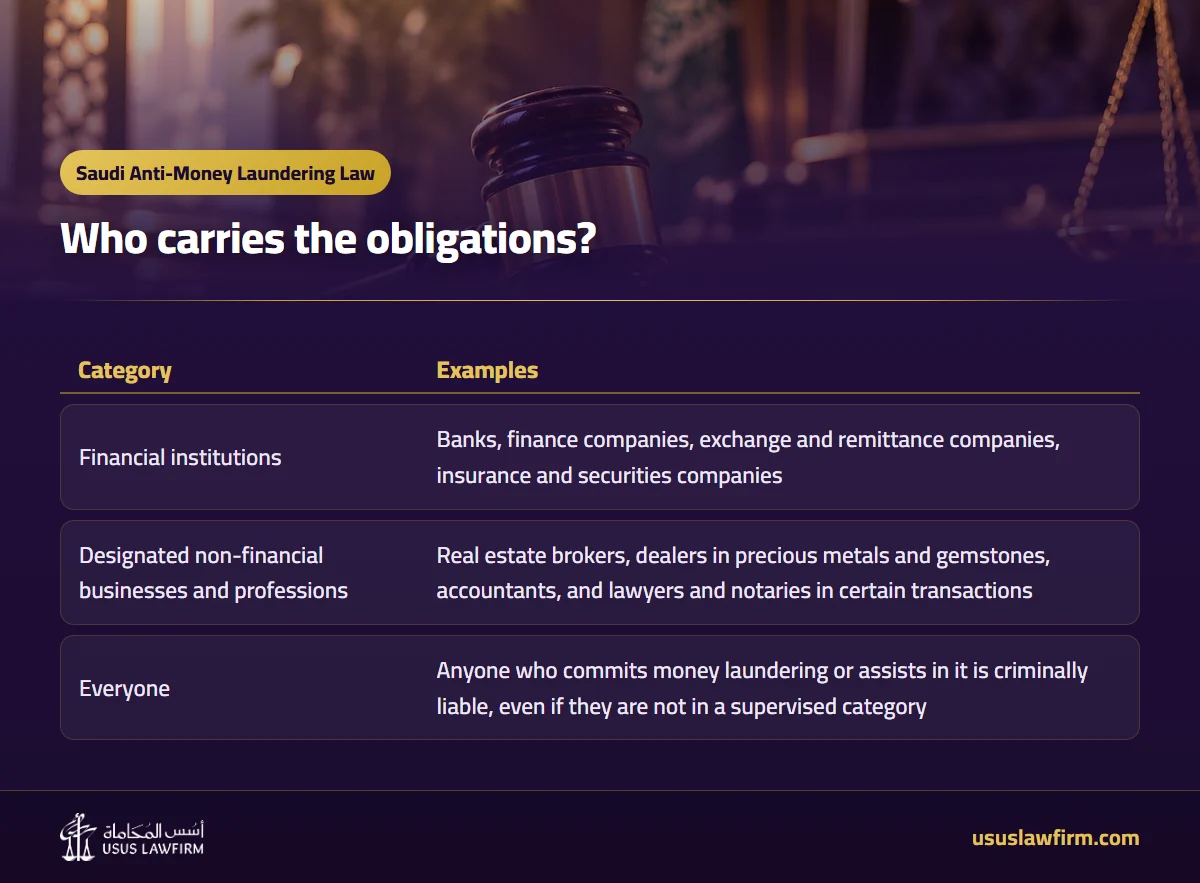
Who carries the obligations?
| Category | Examples |
|---|---|
| Financial institutions | Banks, finance companies, exchange and remittance companies, insurance and securities companies |
| Designated non-financial businesses and professions | Real estate brokers, dealers in precious metals and gemstones, accountants, and lawyers and notaries in certain transactions |
| Everyone | Anyone who commits money laundering or assists in it is criminally liable, even if they are not in a supervised category |
Key obligations for covered entities
- Know your customer (KYC): verify the identity of the customer and the beneficial owner, and the nature of their business, before and during the relationship.
- Risk assessment: classify customers and transactions by risk and apply enhanced due diligence where needed.
- Reporting: report to the General Directorate of Financial Investigation (الإدارة العامة للتحريات المالية, the Saudi financial intelligence unit) immediately on suspicion, without alerting the customer.
- Record keeping: keep documents and records for the period set by law.
- Internal controls: policies, procedures, training and a compliance officer.
The law imposes criminal penalties on offenders and administrative sanctions on entities that breach their obligations. Check the current official text for penalties and periods.
Common patterns to watch out for
- Using your bank account or commercial registration to pass someone else's money through in return for a commission.
- Accepting large cash amounts without clear documents showing where they came from.
- Commercial concealment (تستر, "tasattur"), where a Saudi citizen's name is used for someone else's business.
- Fictitious invoices, or amounts out of proportion to the size of the business.
Frequently asked questions
Someone transferred money to me and asked me to send it on to another account. Is that risky?
Yes. This is one of the best-known ways people are used as "money mules" in money laundering or fraud, and the account holder may be held liable. Don't agree to it, and inform your bank.
I have been accused of money laundering. What is the first step?
Do not make any statement before getting a lawyer, and gather evidence of the source of the funds and that they are lawful. Investigations and proceedings are in Arabic, so any foreign-language documents will need an Arabic translation. Read about the rights of the accused.
Does my business need an anti-money laundering policy?
If it is a covered entity, policies, procedures and training are a legal obligation. Even if it is not, they protect the business. Read about the Anti-Bribery Law.
Need a defence or a compliance programme?
The team at Usus Law Firm handles the defence in criminal cases in full confidence, and prepares compliance policies for businesses as part of its corporate governance work, in Riyadh and Tabuk, and advises in English.
This article is general legal information and is not a substitute for advice on your specific case. Court proceedings in Saudi Arabia are in Arabic; the official Arabic text of each law prevails.
Request a quick consultation
Leave your name and mobile number, and a lawyer from our Riyadh or Tabuk office will call you during working hours. We advise in English.

