

Yes, non-Saudis can own real estate in Saudi Arabia. Ownership is governed by the Law of Real Estate Ownership by Non-Saudis, issued by Royal Decree No. (M/14) dated 19/1/1447H, and its Implementing Regulations, approved by Cabinet Decision No. (43) dated 8/1/1448H. This guide sets out who may own and where, what non-residents and companies need, the fees and the penalties, with article numbers. The full Arabic text of the law and the regulations is on our Arabic page.
| Item | Details |
|---|---|
| Issued by | Royal Decree No. (M/14) dated 19/1/1447H |
| Published and in force | Published in Umm Al-Qura on 30/1/1447H (25 July 2025); in force 180 days after publication (Article 15) |
| Replaces | The Law of Ownership and Investment in Real Estate by Non-Saudis, Royal Decree No. (M/15) dated 17/4/1421H (Article 14) |
| Implementing Regulations | Cabinet Decision No. (43) dated 8/1/1448H, published in Umm Al-Qura on 18/1/1448H (3 July 2026) |

Reviewed by: Rakan Jameel Al-DubaisiFounder & CEO of Usus Law FirmLast updated:
Who may own property under the new law?
A «non-Saudi» is a natural person who does not hold Saudi nationality, a non-Saudi company, a non-Saudi non-profit entity, and any other non-Saudi legal person designated by the Council of Ministers (Article 1).
| Situation | Rule | Article |
|---|---|---|
| Within the geographic zones | A non-Saudi may own real estate or acquire other real rights within the zones set by the Council of Ministers, which also sets the types of rights, ownership percentages, maximum periods and controls | 2(1)–(2) |
| Legal residents | May own one property for their own residence outside the zones, except in the cities of Makkah and Madinah | 2(3) |
| Makkah and Madinah | The right of ownership in paragraph (1) is limited to Muslim natural persons | 2(4) |
| Unlisted companies with a non-Saudi shareholder | May own within the zones, including Makkah and Madinah, and own what they need for their activities and staff housing inside or outside the zones under the Regulations | 3 |
| Listed companies, funds and special purpose entities | Under the Capital Market Law and its regulations and the controls of the Capital Market Authority | 4 |
| Diplomatic missions and international bodies | On a reciprocity basis, with the approval of the Ministry of Foreign Affairs | 7 |
The law does not affect the Premium Residency Law, the rules on ownership by GCC citizens, or other laws that give non-Saudis better rights (Article 5). Ownership is valid once registered in the Real Estate Registry (Article 8(2)).
What non-residents and companies need first (Implementing Regulations)
| Applicant | Requirements before owning | Article |
|---|---|---|
| Non-resident individual | A digital identity, a bank account in the Kingdom in their name, and a Saudi phone number in their name linked to the digital identity | 2 |
| Non-Saudi company | Registration with the Ministry of Investment, disclosure of direct and indirect owners, an identity for the legal representative, and a bank account in the Kingdom | 3 |
| Non-Saudi non-profit entity | Registration with the National Center for Non-Profit Sector Development, an identity for the representative, and a bank account in the Kingdom | 4 |
| Unlisted Saudi company with a non-Saudi shareholder | Outside the zones (except Makkah and Madinah) for its activities or staff housing after Ministry of Investment approval; inside the zones without it | 8 |
Applications go through the electronic portal set up by the Real Estate General Authority and linked to the Real Estate Registry; payments are electronic, and deeds are issued in the Registry (Regulations, Article 6). A non-Saudi's spouse and non-Saudi children follow him for the residential property; none of them may own a residential property separately unless the marriage ends or the child reaches 25 (Regulations, Article 7).
Fees
A fee of up to 5% of the value of the non-Saudi's disposition of real rights may be imposed (Article 9 of the law). The Regulations set it as follows (Articles 9 and 10):
| Area | Rights and uses | Fee |
|---|---|---|
| City of Riyadh, City of Makkah, City of Madinah and Jeddah Governorate | All real rights and all uses | 2% |
| Other dispositions of real rights in the Kingdom | Subject to a zero rate | 0% |
Other zero-rated cases include division of an estate, dispositions under a final court judgment, expropriation for public benefit, and partition of jointly owned property without increasing any partner's share (Regulations, Article 10). Real estate transaction tax is separate: see real estate transaction tax.
Penalties
Violations of the law or the Regulations are punished by a warning or a fine of up to 5% of the value of the real right concerned, capped at SAR 10 million (Article 10). Deliberately providing false or misleading information that led to ownership carries a fine of up to 5%, capped at SAR 10 million, plus sale of the real right; the Public Prosecution investigates (Article 12). Committee decisions can be challenged before the Administrative Court within 60 days of notification (Article 11(3)).
Property owned before the new law
The new law does not affect real estate rights lawfully acquired by non-Saudis and legal persons before it came into force, nor the rules that prohibit ownership in specific places and areas (item II of the Royal Decree).
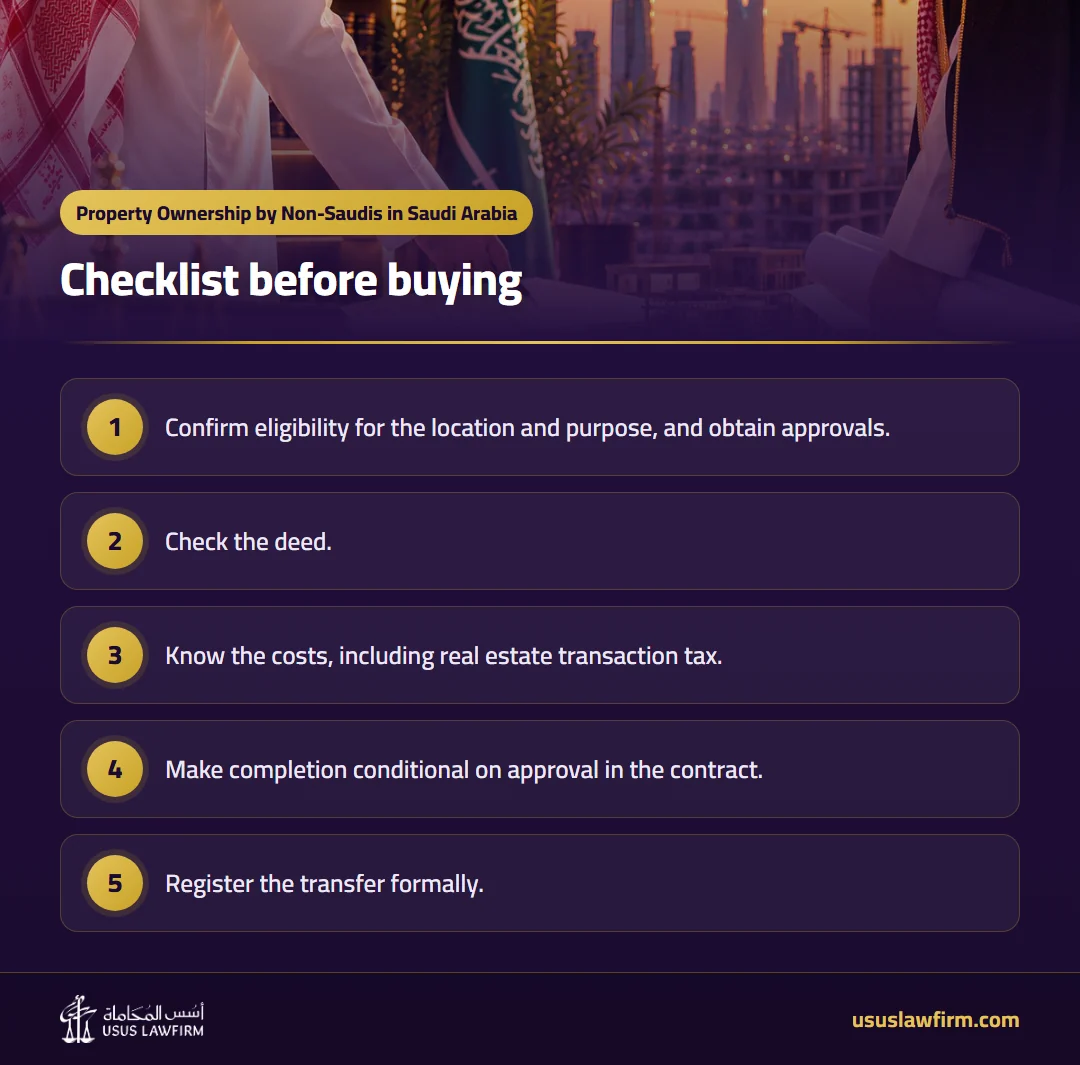
Checklist before buying
- Confirm you are eligible for the location and purpose, and check the approved zones with the Real Estate General Authority.
- Check the deed is free of mortgages and disputes: checking a deed.
- Budget for the non-Saudi ownership fee, real estate transaction tax and registration fees.
- Use a clear contract that makes completion conditional on approvals: property sale contract template.
- Register the ownership in the Real Estate Registry; the agreement alone does not transfer title.
Avoid nominee arrangements
Registering property in a Saudi's name on behalf of a non-Saudi exposes both sides to losing the money and may amount to unlawful concealment (tasattur).
Frequently asked questions
Can foreigners own property in Saudi Arabia?
Yes. A non-Saudi may own real estate or acquire other real rights within the geographic zones set by the Council of Ministers (Article 2), and a legal resident may own one property for their residence outside those zones, except in Makkah and Madinah.
What does a non-resident need before buying?
A digital identity, a bank account in the Kingdom in their name, and a Saudi phone number in their name linked to the digital identity (Implementing Regulations, Article 2).
How much is the fee for non-Saudi property ownership?
Up to 5% of the value of the disposition under Article 9 of the law. The Regulations set 2% in the cities of Riyadh, Makkah and Madinah and Jeddah Governorate, and a zero rate elsewhere (Articles 9 and 10).
Can non-Saudis own property in Makkah and Madinah?
The right is limited to Muslim natural persons (Article 2(4)); unlisted companies with a non-Saudi shareholder may own within the zones, including both cities (Article 3).
What is the penalty for violating the law?
A warning or a fine of up to 5% of the value of the real right, capped at SAR 10 million (Article 10); for deliberately false information that led to ownership, the right is also sold (Article 12).
When did the new law take effect?
180 days after its publication in Umm Al-Qura on 30/1/1447H (Article 15). It replaced the 1421H law (Article 14).
Can a resident buy with financing?
It depends on the lenders' policies and the resident's eligibility.
Buying lawfully?
Usus Law Firm handles real estate matters for non-Saudi buyers and investors in Riyadh and Tabuk, and advises in English. Request your consultation now; fees are explained in writing before any commitment.
Legal review: the Usus Law Firm team
A select team of lawyers and legal advisers licensed by the Saudi Ministry of Justice, working from Riyadh and Tabuk, with experience before the general, commercial, labor, criminal, personal status and administrative courts. Every article is reviewed before publication and updated when laws or regulations change.
Last reviewed: 27 November 2026
General legal information from the Law of Real Estate Ownership by Non-Saudis and its Implementing Regulations, not advice on a specific case. The official Arabic text prevails.
Request a quick consultation
Leave your name and mobile number, and a lawyer from our Riyadh or Tabuk office will call you during working hours. We advise in English.