
Before you file a claim or challenge a judgment, you need the map of the Kingdom's courts: which court hears your case, and where an objection goes. That map is drawn by the Law of the Judiciary, which set the levels of litigation and the specialised courts, alongside the Board of Grievances Law for administrative justice. Here is a practical explanation.
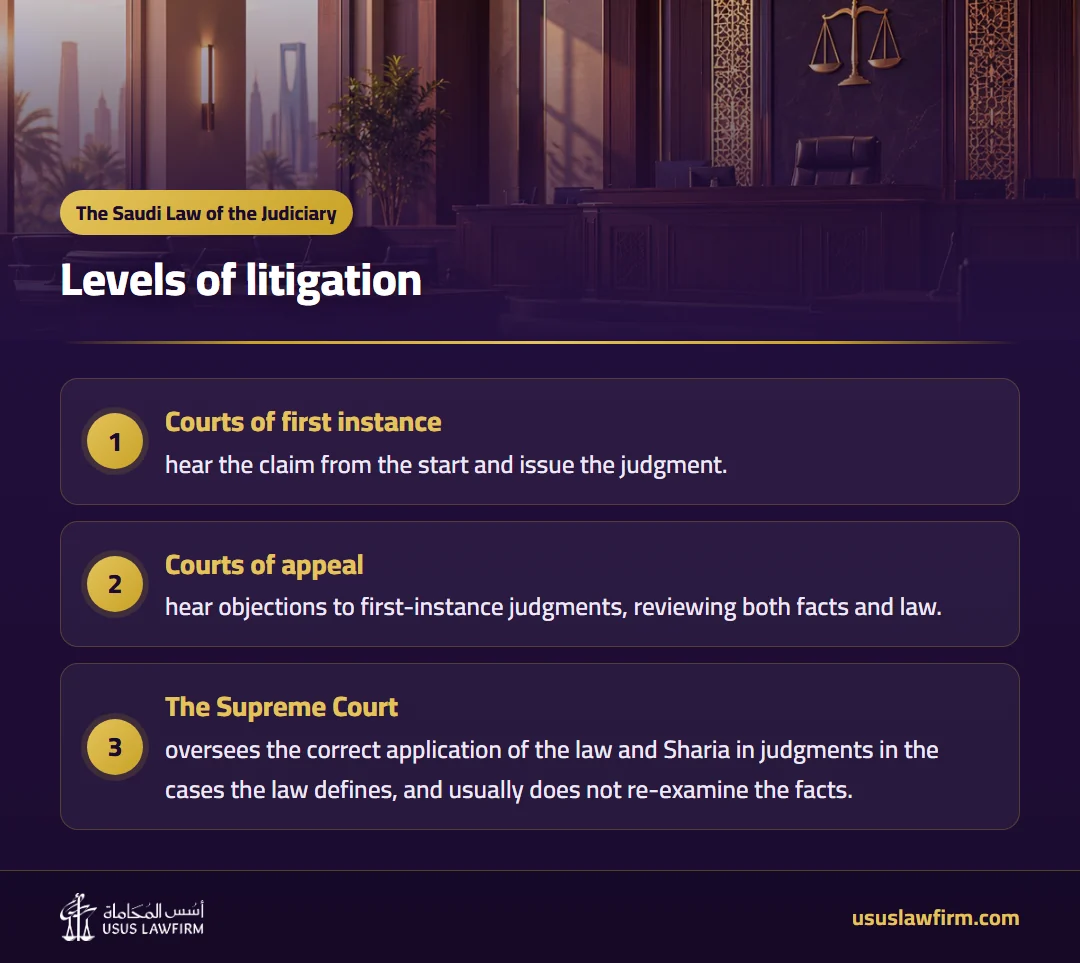
Levels of litigation
- Courts of first instance: hear the claim from the start and issue the judgment.
- Courts of appeal: hear objections to first-instance judgments, reviewing both facts and law. Read the Court of Appeal and ways to object.
- The Supreme Court: oversees the correct application of the law and Sharia in judgments in the cases the law defines, and usually does not re-examine the facts.
Specialised courts of first instance
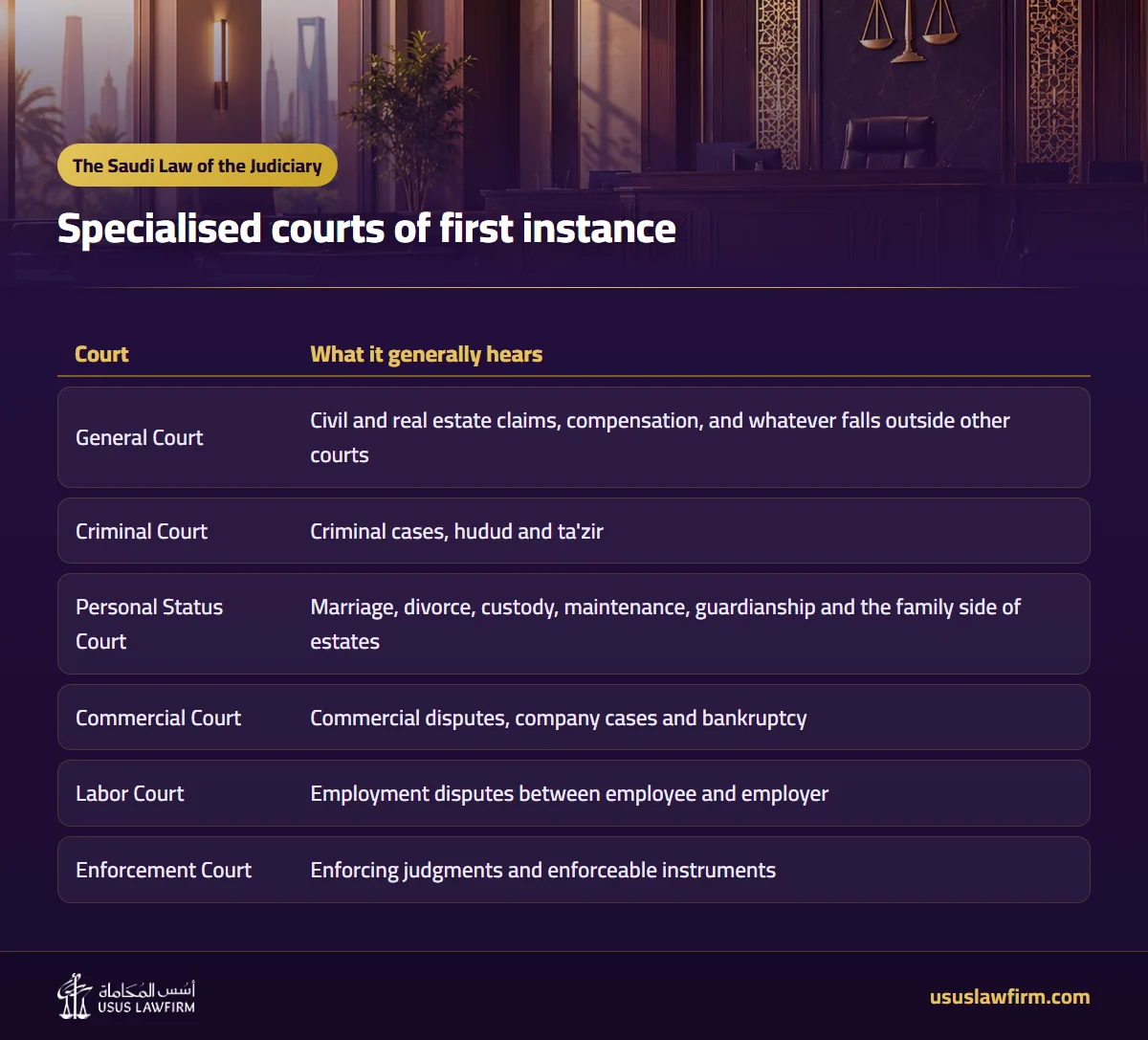
| Court | What it generally hears |
|---|---|
| General Court | Civil and real estate claims, compensation, and whatever falls outside other courts |
| Criminal Court | Criminal cases, hudud and ta'zir |
| Personal Status Court | Marriage, divorce, custody, maintenance, guardianship and the family side of estates |
| Commercial Court | Commercial disputes, company cases and bankruptcy |
| Labor Court | Employment disputes between employee and employer |
| Enforcement Court | Enforcing judgments and enforceable instruments |
Claims against government bodies are heard by the administrative courts of the Board of Grievances. Read the Law of Procedure before the Board of Grievances.
Why does choosing the right court matter?
- Filing before a court without jurisdiction delays the case and leads to a transfer or a ruling of no jurisdiction.
- Each court has its own procedures and periods, such as amicable settlement before the Labor Court.
- Territorial jurisdiction matters too: in which city the claim is filed. Read which court hears my case?
Frequently asked questions
Do all judgments reach the Supreme Court?
No, objections before the Supreme Court are limited to cases and judgments the law defines.
What is the difference between the general court and the summary court?
"Summary courts" is an old name; the current structure divided their jurisdiction among the general, criminal and specialised courts.
Who decides the competent court if the parties disagree?
The court itself, or the body that resolves conflicts of jurisdiction, under the law.
This is a simplified explanation of the court structure; check the current official text of the Law of the Judiciary and the Law of Sharia Procedure.
Not sure where to file?
The Usus Law Firm team helps with general court cases, choosing the competent court and drafting the claim, in Riyadh and Tabuk.
Legal review: the Usus Law Firm team
A select team of lawyers and legal advisers licensed by the Saudi Ministry of Justice, working from Riyadh and Tabuk, with experience before the general, commercial, labor, criminal, personal status and administrative courts. Every article is reviewed before publication and updated when laws or regulations change.
Last reviewed: 12 October 2026
This article is general legal information and is not a substitute for advice on your specific case. Court proceedings in Saudi Arabia are in Arabic; the official Arabic text of each law prevails.
Request a quick consultation
Leave your name and mobile number, and a lawyer from our Riyadh or Tabuk office will call you during working hours. We advise in English.