


"How is the inheritance divided?" is asked in every home after a death. In the Kingdom the rule is the Islamic law of inheritance (fara'id): each heir has a share fixed by the Quran and Sunnah, and whatever remains goes to the residuary heirs. Here we explain how inheritance is divided with worked examples for the most common cases, then the legal steps to actually distribute it.

Reviewed by: Raghad Mamdouh Al-KhamshiLegal Affairs Manager at USUS Law FirmLast updated:
Before division: what comes out of the estate first?
- The deceased's funeral and burial expenses, within reason.
- The deceased's debts.
- Any bequest, up to one third and not to an heir.
- The rest is then divided among the heirs.

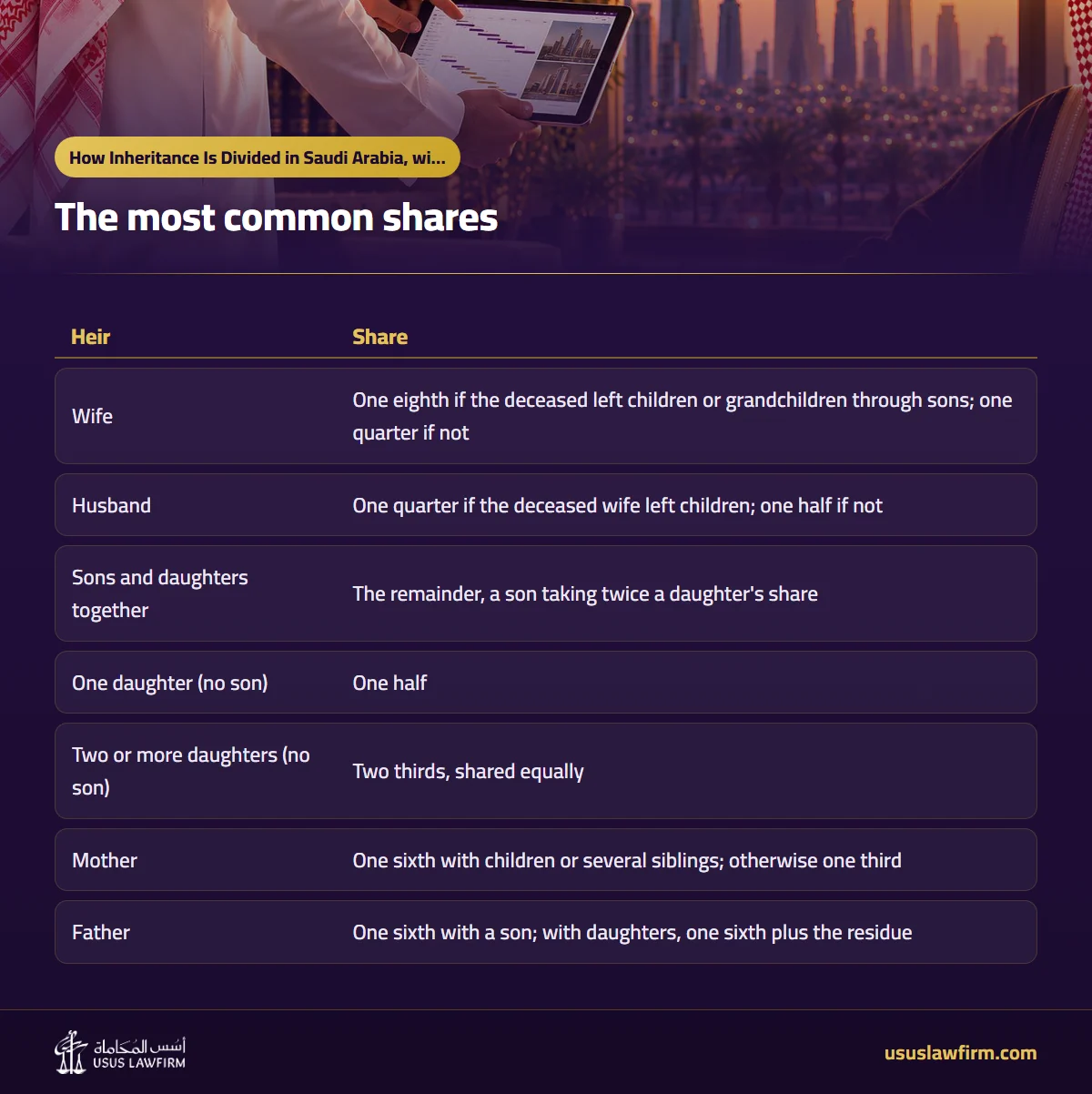
The most common shares
| Heir | Share |
|---|---|
| Wife | One eighth if the deceased left children or grandchildren through sons; one quarter if not |
| Husband | One quarter if the deceased wife left children; one half if not |
| Sons and daughters together | The remainder, a son taking twice a daughter's share |
| One daughter (no son) | One half |
| Two or more daughters (no son) | Two thirds, shared equally |
| Mother | One sixth with children or several siblings; otherwise one third |
| Father | One sixth with a son; with daughters, one sixth plus the residue |
Worked examples
Example 1: A man dies leaving a wife, two sons and a daughter, with a net estate of SAR 800,000. The wife takes one eighth, SAR 100,000. The remaining SAR 700,000 is divided into five parts (two for each son, one for the daughter): SAR 280,000 to each son and SAR 140,000 to the daughter.
Example 2: A woman dies leaving a husband, one daughter and her father, with an estate of SAR 600,000. The husband takes one quarter, SAR 150,000; the daughter one half, SAR 300,000; the father one sixth, SAR 100,000, plus the remaining SAR 50,000 as residue, so SAR 150,000 in all.
Example 3: A man dies leaving a wife, his mother and two daughters, with an estate of SAR 480,000. The wife takes one eighth, SAR 60,000; the mother one sixth, SAR 80,000; the two daughters two thirds, SAR 320,000 (SAR 160,000 each). The remaining SAR 20,000 is returned to those entitled under the rules of radd.
Work out your own case in a minute with the inheritance calculator. For the wife specifically, read the wife's share of inheritance.
These examples are for illustration; cases with siblings, grandparents, an unborn child or a missing person need a precise calculation, and the final division is made by the heirship deed and the division judgment.
From division on paper to actual distribution
- Obtain the heirship deed. Read heirship and estate division.
- List the money, properties and accounts. Read estate inventory.
- Divide by agreement and document it, or file a division claim if the heirs disagree.
- Transfer properties and shares to each heir according to their share.
Frequently asked questions
Does a daughter inherit the same as a son?
When they inherit together, a son takes twice a daughter's share; when there are only daughters, they have fixed shares: one half for one daughter, two thirds for two or more.
Can heirs agree to divide differently from the fixed shares?
An adult heir of sound mind may give up part of their right by consent, and this is documented; it is not allowed with a minor's share.
Who calculates the inheritance officially?
The court, when establishing the heirs and dividing the estate; the Ministry of Justice calculator or ours can give a first estimate.
A disagreement among heirs?
The Usus Law Firm team handles estates and heirship: the calculation, division by agreement, and division claims, in Riyadh and Tabuk.
Legal review: the Usus Law Firm team
A select team of lawyers and legal advisers licensed by the Saudi Ministry of Justice, working from Riyadh and Tabuk, with experience before the general, commercial, labor, criminal, personal status and administrative courts. Every article is reviewed before publication and updated when laws or regulations change.
Last reviewed: 12 October 2026
This article is general legal information and is not a substitute for advice on your specific case. Court proceedings in Saudi Arabia are in Arabic; the official Arabic text of each law prevails.
Request a quick consultation
Leave your name and mobile number, and a lawyer from our Riyadh or Tabuk office will call you during working hours. We advise in English.