


Has your employer asked you to work on Eid or National Day? That is allowed in many jobs, but it is not free. The Labor Law treats every hour you work on an official holiday as an overtime hour with higher pay. Here is how to calculate your pay, when you can be required to work, and what to do if you are not paid.
The rule in brief
- Every employee has a fully paid holiday on the official Eids and occasions (Article 112 of the Labor Law).
- Hours worked on weekly rest days, Eids and official holidays count as overtime (Article 107).
- Overtime hourly pay = the normal hourly wage + 50% of the basic hourly wage.
Check the current official text of Articles 107 and 112 of the Labor Law.
A worked example
| Item | Value |
|---|---|
| Basic monthly wage | SAR 6,000 |
| Actual monthly wage (with allowances) | SAR 7,500 |
| Monthly working hours (8 hours × 30 days) | 240 hours |
| Actual hourly wage | SAR 31.25 |
| 50% of the basic hourly wage (SAR 25) | SAR 12.50 |
| Hourly pay on a holiday | SAR 43.75 |
| 8 hours on Eid | SAR 350 on top of salary |
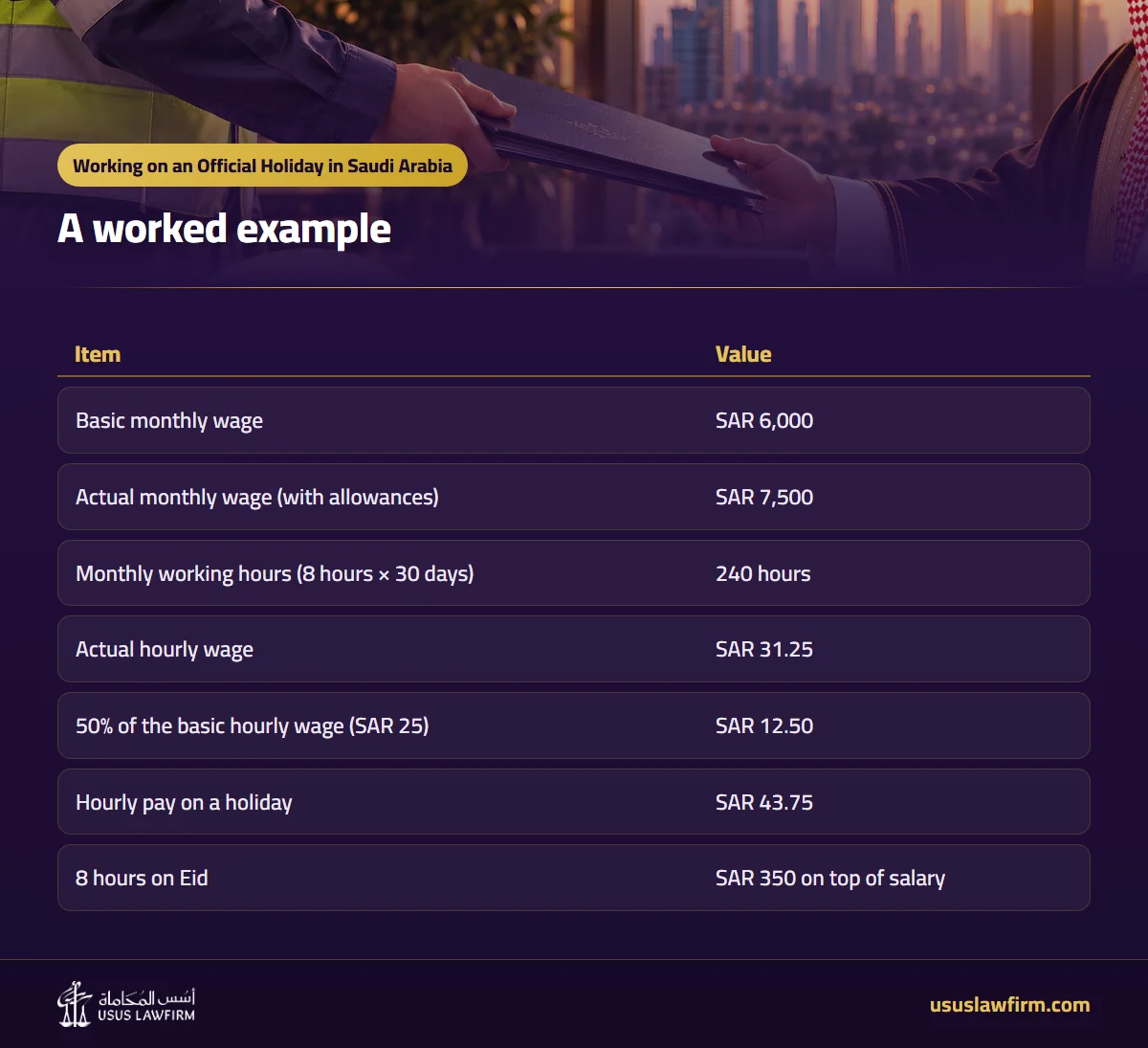
The calculation may differ depending on the contract and how hours are counted; try your own case in the overtime calculator.
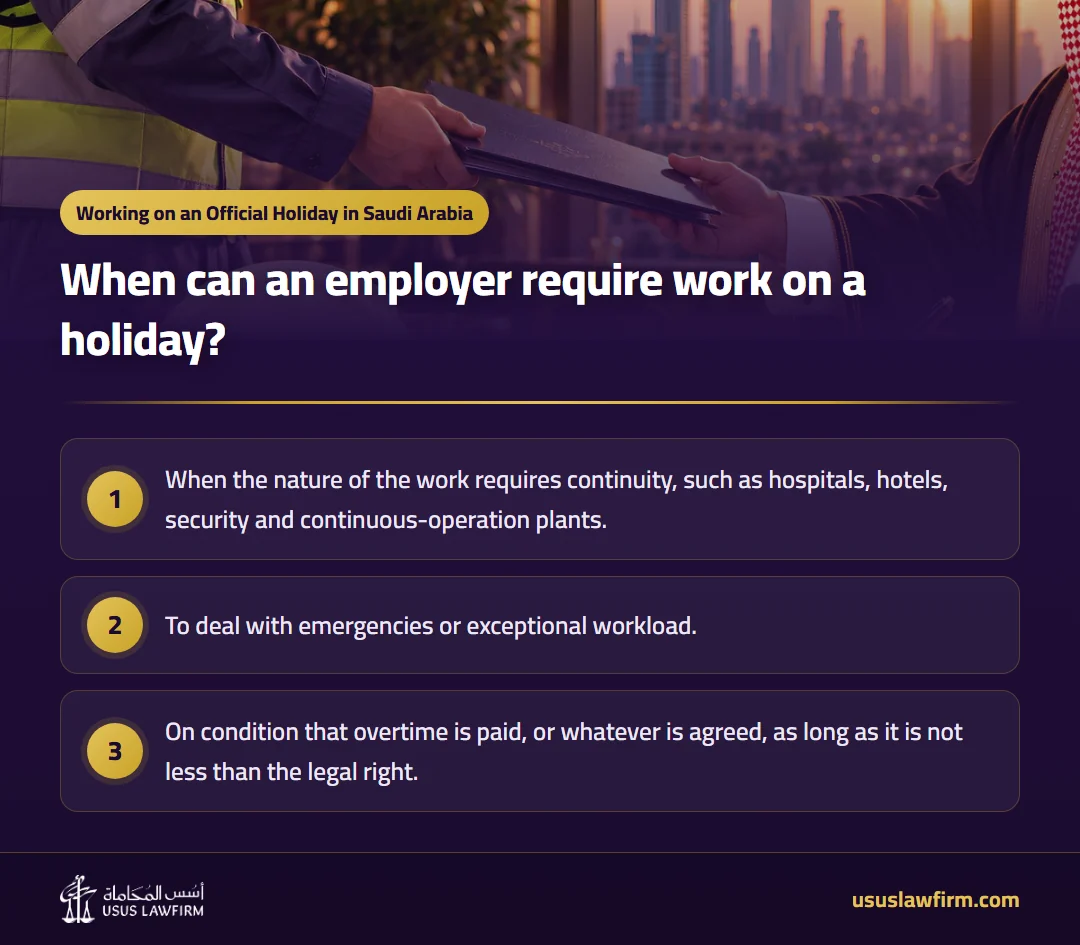
When can an employer require work on a holiday?
- When the nature of the work requires continuity, such as hospitals, hotels, security and continuous-operation plants.
- To deal with emergencies or exceptional workload.
- On condition that overtime is paid, or whatever is agreed, as long as it is not less than the legal right.
Not paid for working on a holiday?
- Keep proof of your work: attendance records, messages in which your manager assigned you, and the shift schedule.
- Ask your employer in writing.
- File a complaint through the Ministry of Human Resources channels. Read labor office complaints.
- If it is not settled amicably, it is referred to the Labor Court. Read filing a labor claim.
Frequently asked questions
Can I be given a day off instead of overtime pay?
Yes, if you both agree, as long as it is not less than your right; the default in the law is overtime pay.
I refused to work on Eid. Can my employer penalise me?
It depends on the nature of the work, the contract and the circumstances; outside genuine necessity, they cannot force you without the legal pay.
Does this apply to expatriate workers?
Yes, the rules on holidays and overtime are the same for Saudis and expatriates.
For the dates of every holiday, read official holidays in Saudi Arabia.
Want to claim your pay?
The Usus Law Firm team handles labor cases: calculating what you are owed, amicable settlement and labor claims, in Riyadh and Tabuk.
Legal review: the Usus Law Firm team
A select team of lawyers and legal advisers licensed by the Saudi Ministry of Justice, working from Riyadh and Tabuk, with experience before the general, commercial, labor, criminal, personal status and administrative courts. Every article is reviewed before publication and updated when laws or regulations change.
Last reviewed: 12 October 2026
This article is general legal information and is not a substitute for advice on your specific case. Court proceedings in Saudi Arabia are in Arabic; the official Arabic text of each law prevails.
Request a quick consultation
Leave your name and mobile number, and a lawyer from our Riyadh or Tabuk office will call you during working hours. We advise in English.