


Release on bail in Saudi Arabia means a detainee goes home before judgment, undertaking to appear when called, sometimes with a guarantor. The Criminal Procedure Law allows release at any time during the investigation if detention is not justified (Article 120). Major crimes requiring detention are different. Here is when release is possible, who decides, and what a guarantor takes on.

Reviewed by: Khaled ElnaggarDirector of USUS Law FirmLast updated:
Facing a criminal case, or is a relative detained?
Tell us what you know: the charge, the date of arrest and who summoned you. A lawyer from our team will reply.
WhatsApp a lawyerCall RiyadhCall Tabuk
What you send us is confidential and used only to study your case.
Service page: Criminal lawyer in Riyadh
When is release allowed?
Article 120 allows the investigator, on his own initiative or at the accused's request, to order release if: detention has no justification; release will not harm the investigation; and there is no fear the accused will flee or hide, provided he undertakes to appear when asked. Unless release is mandatory, he must give an address the investigator approves (Article 121). Major crimes requiring detention are defined by the Attorney General (Article 112), and release there is harder. See detention period.
Who decides?
| Stage | Who | Article |
|---|---|---|
| During investigation | The investigator at the Public Prosecution | 120 |
| After referral to court | The court; the prosecutor may object to release | 123 |
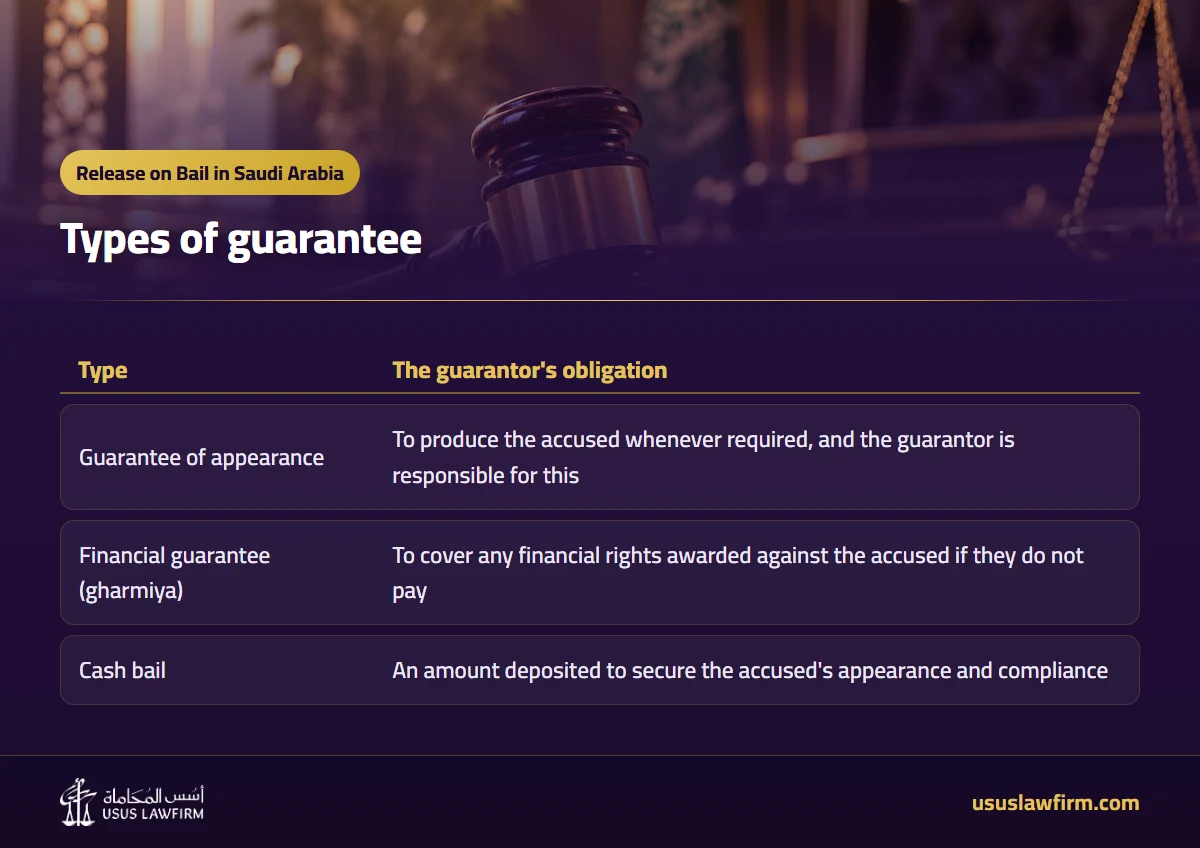
Types of guarantee in practice
- Attendance guarantee (kafala hudooriya): the guarantor undertakes to bring the accused when required.
- Financial guarantee (kafala gharmiya): the guarantor covers financial rights awarded against the accused if he does not pay.
The authority decides which guarantee it accepts and the guarantor's conditions in each case.
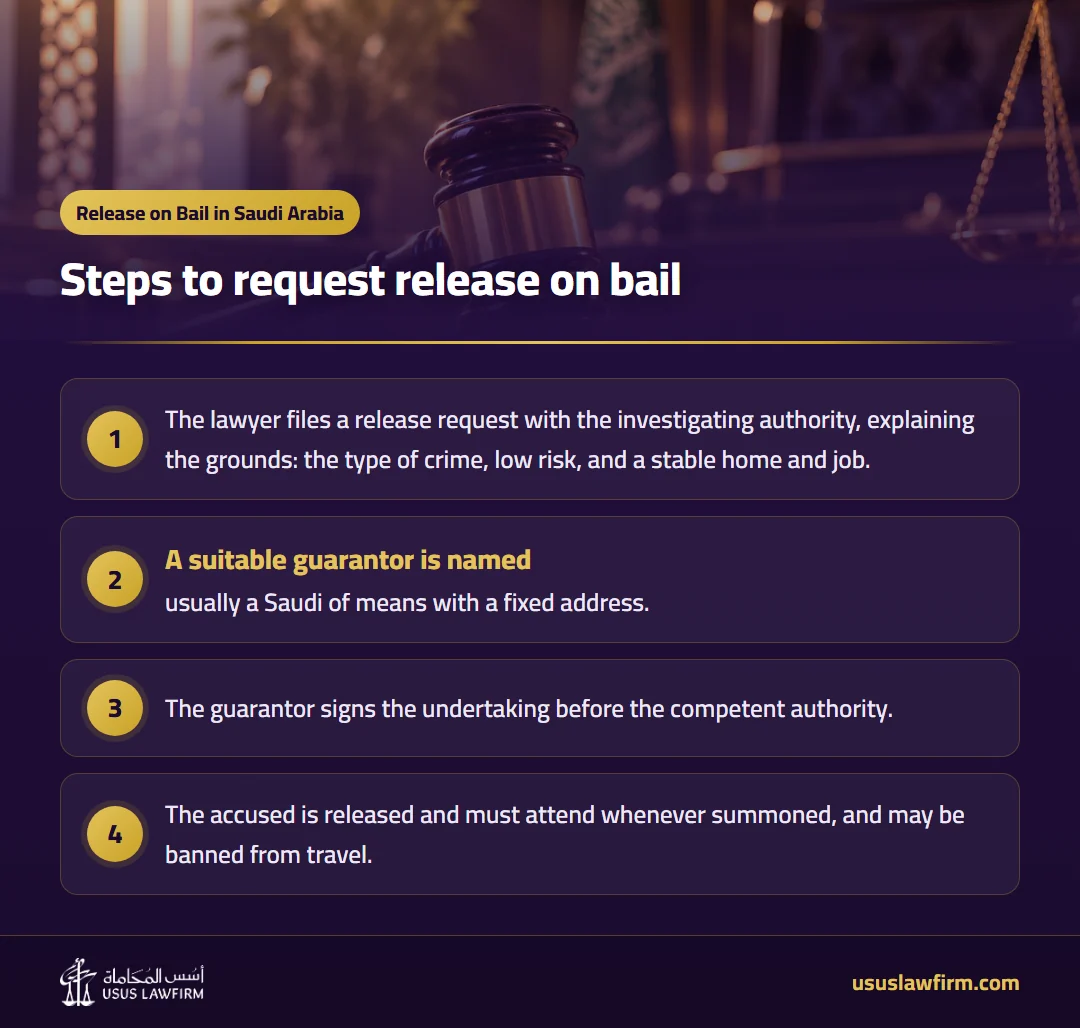
Steps
- The lawyer files a written, reasoned request: no justification for detention, no harm to the investigation, no risk of flight (work, home, family, no record).
- An approved address, and a guarantor if required.
- Signing the undertaking, and the guarantor's commitment.
- If refused, the request is renewed at each extension of detention, or before the court after referral.
Release does not end the case: a new detention order may be issued if the evidence grows stronger or the accused breaches his conditions (Article 122).
Frequently asked questions
When is a detainee released on bail in Saudi Arabia?
When detention has no justification, release will not harm the investigation, and there is no fear of flight, with an undertaking to appear (Article 120) and an approved address (Article 121).
Who releases the accused after referral to court?
The court; the prosecutor may object (Article 123).
Can a released person be detained again?
Yes, if the evidence grows stronger, he breaches his conditions, or circumstances require it (Article 122).
Is bail possible in major crimes?
Major crimes requiring detention are defined by the Attorney General (Article 112); release there is harder and decided case by case.
Want to request release for a relative?
Usus Law Firm files reasoned release requests and follows them with the Prosecution and the court, in Riyadh and Tabuk. See criminal lawyer in Riyadh.
Articles cited are from the Law of Criminal Procedure (Royal Decree M/2 of 22/1/1435H). Always check the current official text.
Legal review: the Usus Law Firm team
A select team of lawyers and legal advisers licensed by the Saudi Ministry of Justice, working from Riyadh and Tabuk, with experience before the general, commercial, labor, criminal, personal status and administrative courts. Every article is reviewed before publication and updated when laws or regulations change.
Last reviewed: 19 October 2026
This article is general legal information and is not a substitute for advice on your specific case. Court proceedings in Saudi Arabia are in Arabic; the official Arabic text of each law prevails.
Request a quick consultation
Leave your name and mobile number, and a lawyer from our Riyadh or Tabuk office will call you during working hours. We advise in English.