


Disobedience to parents ('uquq) is a major sin in Sharia, but it can also become a court case under Saudi law. Parents may complain about an abusive child, and they have clear legal rights such as maintenance. Even so, the courts and authorities prefer reconciliation before punishment. Here is when it becomes a case, what happens, and parents' rights.

Reviewed by: Ghada Nasser Al-HarbiAttorney at USUS Law FirmLast updated:
When does it become a case?
- Physical or verbal abuse of one or both parents.
- Threats, or throwing them out of the home.
- Refusing to support needy parents while able to.
- Taking or using the parents' money without permission.
- Neglect that puts an elderly or sick parent at risk.
Two routes: maintenance and criminal complaint
| Parental maintenance claim | Disobedience complaint | |
|---|---|---|
| Aim | Obliging an able child to provide maintenance | Punishing and stopping the abuse |
| Where | the Personal Status Court | The police, then the Public Prosecution, then the Criminal Court |
| Result | A judgment for monthly maintenance that can be enforced | A ta'zir penalty set by the judge; an undertaking and reconciliation may suffice |
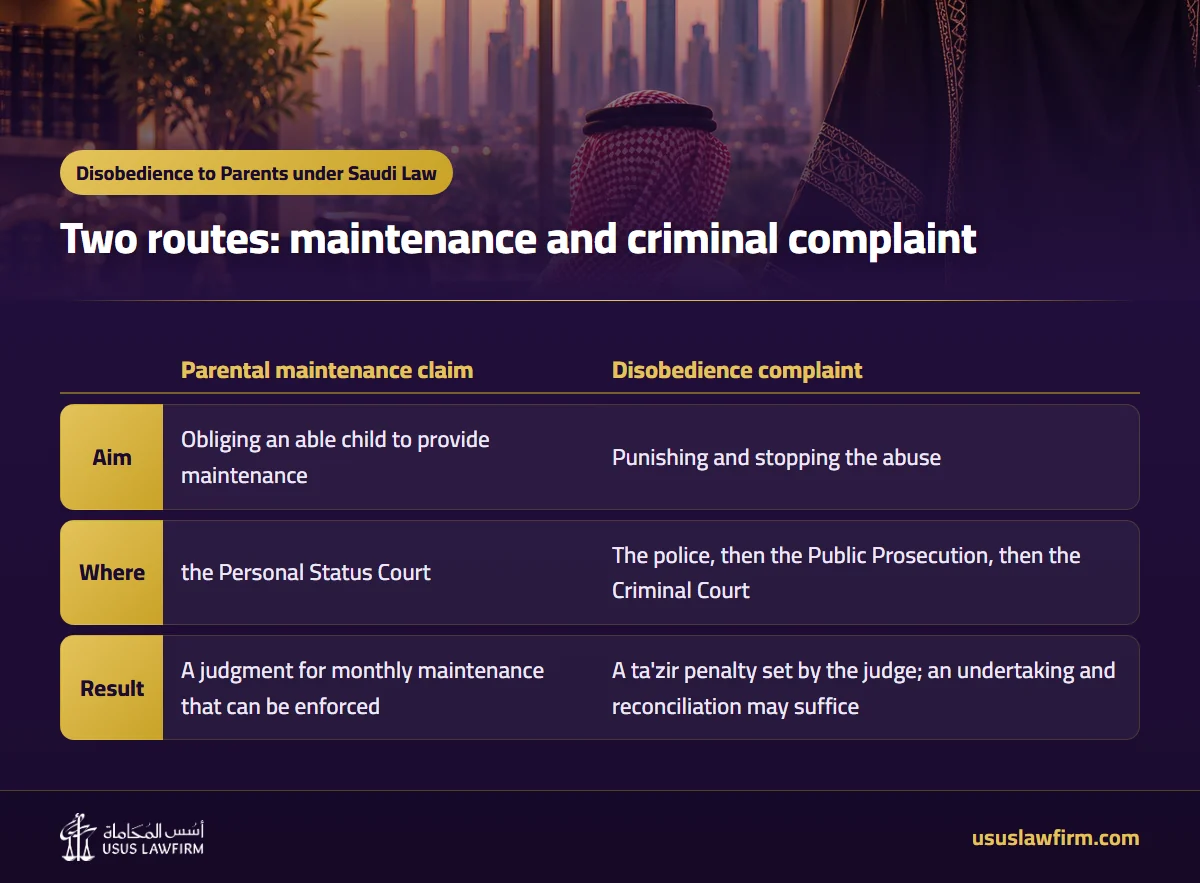
The penalty is discretionary, set according to the act, its seriousness and circumstances, and pardon and reconciliation weigh heavily; check the current official text.
Domestic abuse and protecting parents
If disobedience reaches physical or psychological abuse, it falls under the Protection from Abuse Law, and the competent bodies step in to protect the parent, especially an elderly or sick one. Reports can be made through the official channels. Read Kollona Amn.
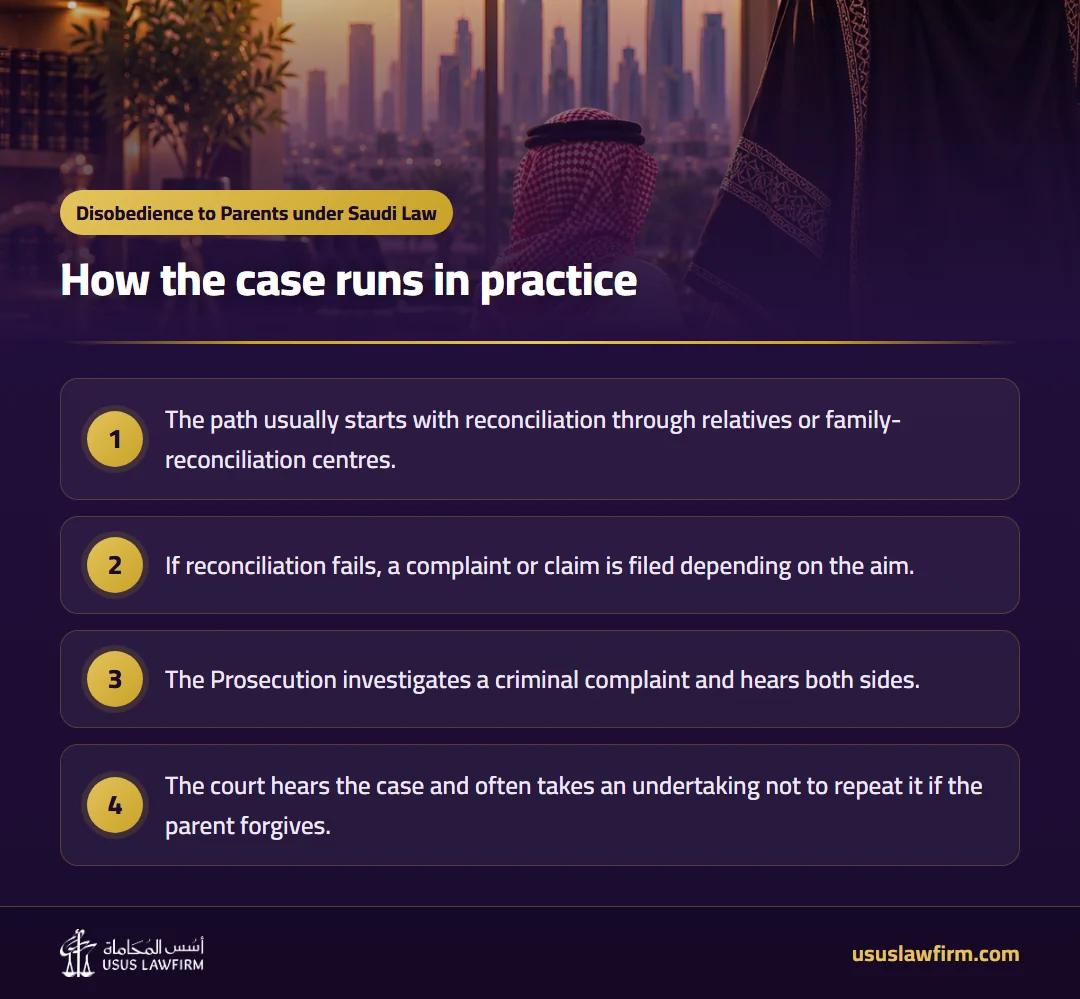
How the case runs in practice
- The path usually starts with reconciliation through relatives or family-reconciliation centres.
- If reconciliation fails, a complaint or claim is filed depending on the aim.
- The Prosecution investigates a criminal complaint and hears both sides.
- The court hears the case and often takes an undertaking not to repeat it if the parent forgives.
Frequently asked questions
Is a disobedient son sent to prison?
A ta'zir penalty may be imposed according to the act, but the parent's forgiveness and reconciliation weigh heavily, and the court considers the family's interest.
Must a son support his parents?
Yes, a child of means must support needy parents, and they can claim it in court.
Can a mother file a complaint against her son?
Yes, either parent may complain, and may withdraw at any stage.
A family dispute that needs wisdom?
The Usus Law Firm team handles personal status cases and maintenance claims in confidence, seeking amicable solutions first, in Riyadh and Tabuk.
Legal review: the Usus Law Firm team
A select team of lawyers and legal advisers licensed by the Saudi Ministry of Justice, working from Riyadh and Tabuk, with experience before the general, commercial, labor, criminal, personal status and administrative courts. Every article is reviewed before publication and updated when laws or regulations change.
Last reviewed: 12 October 2026
This article is general legal information and is not a substitute for advice on your specific case. Court proceedings in Saudi Arabia are in Arabic; the official Arabic text of each law prevails.
Request a quick consultation
Leave your name and mobile number, and a lawyer from our Riyadh or Tabuk office will call you during working hours. We advise in English.