


Zina (unlawful sexual intercourse) is a hudud offence in Islamic law, applied by Saudi courts with very strict standards of proof. This page explains the ruling, the punishment for married and unmarried persons, how it is proven, why the hadd is rarely proven, and the risk of accusing someone without evidence.

Reviewed by: Khaled ElnaggarDirector of USUS Law FirmLast updated:
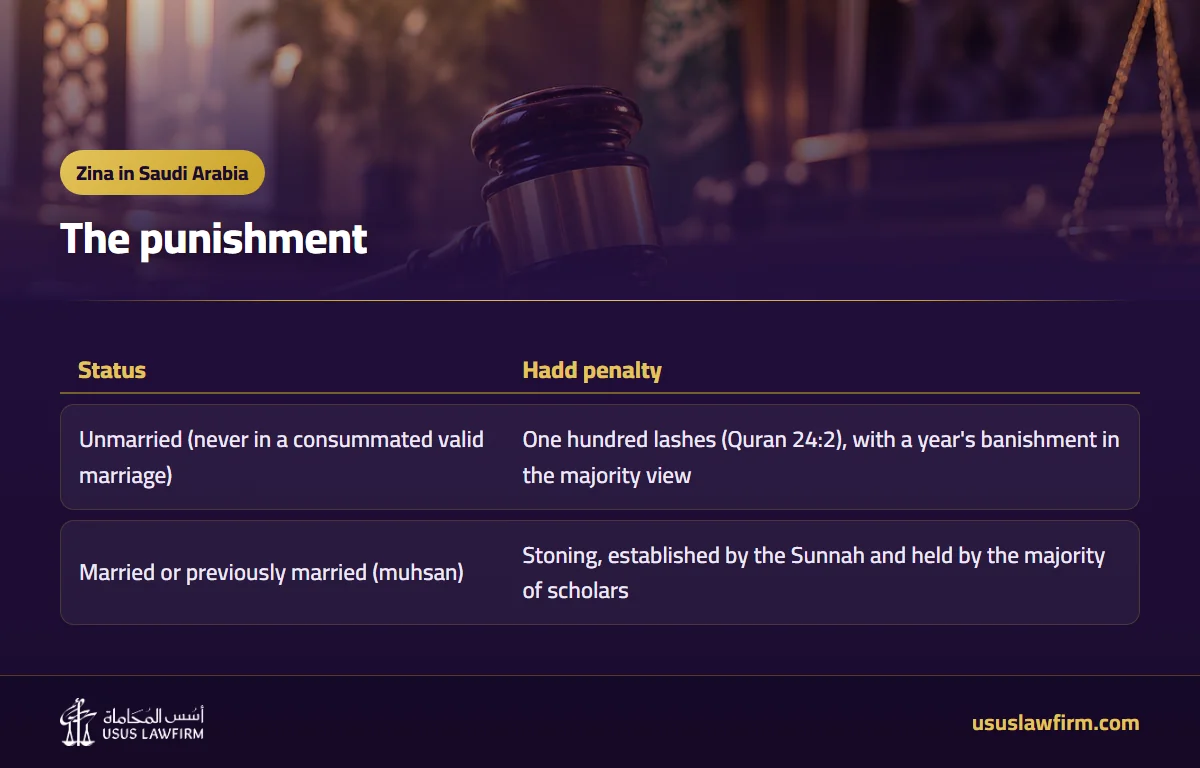
The punishment
| Status | Hadd penalty |
|---|---|
| Unmarried (never in a consummated valid marriage) | One hundred lashes (Quran 24:2), with a year's banishment in the majority view |
| Married or previously married (muhsan) | Stoning, established by the Sunnah and held by the majority of scholars |
The penalty is the same for men and women, and mutual consent does not change the ruling.
How zina is proven
- Testimony: four upright witnesses to the act itself (Quran 24:13), which is extremely rare.
- Confession: explicit and voluntary; in the majority view it may be retracted before execution, which drops the hadd.
- Doubt: hudud are averted by doubt.
So most cases do not reach the hadd. Lesser acts that are proven, such as prohibited seclusion or indecent messages, may be punished at the judge's discretion (ta'zir), and related cybercrimes such as blackmail fall under their own law.
Accusing without proof: the qadhf penalty
Whoever accuses another of zina without four witnesses faces the hadd of qadhf: eighty lashes, and his testimony is no longer accepted (Quran 24:4). Between spouses there is a special procedure, li'an, before the personal status court. See defamation and qadhf.
Frequently asked questions
What is the punishment for zina in Saudi Arabia?
If the hadd is proven: one hundred lashes for the unmarried and stoning for the muhsan, proven only by four witnesses or a retractable confession. Otherwise, proven lesser acts may receive a ta'zir penalty.
What if someone accuses me without evidence?
An accuser without four witnesses faces the qadhf penalty if the accused person claims their right, and a qadhf claim can be filed.
These cases touch reputation and family and need full confidentiality. Usus Law Firm handles criminal cases and defamation claims; see our criminal lawyer in Riyadh.
Legal review: the Usus Law Firm team
A select team of lawyers and legal advisers licensed by the Saudi Ministry of Justice, working from Riyadh and Tabuk, with experience before the general, commercial, labor, criminal, personal status and administrative courts. Every article is reviewed before publication and updated when laws or regulations change.
Last reviewed: 25 October 2026
This article is general legal information and is not a substitute for advice on your specific case. Court proceedings in Saudi Arabia are in Arabic; the official Arabic text of each law prevails.
Request a quick consultation
Leave your name and mobile number, and a lawyer from our Riyadh or Tabuk office will call you during working hours. We advise in English.