

Sponsorship transfer, officially transfer of services today, is an expatriate worker moving from one employer to another inside the Kingdom. Since the Labour Reform Initiative, transfer is possible in set cases without the current employer's consent.
With and without the employer's consent
| Case | What is needed |
|---|---|
| With the current employer's consent | A request by the new employer and approval by the current one on the official platform |
| After the contract ends | Usually no consent from the former employer |
| During the contract | Allowed in cases set by the rules, with conditions including notice |
| Employer breach (late wages, expired work permit, missing labour-case hearings) | Cases that allow transfer without consent as the rules provide |
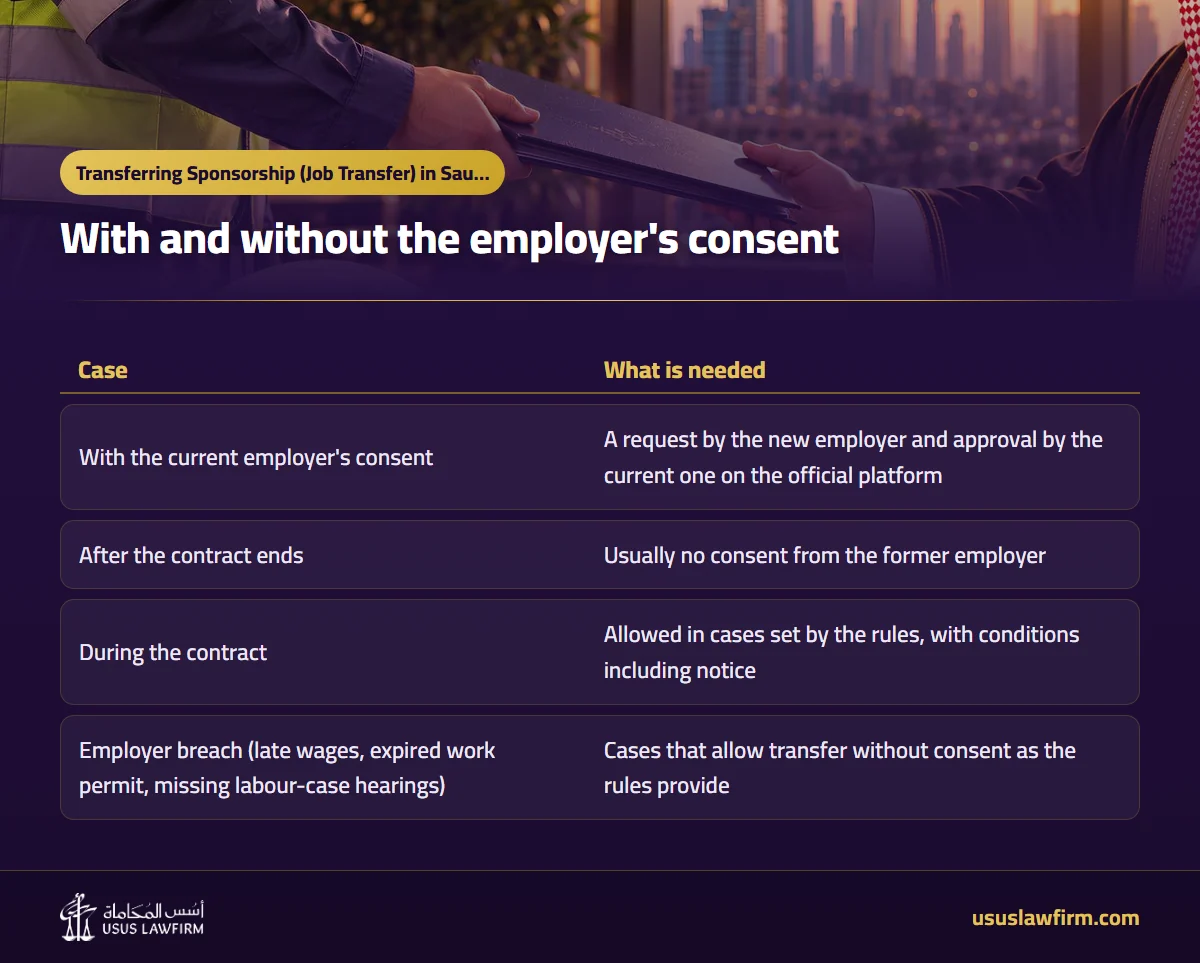
Cases, periods and conditions are set and updated by the Ministry of Human Resources, and the request goes through Qiwa; check the latest official text.
Protect your rights before moving
- End-of-service award: moving does not cancel it; use the end-of-service calculator.
- Late wages: document them; see the wage protection system.
- Ending before the contract term: compensation may be due; see resignation and ending employment and Article 81.
- Absence (huroob) report: if filed unfairly, object immediately.
Read the kafala system in Saudi Arabia. Moving and claiming your dues are not exclusive: see filing a labour case.
Frequently asked questions
Can my employer refuse my transfer after my contract ends?
Once the contract has ended, the employer's right to object becomes much weaker under the updated rules.
My employer has not paid my salary for months. Can I transfer?
Unpaid wages are one of the main grounds for transferring without consent, and for leaving work while keeping your rights. Document the delay before taking any step.
Should I sue or transfer?
The two do not conflict: you can transfer and claim your dues through a labour case.
A dispute with your employer before transferring?
The Usus Law Firm team handles labour cases for workers and employers, in Riyadh and Tabuk.
This article is general legal information and is not a substitute for advice on your specific case. Court proceedings in Saudi Arabia are in Arabic; the official Arabic text of each law prevails.
Request a quick consultation
Leave your name and mobile number, and a lawyer from our Riyadh or Tabuk office will call you during working hours. We advise in English.

