

The penalty for drug use in Saudi Arabia is 6 months to 2 years in prison under Article 41 of the Narcotics Law. But a first offence has routes no other case has: the investigation may be closed without going to court, the court may order treatment instead of prison, and it may reduce or suspend the sentence. Knowing these routes in the first days can change the whole case.

Reviewed by: Rakan Jameel Al-DubaisiFounder & CEO of USUS Law FirmLast updated:
Quick answer
The penalty for drug use in Saudi Arabia is 6 months to 2 years in prison under Article 41 of the Narcotics Law. For a first offence the investigation may be closed without going to court (Article 42(2)) if the accused is not over 20 and the other conditions are met, and the court may order treatment instead of prison, or reduce or suspend the sentence.
- Use differs sharply from possession with intent to deal (Article 38: 5 to 15 years), so how the act is described matters.
- Knowing these routes in the first days can change the whole case.
Facing a criminal case, or is a relative detained?
Tell us what you know: the charge, the date of arrest and who summoned you. A lawyer from our team will reply.
WhatsApp a lawyerCall RiyadhCall Tabuk
What you send us is confidential and used only to study your case.
Service page: Drug lawyer in Riyadh
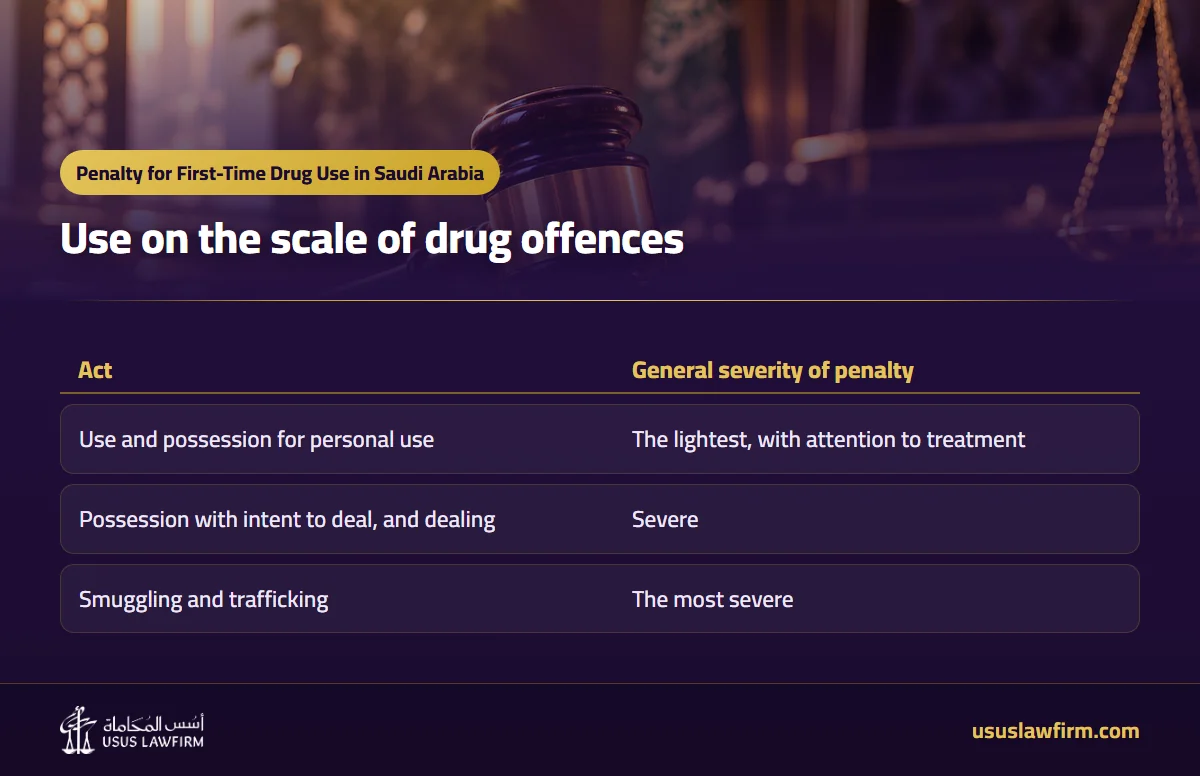
Where use sits among drug offences
| Offence | Article | Basic penalty |
|---|---|---|
| Use, or possession for personal use | Art. 41 | 6 months to 2 years in prison |
| Possession or transport with no intent to deal or use | Art. 39 | 2 to 5 years, up to 50 lashes each time, fine SAR 3,000–30,000 |
| Possession, sale or purchase with intent to deal | Art. 38 | 5 to 15 years, up to 50 lashes each time, fine SAR 1,000–50,000 |
| Smuggling, importing, manufacturing; dealing a second time | Art. 37 | Death as ta'zir; the court may instead impose at least 15 years and a fine of at least SAR 100,000 |
Article 41 raises the penalty if the user works in drug control or used drugs on duty.
Closing the case for a first-time user
Article 42(2) allows the investigation into first-time use to be closed if all of these apply: the accused is not over 20; the use is not combined with another offence that must be heard under Sharia; it is not combined with a traffic accident causing death; and the accused did not violently resist arrest. A closed case ends without a conviction.
Asking for treatment before arrest
Under Article 42(1), no case is brought for use or addiction against a person who comes forward, or whose relative comes forward, asking for treatment, provided any drugs are handed over or their location disclosed. Treatment is strictly confidential, and disclosing a patient's identity is a crime (Article 51).
Treatment instead of punishment
- The court may commit an addict to a treatment facility instead of punishing him (Article 43).
- It may instead require a proven addict to attend a psychiatric clinic (Article 50).
- Article 60 lets the court go below the minimum or suspend the sentence for a non-repeat offender. If the suspension period passes with no new drug offence, the judgment is treated as if it never existed.
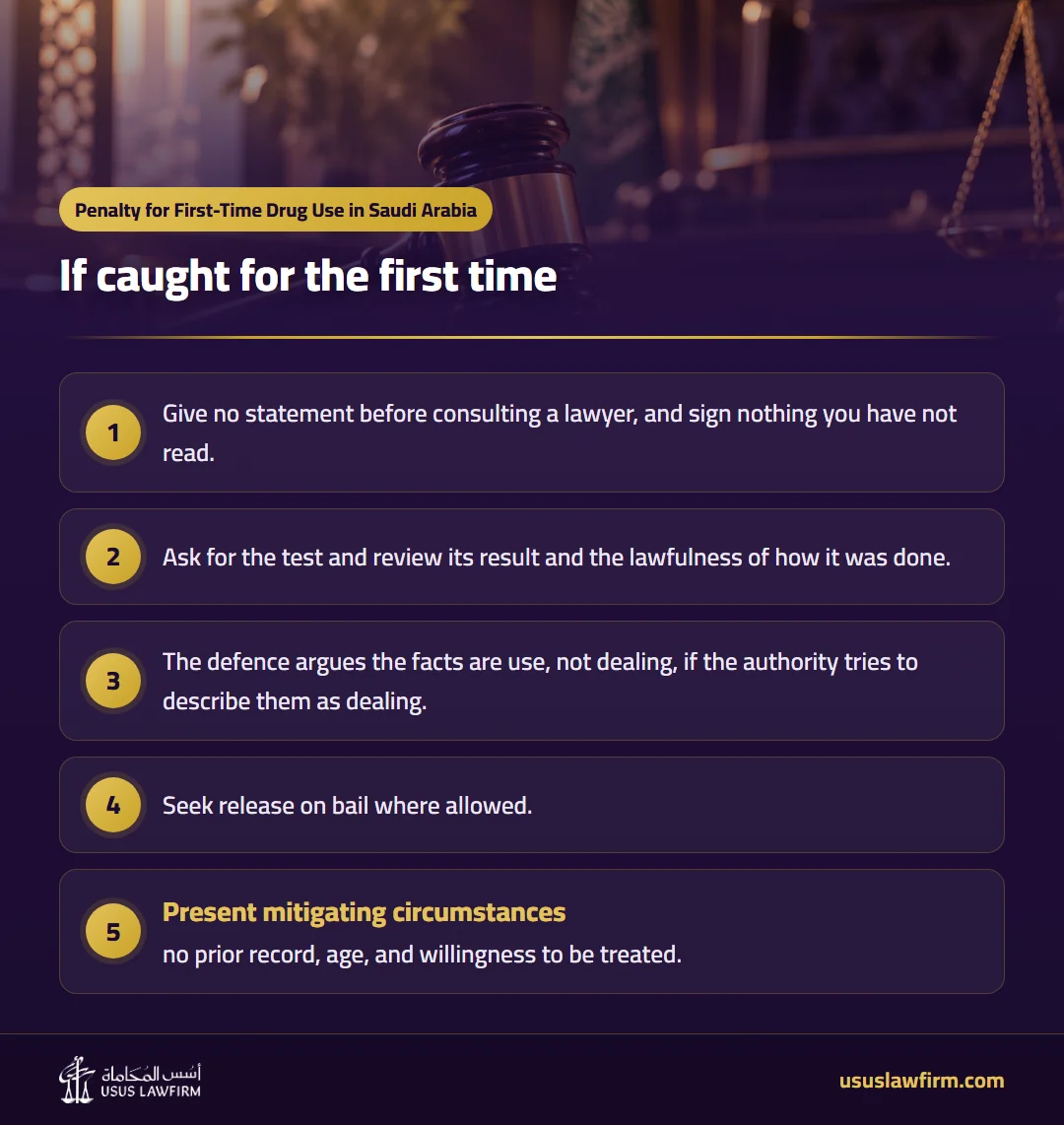
If caught for the first time
- Say nothing before knowing the charge; the investigator must state it at the first interview (Art. 101 of the Criminal Procedure Law), and a lawyer may attend (Art. 65).
- Do not sign what you have not read or understood; ask for a translation if needed.
- Ask for the test result and how the sample was taken and kept.
- Challenge any "dealing" label from the first interview.
- Apply for release, with proof of work and residence. See release on bail.
Frequently asked questions
Is a first-time drug user jailed in Saudi Arabia?
The basic penalty is 6 months to 2 years (Article 41). But the case may be closed for a user aged 20 or under (Article 42), treatment may replace punishment (Articles 43 and 50), and the court may reduce or suspend the sentence (Article 60).
Will the hospital report a patient who asks for treatment?
No case is brought against a person who asks for treatment, or whose relative does, if the drugs are handed over (Article 42), and treatment is confidential (Article 51).
Does first-time use create a criminal record?
A closed case is not a conviction. A conviction is recorded, but a suspended sentence is treated as if it never existed once the suspension period passes without a new offence (Article 60).
Are foreigners treated differently?
The penalty is the same, but a non-Saudi convicted of a drug offence is deported after serving the sentence (Article 56). See drug penalties for foreigners.
A relative caught for the first time?
Usus Law Firm handles drug cases confidentially, from investigation to judgment, in Riyadh and Tabuk.
Articles cited are from the Law of Combating Narcotics and Psychotropic Substances (Royal Decree M/39 of 8/7/1426H) and the Law of Criminal Procedure (Royal Decree M/2 of 22/1/1435H). Always check the current official text.
Legal review: the Usus Law Firm team
A select team of lawyers and legal advisers licensed by the Saudi Ministry of Justice, working from Riyadh and Tabuk, with experience before the general, commercial, labor, criminal, personal status and administrative courts. Every article is reviewed before publication and updated when laws or regulations change.
Last reviewed: 19 October 2026
This article is general legal information and is not a substitute for advice on your specific case. Court proceedings in Saudi Arabia are in Arabic; the official Arabic text of each law prevails.
Request a quick consultation
Leave your name and mobile number, and a lawyer from our Riyadh or Tabuk office will call you during working hours. We advise in English.