


"Felony", "misdemeanour" and "violation" are words people use often, taken from other legal systems that classify crimes by the severity of the penalty. But the Saudi system classifies crimes differently, based on Islamic Sharia and statutory law. Understanding this explains why one accused is detained while another is released, and why penalties differ.

Reviewed by: Rakan Jameel Al-DubaisiFounder & CEO of USUS Law FirmLast updated:
Facing a criminal case, or is a relative detained?
Tell us what you know: the charge, the date of arrest and who summoned you. A lawyer from our team will reply.
WhatsApp a lawyerCall RiyadhCall Tabuk
What you send us is confidential and used only to study your case.
Service page: Criminal lawyer in Riyadh
The common classification in other Arab laws
| Term | What it means in those laws |
|---|---|
| Felony (jinaya) | The most serious crimes with the heaviest penalties |
| Misdemeanour (junha) | Crimes of medium seriousness |
| Violation (mukhalafa) | The lightest acts, punished by small fines |
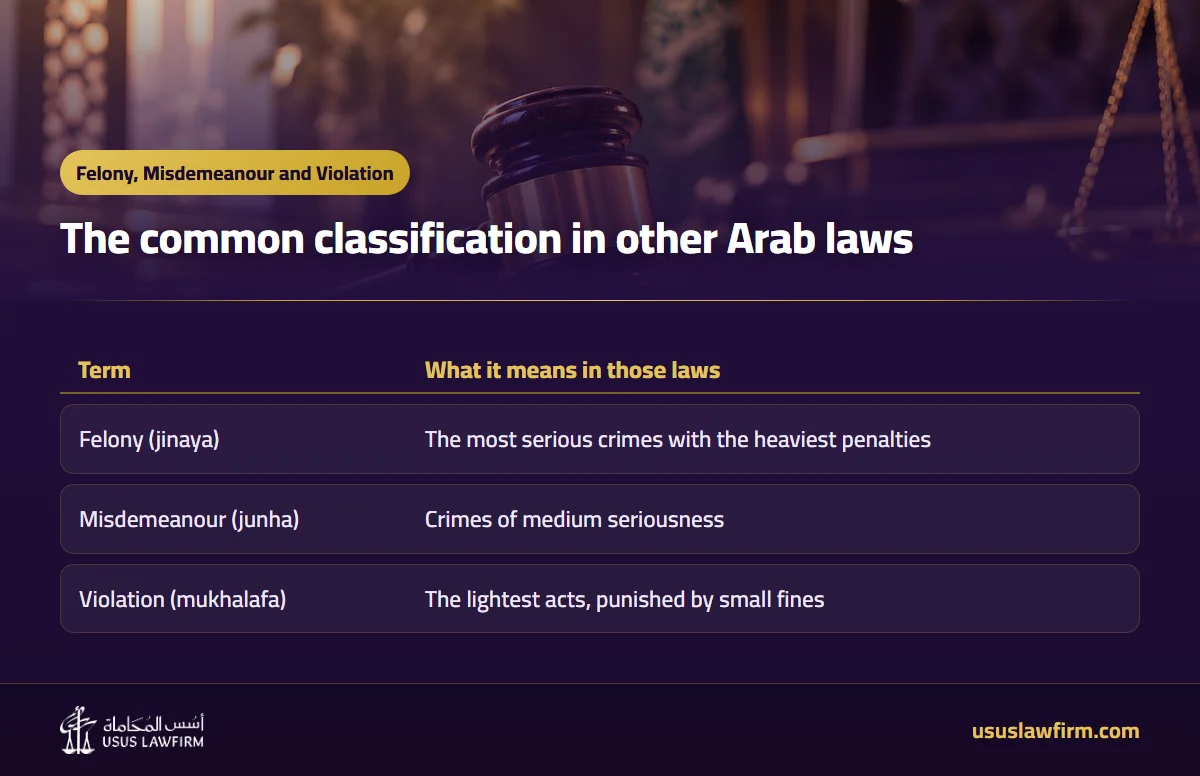
This is not the classification used in the Kingdom, even though the word "jinaya" is sometimes used simply to mean a crime.
How are crimes classified in Saudi Arabia?
| Category | Meaning | Examples |
|---|---|---|
| Hudud crimes | Penalties fixed by Sharia as a right of God, with strict conditions of proof | Hadd theft, slander (qadhf) |
| Qisas and diya crimes | Offences against life or body, with a private right for the victim or heirs | Killing, injuries |
| Ta'zir crimes | Penalties not fixed by Sharia, set by statute or by the judge | Most crimes: drugs, fraud, forgery, cybercrime |
Read the penalty for theft and blood money in Saudi Arabia.
Major crimes requiring detention
Alongside the Sharia classification there is an important procedural one: major crimes requiring detention, a list issued by decision of the Attorney General that sets the crimes in which the accused is detained and released only by order of the competent authority. In other crimes, release on bail is generally possible. Read release on bail.
The list is updated by decisions of the Attorney General; check the current official list.
And violations?
There are violations of administrative regulations, such as traffic, municipal and labor rules, for which the competent authority imposes administrative fines that are challenged before committees or designated bodies; in most cases they are not crimes in the criminal sense. Read traffic violations and how to object.
Frequently asked questions
Is my case a felony or a misdemeanour?
These terms are not used officially in the Kingdom; the right question is whether it is hadd, qisas or ta'zir, and whether it is one of the crimes requiring detention.
Does the penalty differ by category?
Yes: hudud are fixed by Sharia, ta'zir is set by statute or the judge, and qisas involves the victim's right.
Does an administrative violation create a criminal record?
Administrative violations differ from criminal convictions. Read criminal records.
Need your case assessed?
The Usus Law Firm team handles criminal cases of every kind, in Riyadh and Tabuk.
Legal review: the Usus Law Firm team
A select team of lawyers and legal advisers licensed by the Saudi Ministry of Justice, working from Riyadh and Tabuk, with experience before the general, commercial, labor, criminal, personal status and administrative courts. Every article is reviewed before publication and updated when laws or regulations change.
Last reviewed: 12 October 2026
This article is general legal information and is not a substitute for advice on your specific case. Court proceedings in Saudi Arabia are in Arabic; the official Arabic text of each law prevails.
Request a quick consultation
Leave your name and mobile number, and a lawyer from our Riyadh or Tabuk office will call you during working hours. We advise in English.