


Not all theft is the same under Saudi law. There is hadd theft, with precise conditions and a penalty fixed by Sharia, and ta'zir theft, where the judge sets the penalty because the hadd conditions are not all met, which is far more common in practice. Here is the difference, the conditions, what the defence turns on, and the victim's right to recover their property.

Reviewed by: Rakan Jameel Al-DubaisiFounder & CEO of USUS Law FirmLast updated:
Quick answer
Saudi law has two kinds of theft. Hadd theft carries a penalty fixed by Sharia and needs every condition: secret taking, property reaching the Sharia threshold (nisab), taken from a place where it is kept safe (hirz), no claim or doubt over the property, and proof by the recognised means. If any condition is missing, the theft is ta'zir and the judge sets the penalty, such as prison or a fine, which is far more common in practice.
- Hadd penalties are averted by doubt.
- The victim keeps the right to recover the stolen property.
Facing a criminal case, or is a relative detained?
Tell us what you know: the charge, the date of arrest and who summoned you. A lawyer from our team will reply.
WhatsApp a lawyerCall RiyadhCall Tabuk
What you send us is confidential and used only to study your case.
Service page: Criminal lawyer in Riyadh
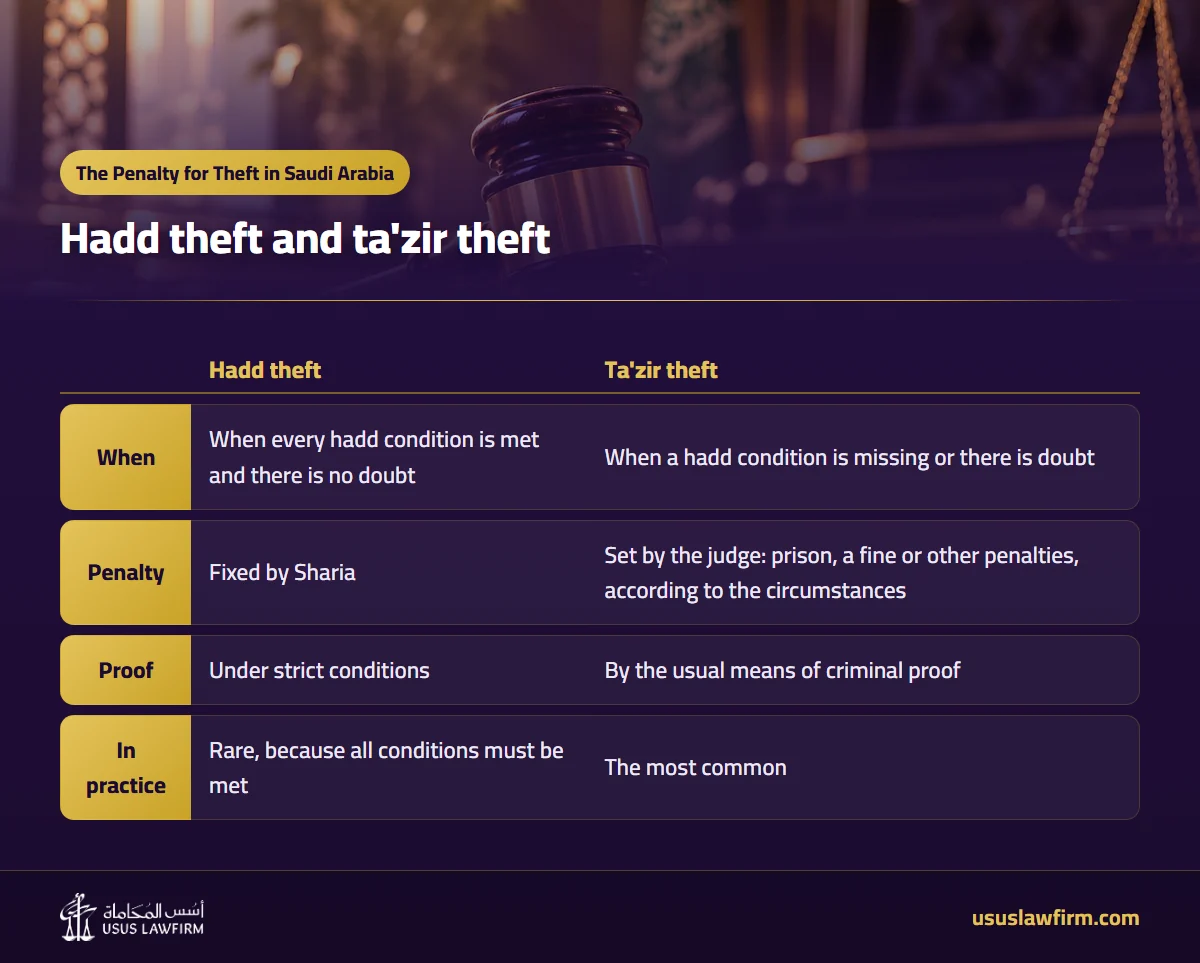
Hadd theft and ta'zir theft
| Hadd theft | Ta'zir theft | |
|---|---|---|
| When | When every hadd condition is met and there is no doubt | When a hadd condition is missing or there is doubt |
| Penalty | Fixed by Sharia | Set by the judge: prison, a fine or other penalties, according to the circumstances |
| Proof | Under strict conditions | By the usual means of criminal proof |
| In practice | Rare, because all conditions must be met | The most common |
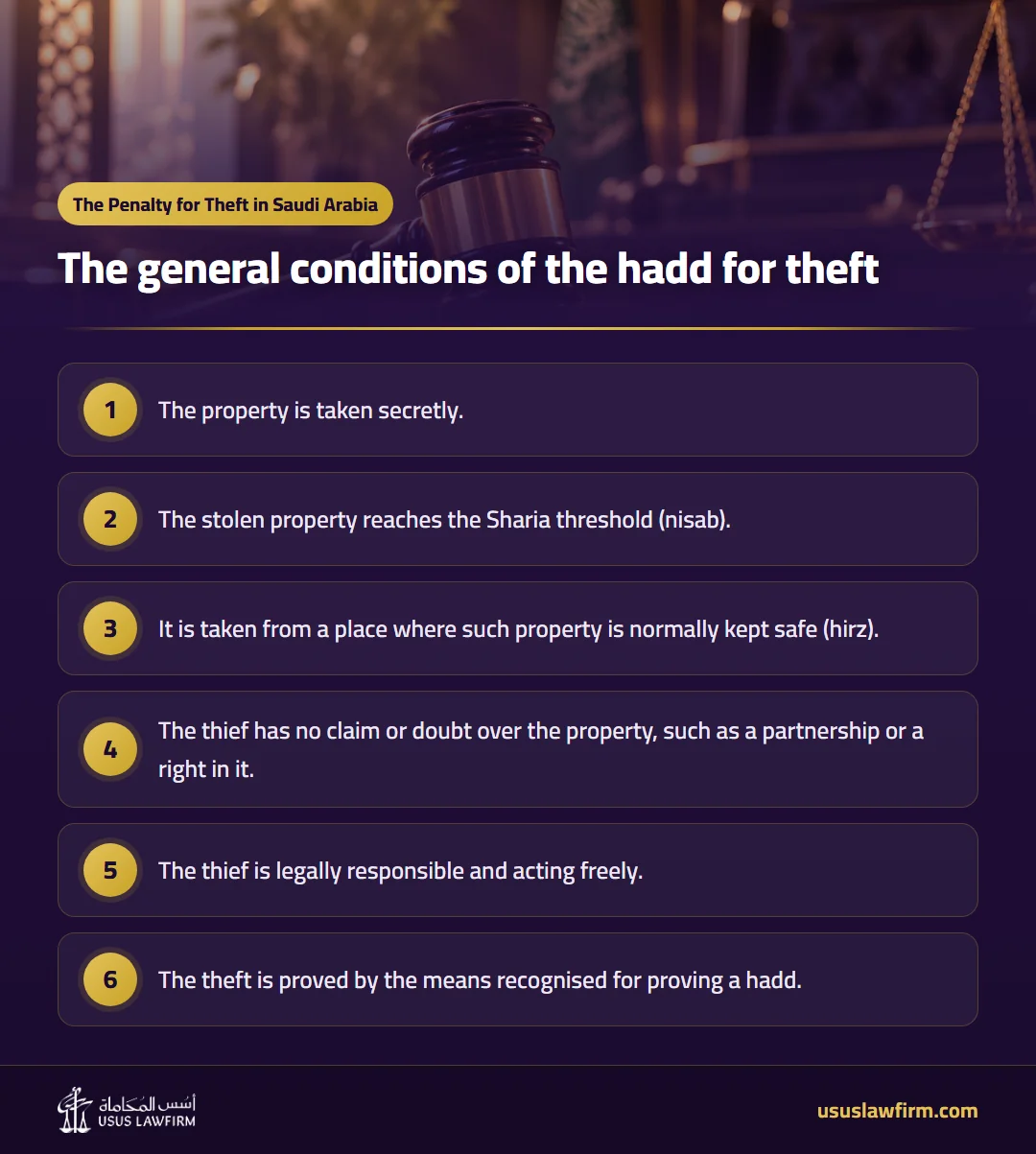
The general conditions of the hadd for theft
- The property is taken secretly.
- The stolen property reaches the Sharia threshold (nisab).
- It is taken from a place where such property is normally kept safe (hirz).
- The thief has no claim or doubt over the property, such as a partnership or a right in it.
- The thief is legally responsible and acting freely.
- The theft is proved by the means recognised for proving a hadd.
Hadd penalties are averted by doubt; if a condition is missing, the case moves to ta'zir. This is a general overview; application is for the courts in each case.
Acts often confused with theft
- Breach of trust: property handed to you willingly by its owner that you then deny.
- Fraud: taking money by deception. Read fraud and scams.
- Embezzlement: by an employee of money held because of their job.
- Theft between relatives and partners: a doubt may exist that prevents the hadd.
What is the defence built on?
- A missing hadd condition, or the existence of doubt.
- Weak evidence or an unlawful arrest and search. Read unlawful arrest and search.
- Retraction of a confession, or a confession made under coercion. Read criminal evidence.
- Returning the property and settling with the victim, and its effect on the penalty.
Frequently asked questions
What is the penalty for a first theft in Saudi Arabia?
Usually a ta'zir penalty set by the judge according to the value stolen, the circumstances and the record, unless the hadd conditions are met.
Is the public right dropped if the thief returns the money?
Returning the money and the victim's waiver affect the penalty, but the public right may remain. Read waiving the private right.
How do I report a theft?
At a police station or through the Kollona Amn app. Read Kollona Amn.
Accused, or the victim of a theft?
The Usus Law Firm team handles criminal cases: the defence, or claiming the private right and recovering the property, in Riyadh and Tabuk.
Legal review: the Usus Law Firm team
A select team of lawyers and legal advisers licensed by the Saudi Ministry of Justice, working from Riyadh and Tabuk, with experience before the general, commercial, labor, criminal, personal status and administrative courts. Every article is reviewed before publication and updated when laws or regulations change.
Last reviewed: 12 October 2026
This article is general legal information and is not a substitute for advice on your specific case. Court proceedings in Saudi Arabia are in Arabic; the official Arabic text of each law prevails.
Request a quick consultation
Leave your name and mobile number, and a lawyer from our Riyadh or Tabuk office will call you during working hours. We advise in English.