


In many drug and criminal cases, the case is won or lost before it reaches court: at the moment of arrest and search. If the search had no legal basis, or the handling of seized items was flawed, the evidence the charge rests on may be excluded. Here is when an arrest or search is unlawful, the effect, and how the defence raises it.

Reviewed by: Raghad Mamdouh Al-KhamshiLegal Affairs Manager at USUS Law FirmLast updated:
Facing a criminal case, or is a relative detained?
Tell us what you know: the charge, the date of arrest and who summoned you. A lawyer from our team will reply.
WhatsApp a lawyerCall RiyadhCall Tabuk
What you send us is confidential and used only to study your case.
Service page: Criminal lawyer in Riyadh
The basic rules
- No one may be arrested or detained except in the cases provided by law.
- People, homes and correspondence are inviolable, and as a rule may not be searched without authorisation from the competent authority or in defined cases such as being caught in the act.
- A search must stay within its purpose, and a record of its procedure and results must be made.
- Seized items must be sealed, labelled and kept in a way that prevents tampering.
Details in the Law of Criminal Procedure. Check the current official text of the articles on arrest and search.
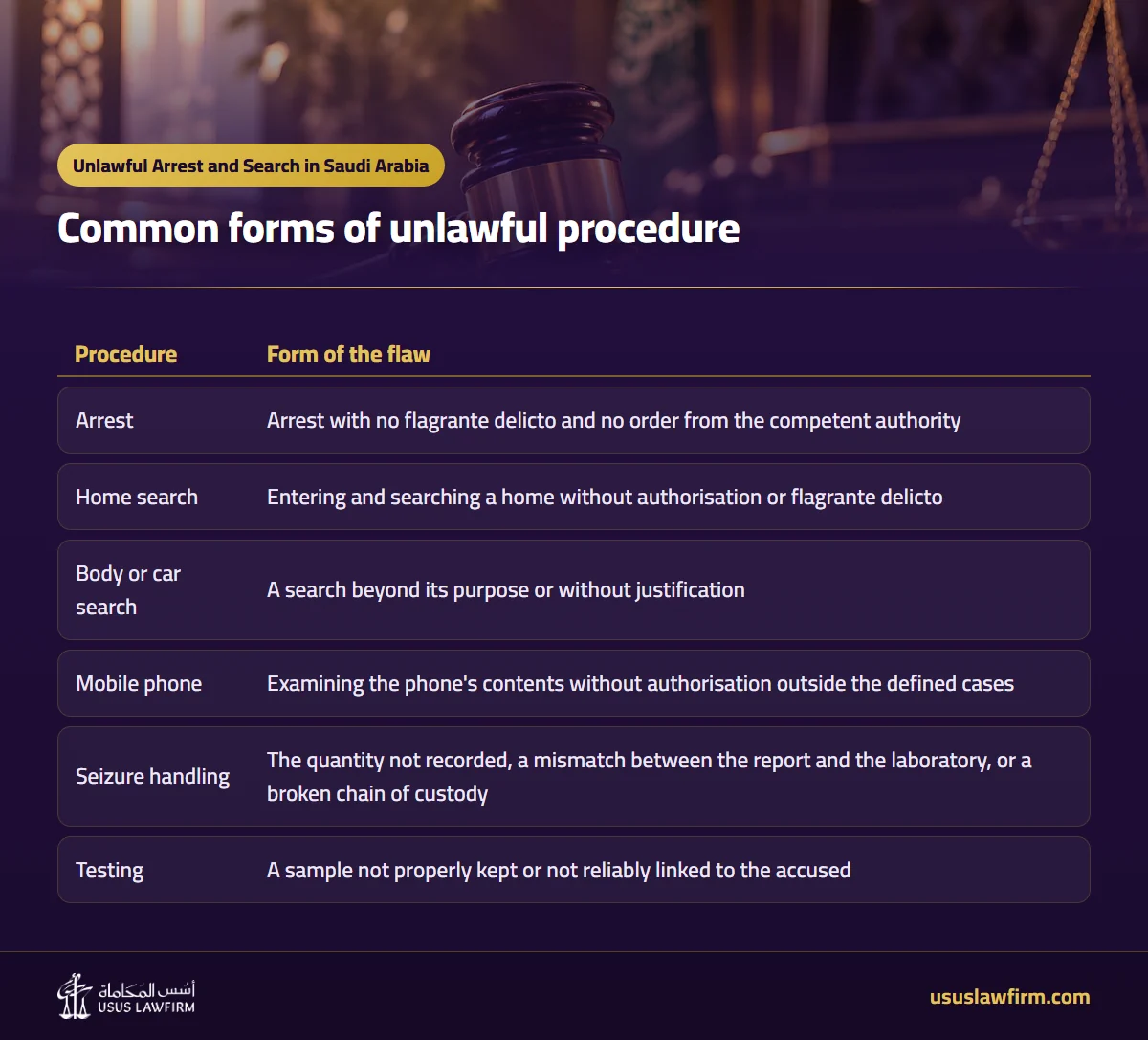
Common forms of unlawful procedure
| Procedure | Form of the flaw |
|---|---|
| Arrest | Arrest with no flagrante delicto and no order from the competent authority |
| Home search | Entering and searching a home without authorisation or flagrante delicto |
| Body or car search | A search beyond its purpose or without justification |
| Mobile phone | Examining the phone's contents without authorisation outside the defined cases |
| Seizure handling | The quantity not recorded, a mismatch between the report and the laboratory, or a broken chain of custody |
| Testing | A sample not properly kept or not reliably linked to the accused |
What is the effect of unlawfulness?
If a procedure is found unlawful, the evidence that resulted from it is, as a rule, excluded. If that evidence is the backbone of the charge, the case may end in acquittal or for lack of evidence. But unlawfulness is not presumed: it must be raised and proved, and other independent evidence may still be enough to convict. Read criminal evidence and its weight.
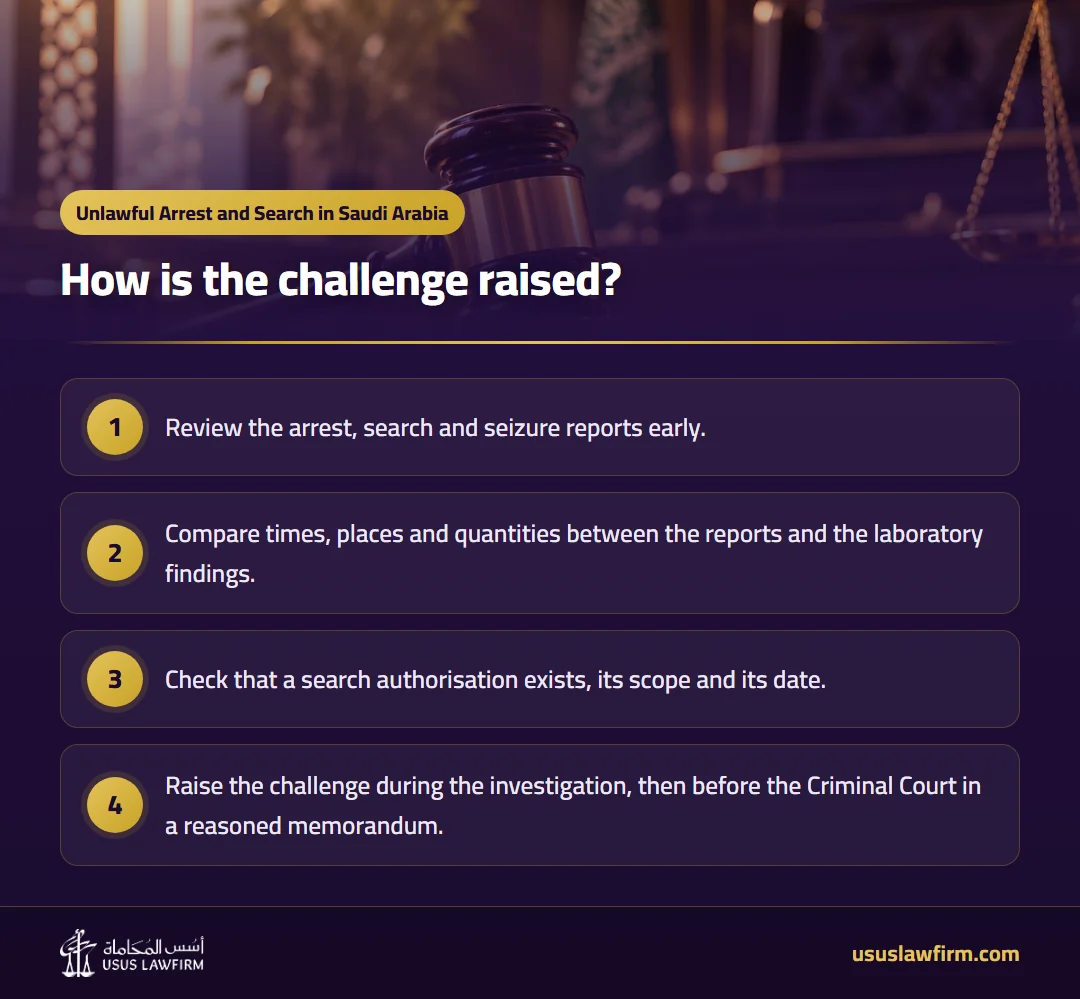
How is the challenge raised?
- Review the arrest, search and seizure reports early.
- Compare times, places and quantities between the reports and the laboratory findings.
- Check that a search authorisation exists, its scope and its date.
- Raise the challenge during the investigation, then before the Criminal Court in a reasoned memorandum.
Frequently asked questions
Can my phone be searched when I am arrested?
Examining a phone's contents touches the privacy of correspondence and has rules; any examination outside them can be challenged.
I signed the search report. Have I lost the right to challenge it?
Not automatically, especially if you signed without understanding or under pressure, but it makes the challenge harder.
When should the challenge be raised?
At the earliest opportunity, ideally from the investigation, and again before the court.
Doubt the lawfulness of the arrest or search?
The Usus Law Firm team examines the case reports and builds the defence on them in criminal cases and drug cases, in Riyadh and Tabuk.
Legal review: the Usus Law Firm team
A select team of lawyers and legal advisers licensed by the Saudi Ministry of Justice, working from Riyadh and Tabuk, with experience before the general, commercial, labor, criminal, personal status and administrative courts. Every article is reviewed before publication and updated when laws or regulations change.
Last reviewed: 12 October 2026
This article is general legal information and is not a substitute for advice on your specific case. Court proceedings in Saudi Arabia are in Arabic; the official Arabic text of each law prevails.
Request a quick consultation
Leave your name and mobile number, and a lawyer from our Riyadh or Tabuk office will call you during working hours. We advise in English.