


When a relative is detained or sentenced to prison, the family's first questions are: how do we visit? How do we stay in touch? How do we know where the case stands? Here we explain prison visits and how to book them, ways to contact a detainee, what the family is entitled to know, and how a lawyer helps at this stage.

Reviewed by: Raghad Mamdouh Al-KhamshiLegal Affairs Manager at USUS Law FirmLast updated:
Facing a criminal case, or is a relative detained?
Tell us what you know: the charge, the date of arrest and who summoned you. A lawyer from our team will reply.
WhatsApp a lawyerCall RiyadhCall Tabuk
What you send us is confidential and used only to study your case.
Service page: Criminal lawyer in Riyadh
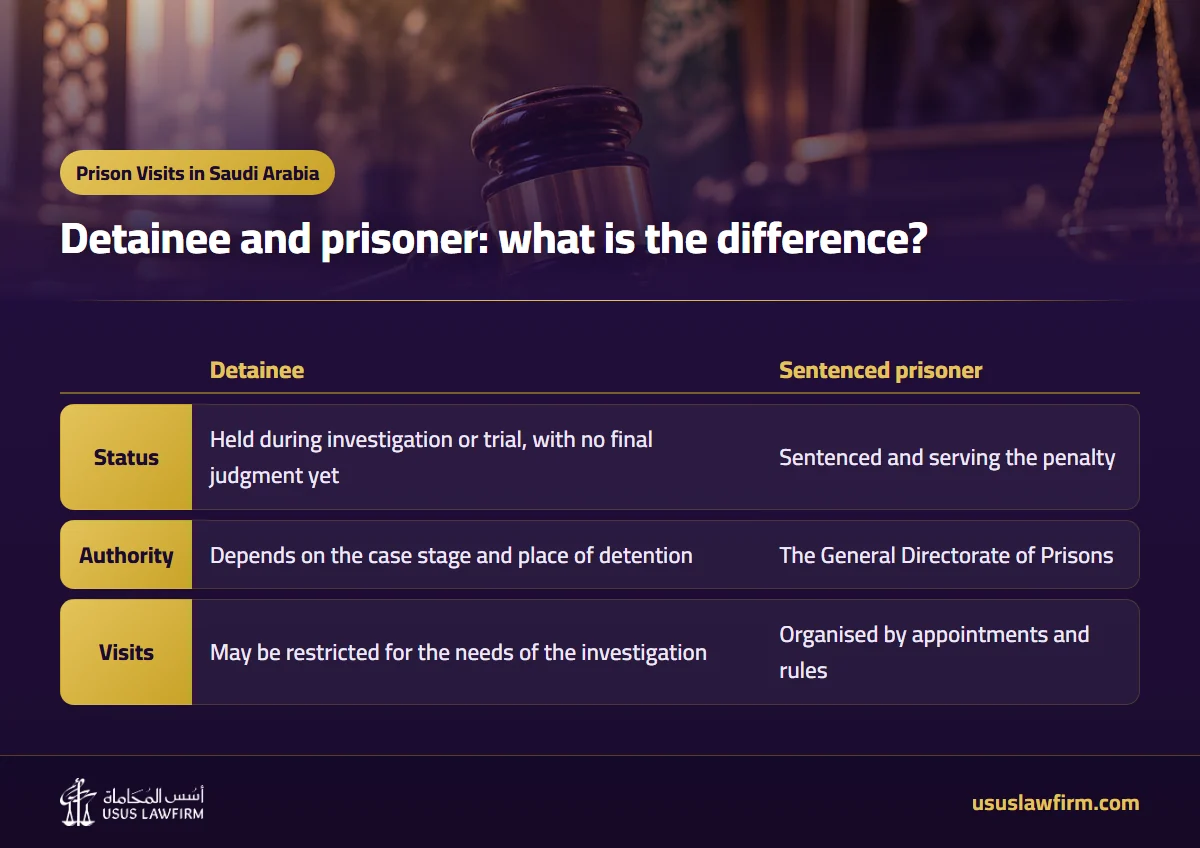
Detainee and prisoner: what is the difference?
| Detainee | Sentenced prisoner | |
|---|---|---|
| Status | Held during investigation or trial, with no final judgment yet | Sentenced and serving the penalty |
| Authority | Depends on the case stage and place of detention | The General Directorate of Prisons |
| Visits | May be restricted for the needs of the investigation | Organised by appointments and rules |
Steps to book a prison visit
- Confirm where the prisoner is held and the prison's name.
- Book the appointment online through the dedicated service on Absher or the General Directorate of Prisons channel, as available.
- Enter the visitors' details and relationship; visits are usually for relatives of set degrees.
- Arrive on time with your original ID, and follow the prison's rules on clothing and permitted items.

The service name, conditions, number of visitors and visiting times are set by the competent authority and may change; check the official channel.
Other ways to stay in touch
- Phone calls: the prisoner may call set family numbers under the rules.
- Video visits: offered by some prisons for families who live far away.
- Deposits: the prisoner has an account the family can pay into for their needs, under the rules.
- The lawyer: an appointed lawyer has the right to meet the client, and is the fastest way to learn where the case stands.
How the family can help legally
- Appoint a lawyer early; most of the case is built during the investigation.
- Gather what helps the defence: documents, witnesses and proof of good conduct.
- Pursue release on bail during the investigation where possible. Read release on bail.
- After judgment: file the objection in time, then pursue conditional release and the royal pardon when the conditions apply.
Frequently asked questions
Can a detainee be visited during the investigation?
Visits may be restricted at this stage by the investigating authority for the needs of the investigation, and the lawyer can meet the detainee under the law.
How do I find out which prison my relative is in?
Through the competent authorities' e-services or by visiting them, or through the appointed lawyer.
Is the family entitled to know the details of the case?
The details are available to the parties and their agents, so the appointed lawyer is the family's way to follow the case.
Is your relative detained?
The Usus Law Firm team handles criminal cases and drug cases: meeting the detainee, attending the investigation, seeking release and defending through to judgment, in Riyadh and Tabuk.
Legal review: the Usus Law Firm team
A select team of lawyers and legal advisers licensed by the Saudi Ministry of Justice, working from Riyadh and Tabuk, with experience before the general, commercial, labor, criminal, personal status and administrative courts. Every article is reviewed before publication and updated when laws or regulations change.
Last reviewed: 12 October 2026
This article is general legal information and is not a substitute for advice on your specific case. Court proceedings in Saudi Arabia are in Arabic; the official Arabic text of each law prevails.
Request a quick consultation
Leave your name and mobile number, and a lawyer from our Riyadh or Tabuk office will call you during working hours. We advise in English.